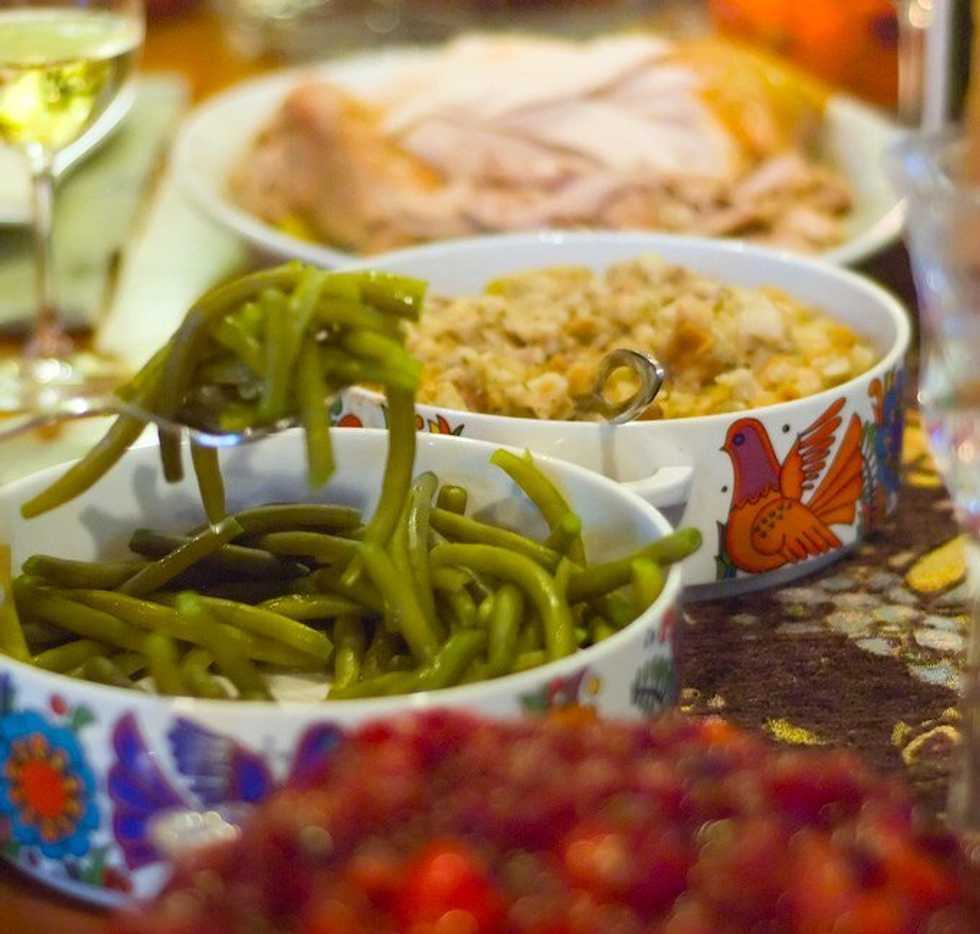
Thanksgiving may be over, but the ideas offered from across the dinner table cannot afford to be forgotten. While it’s loved by some, and dreaded by others, no family gathering would be complete without the healthy dose of political discourse — not in my family, at least. Potential anger and ranting aside, dinnertime politics can prove to have benefits, especially when the posed viewpoints offer insight to other potential schools of thought. While it’s rare, impossible, even, to find a topic that everyone will agree on one hundred percent, it’s possible to have qualifying, agreeing, or even opposing viewpoints and to still remain a family at the end of the night.
I, hailing true to the aspiring reporter I claim to be, furiously tapped away at my phone during dinner in lieu of devouring our Thanksgiving macaroni and cheese, typing down any thought-provoking statements which others could seek to benefit from.
“Has everyone settled down from the elections, yet? No? Just look at this all as entertainment, darling.” — My grandfather
Insightful and rather humbling before dinner had even been thought to be served, this was one of the first — and arguably the most memorable — quotes hailing from our living room discourse. The election results served as the proverbial elephant in the room — no pun intended — and my grandfather was unsurprisingly brazen enough to get the conversation rolling. Has everyone settled down, the initial question, was met with protest on its own, primarily from my mother and myself. Settled down? With so much negativity, with so much anger, with so many outlets, with so much violence on our news feeds, with so much hatred blooming from between the cracks of our nation's safety net, with so many things to be stirred up about, how could we possibly be asked to settle? His response was simple enough: entertainment.
How can you afford to be so nonchalant, Pop-pop? Can’t you see just how frightening this is? Can’t you see we have something to be afraid of? That this is something new and terrible? Through our counterarguments, however, my grandfather merely smiled and shook his head.
Entertainment is not a new word as far as the recent political turmoil is concerned. Though my grandfather was the one to label it so on this evening, my father has been just as quick to shake his head at the “entertainment” on the Channel Five news. Not an odd viewpoint, but an uncommon one. To view the political discourse the way one views reality television, perhaps easier said than done.
“This is bad,” I found myself saying aloud, “This is bad.” The response from my cousin brings me to our next memorable quote.
“This is bad? You want to know when it was really bad? In Martin Luther King’s days.” — Cousin Jerome
And his viewpoint, while disagreeable, was just as understandable… Wasn’t it? No, we aren’t living in systemized segregation. No, we are not required to sit in the back of the bus. No, I am not forced to go to separate schools or drink from separate water fountains. And, no, I’m not sitting on the corner shining the monolithic White Man’s shoes. This argument may be a stacked one, but is it a justified one?
Bad remains a relative term, first and foremost. A chipped nail is ‘bad’, as is global warming, as is unrequited love, as are is the attitudes of college students. Though they all may be "bad", it’s difficult to compare them on a linear scale. The same can be said about the oppression seen today in comparison to the oppression seen 50 years ago. (50 years, I must add, is not so long. There were members sitting at our family’s dinner table who've experienced the "long dead" oppression of the Civil Rights movement firsthand. This is a reality; not an ancient history.)
To continue: no, we do not have segregation in the forefront, but racism in subtle—and not so sublte — forms are far from eradicated, and anyone who tells you otherwise is feigning ignorance.
“I’m still afraid of walking alone from parking lots.” — My mother
The most jarring quote of the night hailed from my own mother. Conversation ran, and opinions were given left and right, and her comment was nearly glossed over. It hit too close to home, rather literally, for me. My mother — my mother, caregiver, role model, conqueror of the world — admitted fear of the mundane. A woman. An African-American woman, whom presumably is not alone in her fear, took the spotlight for a mere moment before the conversation shifted once again to economics and global policy.
That, that was what this entire discourse boiled down to; fear. A fear of the future, a fear of regression to the past, a fear of lost rights, a fear of one's security. All opinions, whether they were spoken with the intent of reassurance or dismissal, were given with a dosage of fear within the mind's eye.
The election didn't create fear; no source of singular causation can create something so powerful — at least, according to sociology classes — but amplification is a possibility. Fear was not created: it was catalyzed.
Regardless of which side of the fence one stands upon, the last quote I'll leave you with gives you one final insight to a singular viewpoint of my family. She doesn't speak for all, but she speaks for enough when my Aunt Ann states:
"Now is the time to hold our prayers and to look out for our own."