
Growing as I did through my late teens and into my early 20s, I developed weird obsessions with a few particular niches in contemporary American literature. From the farthest reaches of space with pulp science fiction writers, to the deepest depths of the Gritty Ole Southern Shtick, I’ve cultivated my own little collection of men in cabaret, from Larry Brown to James Tiptree, Jr. (actually a pseudonym for a woman writer who wrote science fiction at a time when women writing in the field was not given the highest of praise).
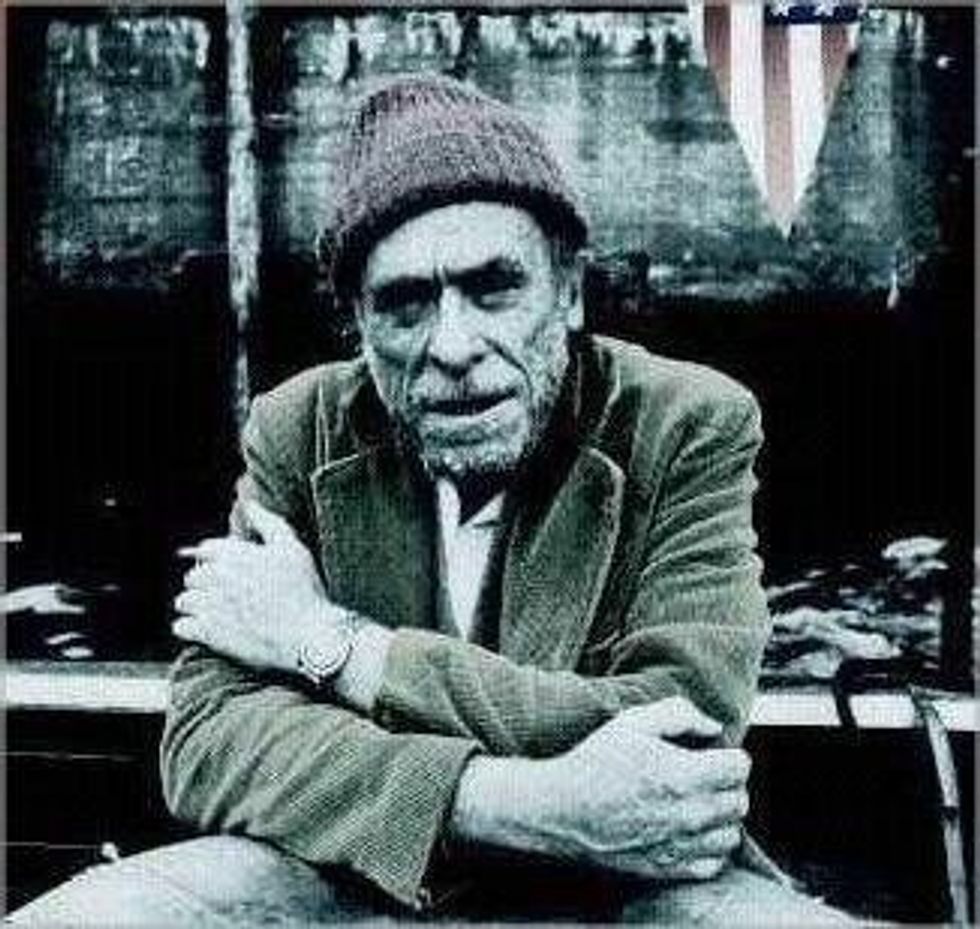
But nobody—and I mean nobody—consumed as much time for me as did Charles “Hank” Bukowski, aka the Dirty Old Man.
Born in 1920 and died in 1994, Hank is probably the most published American poet. With common themes of the down-and-out in Los Angeles, seedy bars and weird romantic trysts, low-paying blue collar jobs and fist fights, Hank was no easy man to digest as far as his words go. Influenced by "Ask the Dust" writer John Fante, he inarguably became more popular with the national conscience (though by my own estimation Fante was a much more capable writer). The man wrote at least three or four stories a week, hundreds of poems in the same time span, and came at the end of his life having finished editing his sixth novel, "Pulp." Which is all quite impressive, but is the man worth the price of the paper he’s printed on?
Detractors often note the harsh and menacing misanthropy evident throughout Bukowski’s work. Harsher critics bash him over the head for misogyny. Neither group is wrong on the face of it, but does that make ole Hank unworthy of our readership? Is there something worthwhile hiding behind all the bare-bones tomfoolery?
Consider, for a moment, the poem “Oh yes.” Note the germ of wisdom dripping in so few lines:
Oh yes
there are worse things than
being alone
but it often takes decades
to realize this
and most often
when you do
it's too late
and there's nothing worse
than
too late.
The old dodger knew a thing or two for being known as a dirt bag. At his best he lived by his own quote: “Genius might be the ability to say a profound thing in a simple way.”
At his worst, well…
There’s no defending the endless bedroom affairs run rampant in the novel, "Women." And as good as the poem “To the Whore Who Took My Poems” might read in its content, there’s just no getting around that title, is there? A thousand or more Bukowski fans might crop up, and heck, I’m a bit of a fan myself; but some things must be called out for what they are if they don’t hold up to scrutiny.
I read writers of all walks of life. I’ve read army vets, alcoholics, feminists and those of extreme prejudice. I traveled down the back roads of Louisiana as well as the foothills just south of Mount Everest. In my mind’s eye I have come across so many viewpoints, and some I have agreed with while others are best left to the dust. But just because an idea is disagreeable to my taste doesn’t mean I brush it off at first. How can I know how to argue against something about which I know nothing? How does one counteract the rampant objectification within Bukowski’s lesser works if I don’t even know what he’s saying? Is there a reason to his overall hatefulness?
Scholars have written thousands of words on the subject. He harshest abuses at the hands of a father, and the health and financial issues which have isolated the man in his time of adolescence have all served to shape a man into quite a hard pill to swallow. And the literature the man left behind (such as it is) offers us a window into which we catch sight of the ghastly, the tragic, and sometimes, the beautiful.
The dirty old men of the world give us an example of how not to live, and their creation teaches us how not to create. There is honor and dishonor, but how dishonorable can we be if we don’t pay attention to those who come after us? The days of the Depression, the Sixties and the Cold War are not so far behind us; do we ignore the examples of the past and in so doing doom ourselves to endless repetition? Is there no way to change the world?
I call your attention to one last saying from ole Hank: “You begin saving the world by saving one man at a time; all else is grandiose romanticism or politics.”
Now here’s a toast to the down and out, living on skid row and looking for an honest buck. May you sleep well tonight as we come to offer you a helping hand before it’s too late.
Because there’s nothing worse than too late.