There's some sort of stigma that comes with criticizing films made for young audiences. When I point out that “Big Hero 6” was derivative and insubstantial people will say, “It's a kid's film! What do you expect?”
Oh you morons. Maybe kids would be less stupid if we stopped being so condescending when it comes to engaging with them intellectually. The best films for children are still good when you've grown up because they don't talk down to younger audiences. Entertainment for children can be enlightening and inspiring, and to dismiss all entertainment with a child audience to be substance-less dribble is only going to perpetuate the idea that kids are incapable of doing great things. Even "Sesame Street" knows that it can educate kids as young as three and still maintain a level of sophistication and integrity.
If you have movie-loving kids, I would recommend movies like Studio Ghibli's “ Ponyo” or “Spirited Away ” and the early “Muppets” films - “The Great Muppet Caper” being the one I watched the most in my early years.
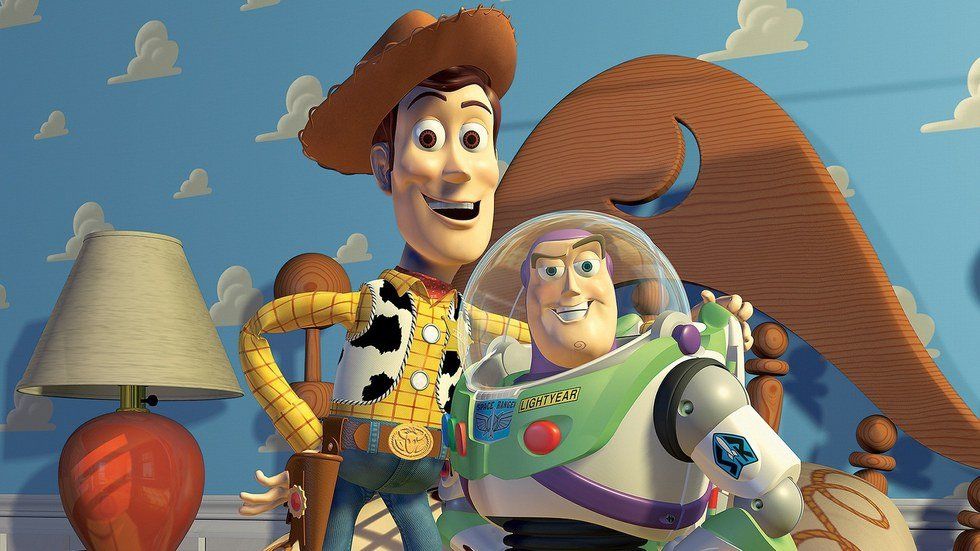
But to demonstrate how complex “kids movies” can be, allow me to dissect a trilogy of movies most kids will probably watch before they turn twelve. The “Toy Story” franchise was never intended to go beyond the first film, but Disney is a beast whose hunger for money never wanes so it ended up being a trilogy of very well crafted films. What most people don't pick up on is that Toy Story is a series all about life and the worth of living. In fact, Toy Story could be considered an incredibly existential series of films. Let's go through each film one by one.
Toy Story
You ever notice how the toys will put themselves in mortal danger just to refrain from being witnessed as living? Even when being physically tortured, Woody just sits there motionless. Even Buzz, who is convinced that he is an actual spaceman, sits motionless. Clearly, there is a divide between the world of human beings and the world of toys. A big part of Pixar's early works is the existence of the extraordinary in every day things. It only makes sense that the toys you owned as a kid loved you back and went on their own adventures - but only when you weren't looking. For Andy, his toys are his world, so naturally the toys are a world in their own. The toys are alive because to Andy, they really are. Without that childlike imagination, the toys cease to be anything other than toys. Every game he plays with them is something they truly experience. Andy pretends that Woody foiled Mr. Potatohead's ransom for Bopeep's sheep, and afterwards Bopeep and Woody flirt as if that is actually what happened. At the end of the day, though, they are toys and know that they are simply what Andy imagines them to be. The scenarios Andy pretends for his toys are real for them, even though they all know that it's all a figment of Andy's imagination.
So Buzz's existential confusion makes a lot more sense now. Of course Buzz would think of himself as a real space hero, Andy gives him the illusion that he is one. The difference between him and the other toys in the room is that he has recently come to life and therefore has no idea that he is a toy. Which leads to his existential crisis. The kicker is when he discovers that he cannot fly - flying being a metaphor for the fantastical existence Buzz once thought he lived in. His arm falls off when trying to fly off a staircase to show that this revelation has made him lose a part of himself. He isn't whole, he is a person stuck in a reality where he exists as an idea. I think this is illustrated in the image of Buzz playing with his disembodied arm and making rocket noises, his existence is so insignificant that even his separated arm is just something to be played with. He doesn't have a will to live.
The turning point comes when Woody puts aside his jealousy to explain to Buzz that his literal existence as a toy is not his only existence. He is a Buzz Lightyear, and to Andy and children like him, Buzz is a space hero. Him being a toy is only one of two different identities he lives as. The reality in which Buzz is a hero exists because of the reality in which Buzz is an object. The two exist together and the barrier between them is artificial at best. This is demonstrated when the toys scare the living hell out of poor Sid. With the two realities now merged,at the climax of the film, Buzz and Woody defy physics and fly. Their reality is whatever they make it and life is worth living because they matter to someone, even if they don't matter a lot in the grand scheme of things.
Toy Story 2
Keep in mind that Pixar never intended there to be a “Toy Story 2.” Disney forced it, and as a result some of the themes the original left us with aren't touched on in the sequel. Buzz no longer flies and nobody seems to bring up the fact that they've scarred a young child for life by effectively breaking through the barriers of their existence.
This time, the movie is all about mortality. Woody, having been damaged during a play session with Andy, is now aware that he is not invincible. The tear in his arm is a reminder to him that he only has a set amount of time on this earth and that time is slowly going away. One day, Woody is going to die. In the context of the story, this means that Andy will one day grow up and leave Woody behind. The image of Woody's damaged arm is a motif that appears many times throughout the story, and it's an important one so keep it in mind.
When Woody is abducted and introduced to his legacy, he meets Jessie and Pete. Jessie, having been abandoned by her previous owner, represents what will eventually happen to Woody. Pete, on the other hand, has plans on going to Japan and living forever behind glass in a museum. Pete represents immortality. Woody has a taste of immortality himself when his damaged arm is repaired and is rejuvenated with a new paint job. If Woody goes to Japan with Pete and Jessie, he will never be abandoned by Andy and he will never be broken.
Buzz slaps Woody back to his senses. Woody may be mortal, but his life has meaning. As an immortal, Woody will never be loved or played with. There will be no other reality for Woody to exist in but as an object. His time may be fleeting, but ultimately Woody chooses mortality. Pete damages Woody's arm in response, showing that Woody has sacrificed his immortality for an eventual death. But this time, Woody has accepted his mortality. In the end, Woody's arm is fixed and has even bulked up from Andy overstuffing his arm. Woody is stronger for having chosen mortality, and even if he knows it won't last forever it will be worth it. At the very least, he won't be alone.
Toy Story 3
Having confronted his mortality, Woody is prepared for Andy's adulthood and the end of his life as a beloved plaything. The rest of the toys not so much, so the end of the Toy Story trilogy is about coping with death. While Buzz and the rest of the gang grieve over the end of what is essentially their lives, Woody is the one with a level head attempting to make sure that even in death, he is there for Andy whenever that may be.
When Woody separates himself from his friends to find Andy, he loses his hat. Much like Buzz's disembodied arm, Woody has left a part of himself behind and can only be whole when he is together with his friends. Woody and co. aren't going to get out of this situation without each other, and the ultimate moral you can pick out of the series is the importance of togetherness. The first half of the movie is about the toys learning this lesson in order to overcome their grief, with the latter half being about them facing death.
Lotso is a character in denial, having been replaced by his owner, he takes out his aggression on other toys who were once loved like he was. Lotso, in terms of his existence as a toy, has been dead for a while by the time the film starts. He just hasn't accepted it yet. His domain is the preschool, which acts as a biblical purgatory where toys are never truly alive or dead. The biblical allusions don't stop there, as we all remember the scene with the furnace. This is where the climax of the film takes place and the toys can no longer deny it any further - they are dying. All of them try to fight it, climbing up the rubble but to no avail. When asked by Jessie what they will do, they all let go. They all stop fighting and realize that the only way they're going to face this hurdle is to do it together. And so, they all hold hands and face the inevitable death that is in front of them. Just when it looks as though they are facing a biblical damnation into the fires of hell, the little green men show up with a crane from above. The light shining down on them and the crane grabbing onto them like the hand of God, taking them to heaven now that they've all finally accepted their death.
But we aren't through yet. The moral is “stick together.” Woody could live for a little longer with Andy in college, but he decides that his life is tied with the people he has spent his life with. That's why he voluntarily stays with the other toys instead of going off to college, where he would presumably bare witness to Andy's drunken nights with a fraternity. If Woody is going to face death, the only way he can move onto the afterlife is with his friends. They are all then reborn, being given to a new owner who brings life back into them by playing with them. And the cycle begins again. Eventually, they will die and be passed down to somebody else. Similarly to how we all eventually die and leave behind a new generation.
In summary, the Toy Story trilogy is a series that contextualizes life and death in a way that younger audiences can understand. Ultimately, the trilogy is an uplifting story about how life is worth living and that death is an enemy that can be conquered with love and companionship.
And if you think I'm overanalyzing, I would remind you that this is Pixar we're talking about. Pixar has shown us many times how well they've mastered storytelling and symbolism. If you've ever watched a “behind the scenes” feature on one of Pixar's movies, you will see how much thought and careful consideration is placed in every frame of their films. Watch “Finding Nemo” with the commentary and see what I mean.
Pixar does not need to dumb itself down to tell a story to engage young audiences. Or at least, it didn't until “Cars 2,” which was another sequel that Pixar didn't want to do. The point remains though, that if people were willing to put as much effort into the material they provide for children as Pixar does/did, maybe we wouldn't feel forced to talk down to kids. Entertainment is not a babysitter, it's another opportunity for kids to learn and think about things in a new way.
Or you know, we could have a movie in which Kevin Spacey becomes a cat.