

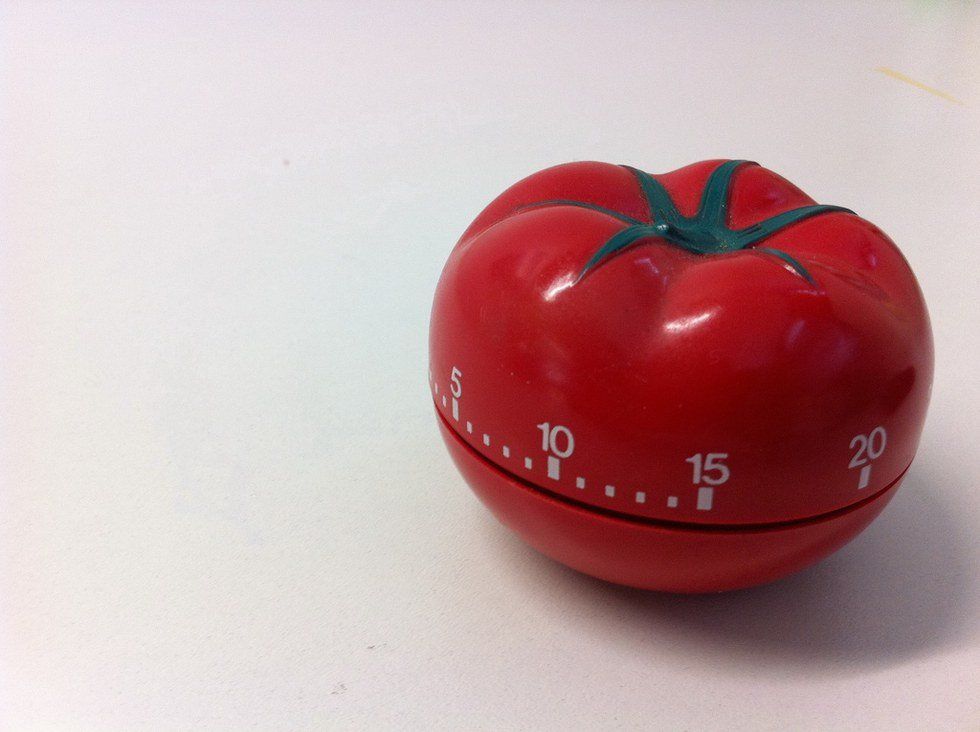
Pomodoro.
That's a fun word isn't it?
It means tomato in Italian.
Which is probably why their official timer is shaped like a tomato.
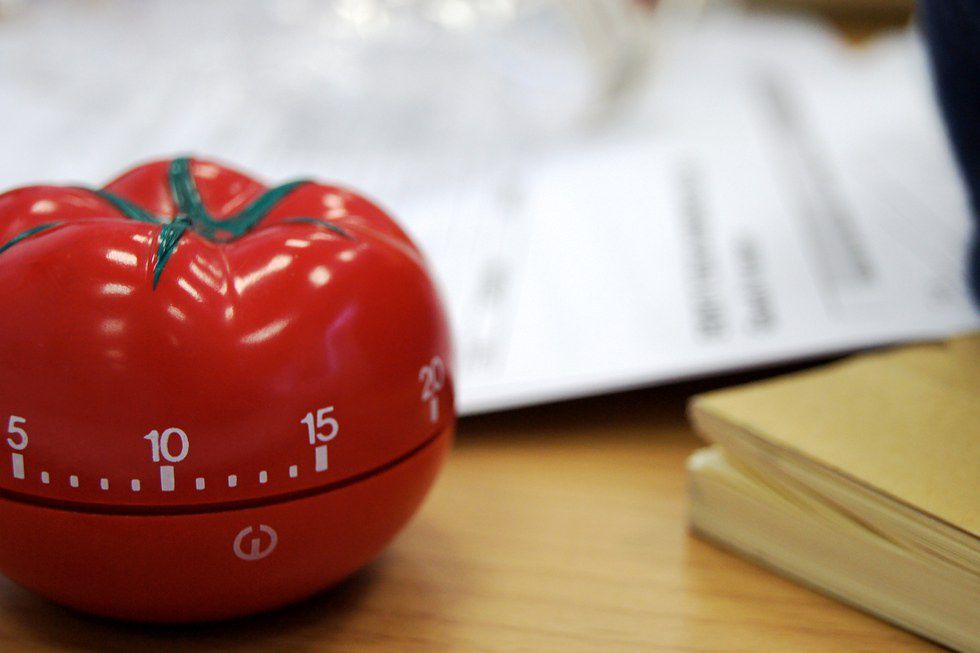
Anyway, the Pomodoro technique is my go-to study method. I would go as far as saying it is my favorite way to study. I discovered this technique after searching Pinterest for new ways to study. Basically, at the time, I was struggling a little exam-wise, and I thought that anything would be better than what I was doing originally.
The Pomodoro Technique Works Like This:
1. Grab a timer (or your phone) before you even sit down and open your book.
2. Set that timer (or phone) to 25 minutes.
3. Get your study on!
4. After the 25 minutes are up, set the timer again for 10 minutes. That is how long your break will be. Plus, if you set a timer then you'll know exactly when to get back to work.
5. Once your 10 minutes are up, sit back down again, and set the timer for 25 minutes again.
Easy enough, right? Just keep repeating these steps for as long as you want. I think that the reason why this works for me is that I don't feel like I'm cramming a lot of information into my head at one time. This is a way better idea than just studying straight through for three hours and then not picking up the book for the rest of the night. You won't remember a thing!
Believe me, this has happened to me before, and it is terrible.
According to LifeHacks.org, one of the benefits of this technique is that by taking frequent breaks, you're keeping your mind fresh and focused. Which is exactly how I feel about it. It's almost like you're storing the information you processed within those 25 minutes away and clearing space in your mind for new information.
Like everything in the world, there is some negative feedback about this technique. Blogger Jan Tomka described in his blog post the difficulties in managing interruptions. You can't stop things from happening like an emergency coming up or someone coming up to you to ask a question. I agree with that too; some aspects of the technique are rather unrealistic. Then again, it really depends on the situation. I feel as though the Pomodoro technique wasn't designed for someone to use while working in a busy office or collaborating with others on a project. I think it was designed to help people stay focused while they are working on work that is mainly solitary.
All and all, if you have never heard of this, then I encourage you to try it out when studying for your next test. I know it won't work for everyone, but who knows this might become your go-to study method as well.
You never know unless you try.