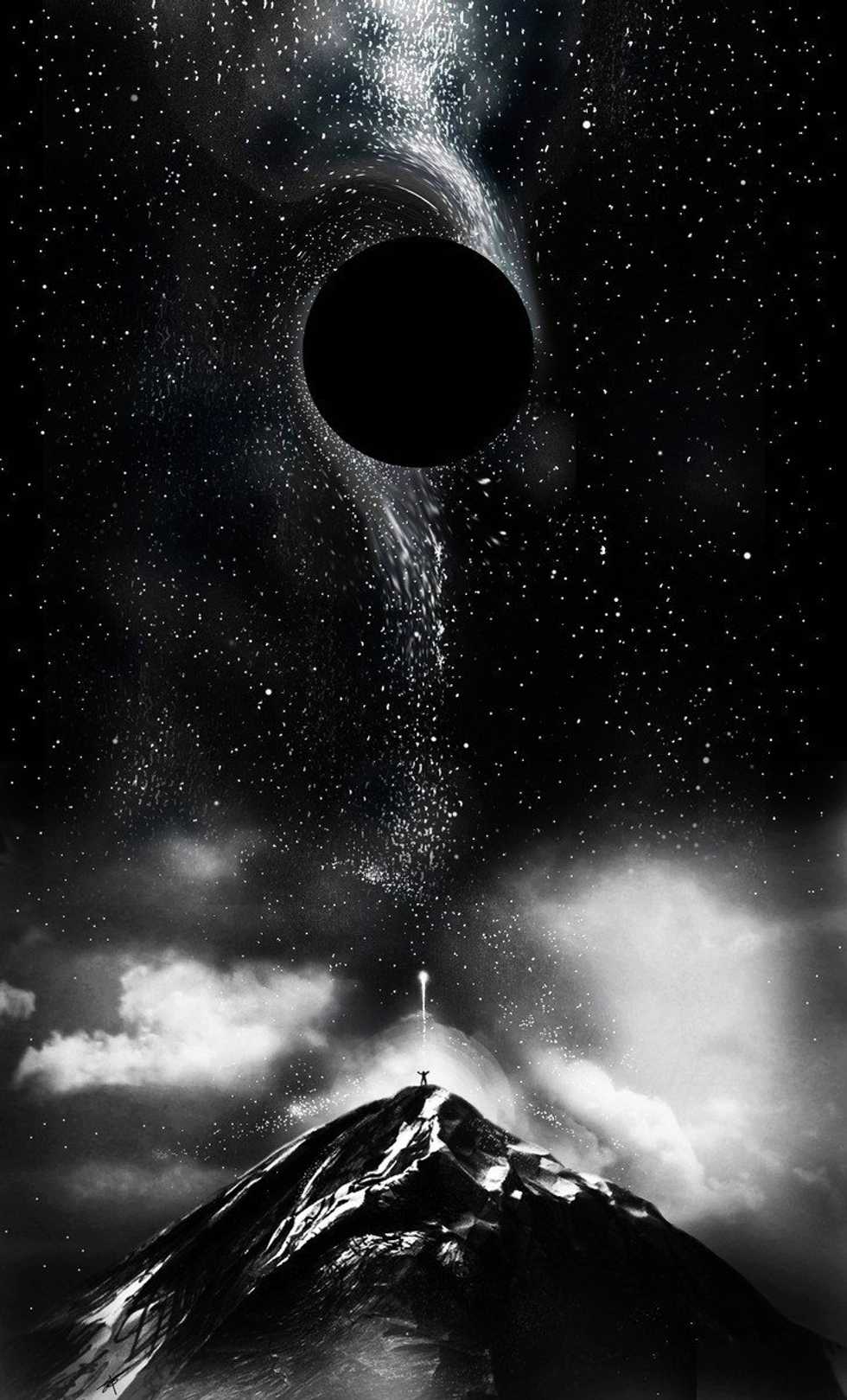
In this day and age, it would be a challenge to find someone who has not at least been introduced to the existence of black holes in our universe. "Interstellar," the 2014 blockbuster starring Matthew McConaughey, brought this idea to the forefront of pop culture. As an advocate of astronomical awareness, I appreciate that Christopher Nolan went to great extents to realistically portray the physics within the movie's extra-solar setting. The only negative is, people who have seen the movie are suddenly "experts" when it comes to black holes, space travel, and relativity. My goal here is to explain black holes enough so that you, the reader, can identify these so-called experts and help them along their way to gaining true knowledge on the matter.
Let us begin by understanding what a black hole is, physically. Stars go through what astronomers refer to as life cycles. Trust me, we are fully aware that stars aren't living. However, it is evident that stars are first formed, then spend a long time emitting light, and eventually explode and/or collapse. If a star is massive enough, the force of gravity will cause the star to explode as a supernova, followed by a collapse of the mass itself into what seems to be an infinitely small volume. This tiny ball of mass, to put it simply, is referred to as a singularity. To condense this, a singularity is basically an excessive amount of mass in an unfathomably tiny space. Therefore, this amount of mass produces an immensely strong gravitational field.
Let us take a side step just to cover the idea of orbits. You likely understand that Earth orbits the sun in a relatively circular path. The Earth is able to do this because the sun's gravitational force pulls on the Earth. At the same time, Earth is moving with a certain velocity, keeping it constantly moving in a circle. Though this explanation is somewhat vague, further detail can get wordy and a bit complicated. The point that you need to understand is that the Earth needs to move at a specific velocity in order to stay in orbit at this distance from the sun. That specific fact will help make sense of what is so special about black holes.
Since black holes have an extremely dense mass, their gravitational force is huge. In order for a star to become a black hole at the end of its life, it has to be at least 25 times the mass of our sun. The gravity caused by such a massive object is so great that, within a certain distance from the singularity, orbital speeds are greater than the speed of light. In our universe, there is nothing that can move faster than the speed of light. Within that distance from the singularity, no light can get out. This threshold, where light can no longer orbit the singularity, is referred to as the event horizon. The name, black hole, finally makes sense, right? No light can escape the event horizon, so the entire volume appears absolutely black - no light whatsoever.
To review: Black holes begin as stars. They aren't some weird, planet-sucking entities floating in space. They're really just huge stars that have run their course. A star may only form a singularity if it is at least 25 times the mass of the sun. Extreme mass-density produces gravitational forces that require orbital speeds beyond the speed of light. No light comes out, so it's just black -- hence, black holes.
In a sense, black holes aren't as confusing as you probably first thought. However, they aren't easy to find, nor are they too common. Since they emit no light at all, the only true way to find them is to observe the effects they have on objects around them. Elusive as they may be, black holes are out there. And though this article is not at all exhaustive of the topic, I would argue that you have most of the information that the average person cares to read about.
If you do have any questions about black holes, or anything discussed in this article, comment below and I would be happy to field them.