My dad was always the consummate dresser. He was forever attentive to his style outside of his work clothes, for obvious reasons. He was a plumber. And if you’ve ever had to experience that trade in any form, you know it can be rather unpleasant. So he worked just as hard to look like he didn’t just crawl out of a sewer pipe when going out on the town. One of the things that he was absolutely compelled to do to make his outfits complete was the inclusion of a watch. I’m quite sure that my dad didn’t realize it at the time, but he became a collector of watches.
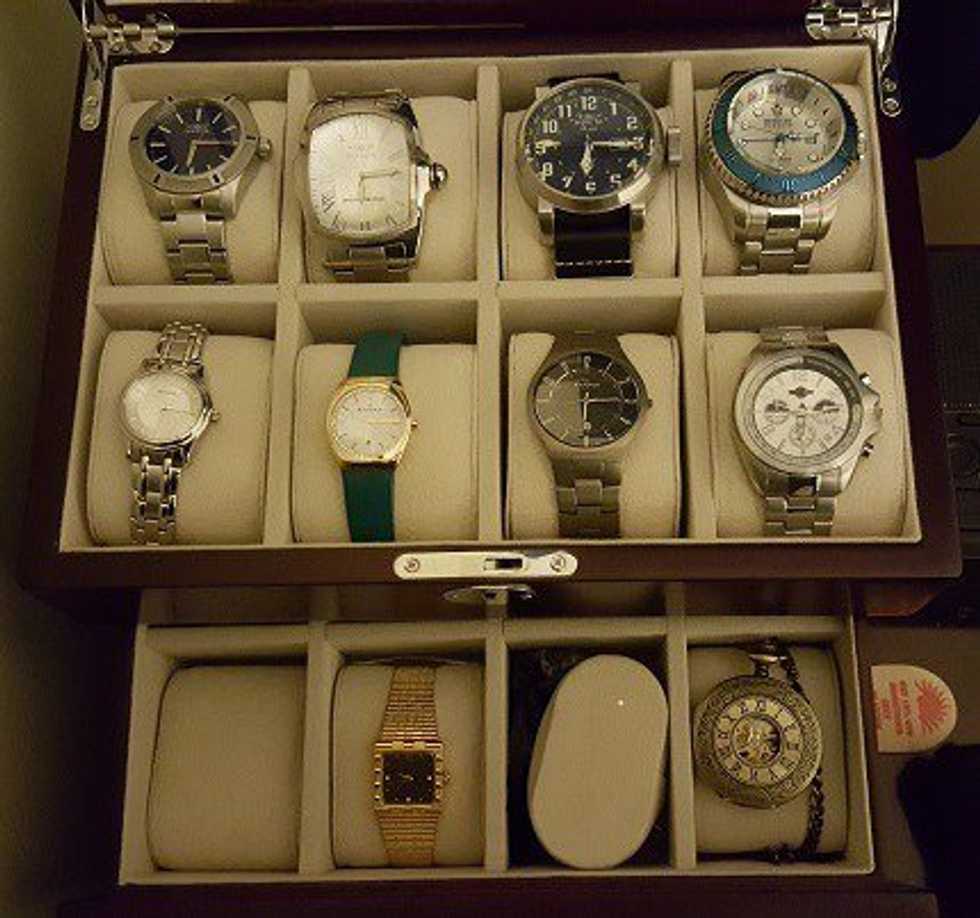
Let me clarify: Obviously he knew he was collecting, but his collecting wasn’t for the sake of collecting. He would’ve considered his collection “fashion accessories” as opposed to just “timepieces." Regardless of how he viewed them, there were a variety of watches within his safe that had an equally greater collection of clothing which they matched. Yes, my father was quite the fashion bug. As much as he tried to pass on his belief when it came to the age old adage “clothing makes the man," the only thing I gleaned from it were his love of watches. A love that has made me a full blown, obsessed collector of timepieces. Alright, I may be overly exaggerating here, due to the fact that I have amassed a total of eight watches, but I plan on expanding that total by leaps and bounds, if my wife allows me.
That brings me to a point that I come across every now and then. Now as I’ve mentioned, my dad collected watches under the guise of them being fashion accessories. I collect them because I subscribe to the idea of collecting for the sake of collecting. I enjoy them because I place the value of them over their current role in the fashion industry. Here, I’ll go into this kind of ideology a little bit deeper…
Time, I believe, is the most important aspect in our lives. People can throw together a list of things that they’ll place higher than time in reference to importance. But, in order to consider anything greatly important, you have to understand that you need time to appreciate said subject/object in order to place it in order of importance. You can’t just select something out of the blue and say it’s most important over everything else, without knowing how important “it” is. And knowing something of that nature takes… You guessed it, time. And throughout history, we’ve learned that the measurement of time is critical. Having an instrument to be able to measure time is important. Otherwise why look at a clock when you’re running late?
Now the manner with which we keep track of time is equally important. Watches were merely shrunk down and portable clocks, that initially, more often than not, the well to do had available to them. Over a short period of time, no pun intended, the proliferation of timepieces grew to include all walks of life. Young and old, rich and poor, we all got our hands on a watch. It helped us get to places and people within a respectable time frame. We began to regiment ourselves to the three hands that revolved around a face, telling us what hour it was, what minutes had passed and how fast the seconds flew by. We finally had a visual effect of time passing us by, literally. The watch became one part of the “holy trinity” of property you could not leave your home without: keys, wallet/purse and watch. The three most essential items that made your return home that much smoother. Their designs were simple and straightforward. You got the time and not much else.
Then designs began to change, and the round faces everyone had become accustomed to became squarer or more oval. An obvious evolution was taking place, especially when watchmakers like Rolex (est. 1905), Patek Philippe (est. 1839) and Longines (est. 1832) began producing watches that had embellishments and intricate designs. These timepieces were becoming fashionably acceptable. And with the eventual inclusion of the day and date feature within timepieces, the need to have one started a small battle between form and function. Although function won out for the better part of a century, eventually form become the de facto reasoning behind the purchase of a timepiece. The line between timepieces and fashion accessories started to blur heavily. Then as digital watches came into play (the Hamilton Pulsar P1 was the first to come to market back in April of 1972), time was not on function’s side.
What wasn’t on the radar at all was how telling time became an afterthought, especially in reference to the most important tool ever added to our everyday carry arsenal: the cellphone. Now that it was possible to just pull out your phone and look at the time, watches were relegated to the level of accessory; nothing more, nothing less. They still were produced and were only considered by a few professional trades (pilots, divers, etc…) as a necessity, but mostly they were acknowledged as an additional piece to round out your outfit. The "holy trinity" that was a part of our daily regimen for more than a century was reduced to a divine duo: keys and phone (even now wallets/purses are being affected by the form and function argument). Although electronics manufacturers are now producing smart-watches to work in tandem with cellphones, these gizmos aren’t accepted as the replacement to wristwatches. Because of the birth of these contraptions, it is here where we start to lose sight of the watch. This is where it finds itself, in a manner of speaking, in limbo. Neither here nor there. For all intents and purposes they still exist. But it’s their multifaceted abilities, all dependent on their manufactured purpose, which might just be lost. Everything that one can do with a watch will be a part of the past, only retrievable through literature and not passed along by word of mouth.
I believe that it was this single event, the introduction of the cell phone and smartwatch as we know it, that placed the watch into the hands of fashion designers as a way to keep them in the consumer's line of sight as a must need item. When designers like Gucci (post 1990s), Tommy Hilfiger (the Movado Group is licensed to make and sell watches under the Hilfiger brand), Michael Kors and Armani (both of which fall under the Fossil group) started their own lines of fashion watches, the line in the sand between accessory and essential timekeeping became that much more shallow. While these fashion houses can stamp out watches, hand over fist, that cost significantly less to make than what they are sold at, precision timepieces that are hand crafted became expensive beyond what the everyday person could ever afford. The quality of a fashion watch was sacrificed over quantity. And as long as the watches looked good or great, they did not intend on any of their products to carry heritage or the possibility of being an heirloom. A temporary piece of inexpensive material subterfuges as one of the most important instruments in the existence of humanity.
The idea of watches that have hand crafted precision and have been dutifully cared for are just a few of the earmarks that are sought out in a timepiece, as opposed to watches that have no character beyond the means of a mechanical stamp. A delicate yet strong set of lines, and quality unmatched, is what sets a $200 Michael Kors fashion accessory from even the cheapest Tag Heuer timepiece (Tag Heuer is easily 10 times the price of any fashion house watch). While people are going to willingly buy a watch that’ll have a short lifespan for the sake of making it a part of one’s wardrobe, watches that work both ends of the spectrum with equal measure appeal to me. Now, I’d be stupid to forcibly speak on how timepieces and fashion accessories are not one and the same in this modern day and age, because realistically they are. Yet the watches that I have, and look forward to owning, have an aspect that falls short of those you’d find being sold by fashion designers: No matter what, their name and craftsmanship are synonymous with timekeeping and can never be denied.
My dad’s collection of watches had dwindled significantly after he retired. My brother still has a piece or two that my father had given him. I own one. A gold mechanical watch. No name brand. No country of origin. And the most basic of internal clockwork that could fit, all supported by plastic. Clearly the watch itself is about as cheap as cheap could get. But it holds the distinguished honor of holding the #1 slot in my watch case. Despite its no name status, it holds sentimental value. It isn’t an heirloom by any means. Just a memento. It’s a piece from my dad that reminds me of how I’ve taken his love of accessories, and made it into an undying love for watches. A love that raised attentiveness to time and how much of, or less of it that we have.