Do you remember roller coasters when you were a kid? You were walking down the long silver chute, anxiously awaiting your turn, and slowly creeping forward while the anticipation built. Terrified and excited, you finally got to the front of the line and barely reached the “You Must Be This Tall To Ride This Ride” line. When they strapped you in, it finally hit you: there was no turning back. The ride lurched forward, and you instantly began to doubt the sanity of your decision. As you reached the base of that first climb, your anxiety built exponentially. With each click up the first hill of the track, your heart beat faster. At this point there was no doubt that your life was close to its finish. You reached the top and down you plunge, your stomach flying abruptly into your throat. After what seemed like both a moment and an eternity, the ride slammed to a halt, and your first thought post-haze was: “Let’s do that again!”
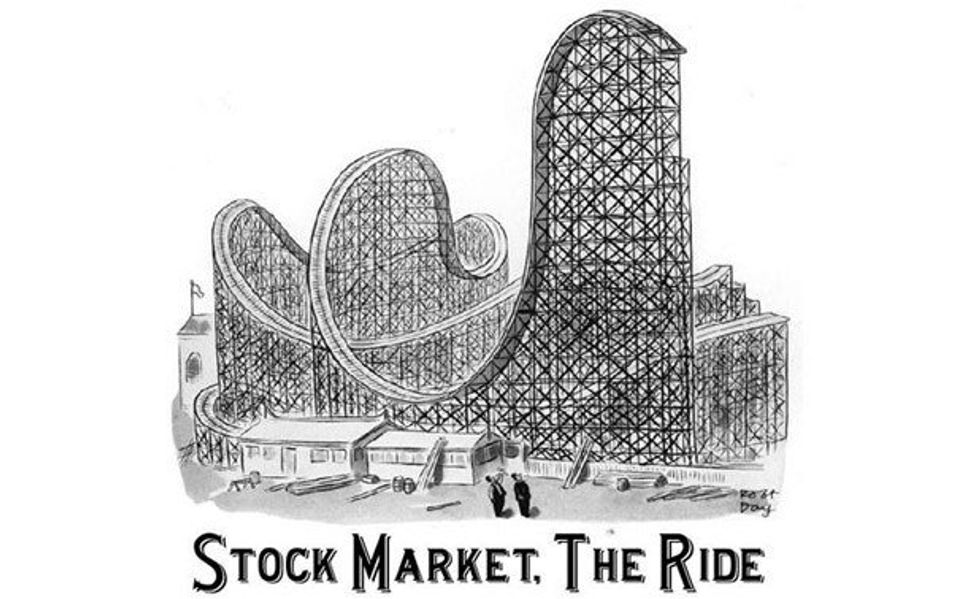
We didn’t realize it as kids, but we eventually understand that the roller coaster is only dangerous if you jump off. There was no real danger to you the first time they strapped you in and sent you hurtling towards the earth; however, it’s difficult for us to understand that something which appears so inherently dangerous is actually quite safe. The stock market acts much the same way. There are ups and downs, turns and twists, sudden drops, and even the occasional corkscrew, but as long as you don’t jump off? You’ll be just fine.
Earlier this week, we saw this principle at play. On Monday, the DOW Jones took a downturn, sliding from 16,459.75 points to 15,666.61 points when trade floors closed on Tuesday. Just like little kids on a roller coaster, many of us were terrified, believing that every penny we had would soon be a distant memory. Hysteria set in for many people, and they began to jump off the coaster as they cashed in IRAs, 401Ks, and other investments because they believed that if they didn’t do it as soon as possible, every cent would be gone in a flash.
By Friday, the market is right back where it was, better even, as the DOW Jones rang in at 16,639.53 points when it closed on Friday. No real damage occured, there was just a little dip in this roller coaster. However, there was harm done to some: those who decided to jump ship instead of staying the course and allowing the market to do as it has historically done: recover and continue to grow.
We saw something very similar during the 2008 Financial Crash. The market seemed to be down by half in the blink of an eye, as the DOW Jones fell from the Pre-Recession high of 14,164.43 points to only 6,594.44 points in under eighteen months. Many believed this country’s economy would never recover, and people began jumping off the roller coaster in droves, destroying key investments for their retirements and futures. Now, seven years later, the DOW has risen to over 2000 points more than the Pre-Recession high.
The stock market is the grown-up version of a roller coaster, and kids fear a roller coaster because of the “incredible danger” that comes with the ride even though there is no real threat. Investing is the same. Though the ups and downs seem to be incredibly dangerous, remember: you will not get hurt if you don’t jump off. Allow the market to do what it’s always done, recover and grow, and set yourself up for a brighter tomorrow.