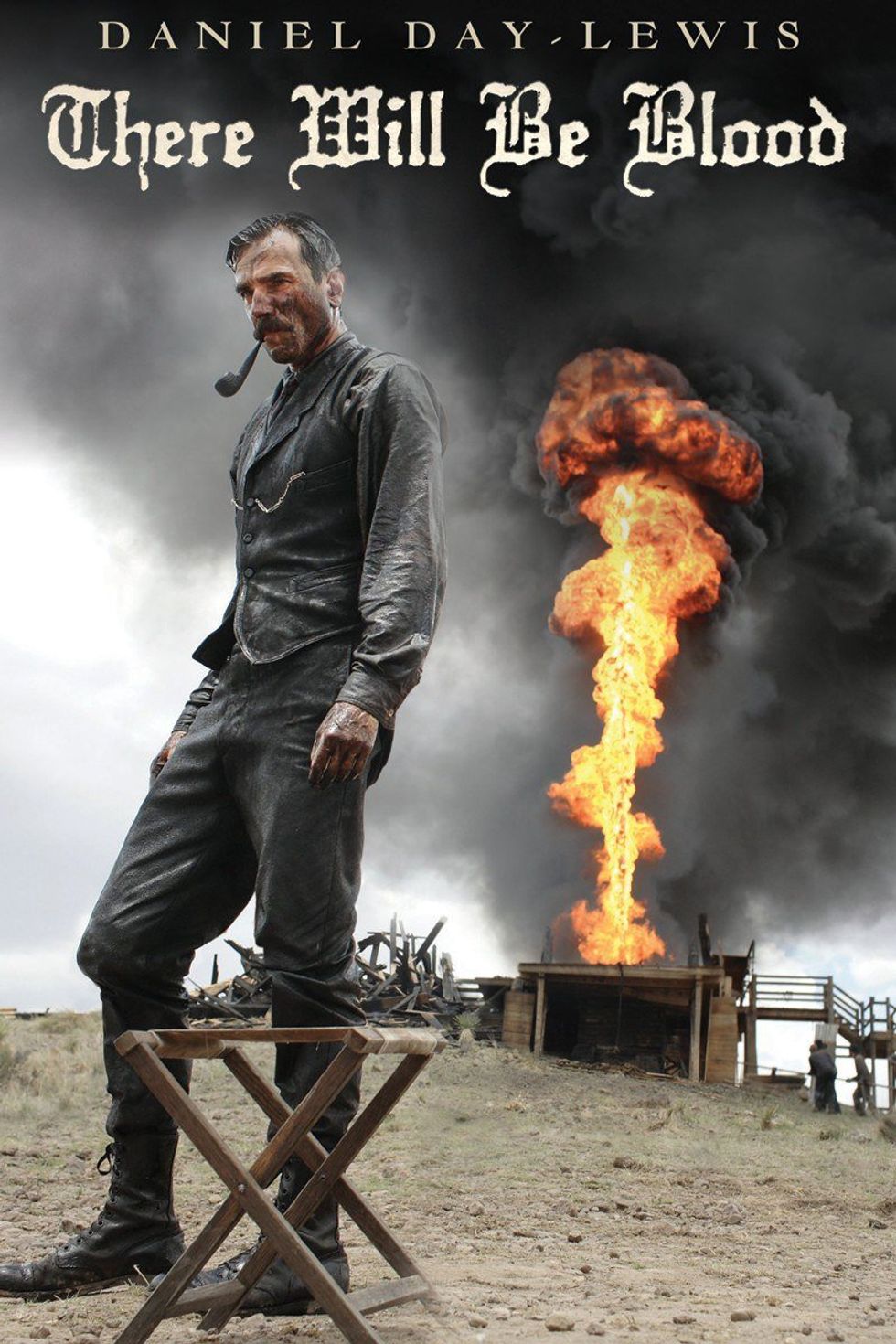
The roots of "There Will Be Blood" are that of satire, farce and socialism. While the film does show a remarkably, and realistically, dark version of capitalism, Anderson’s story is perhaps too nuanced and too reliant on the fairytale of the “American Dream” to have an impact on an audience already indoctrinated by capitalism. It never goes far enough to indict capitalism, but rather gives the impression that power has corrupted this one man, Daniel Plainview. Rather than fully embracing the satirical elements of its parent novel, "There Will Be Blood" scoots around them and instead is a character study.
The film’s detractors often sight it as “over-the-top,” especially in it’s final scenes, but it’s in those moments that director Paul Thomas Anderson is closest to bringing his film any kind of clear message. Part of the brilliance of satire is its use of hyperbole and exaggeration, and while nuance is often still a part of such works, it is these two elements that make the piece’s message obvious. This may sound like talking down to the audience, but to use Upton Sinclair’s novel "Oil!," upon which this film was based as an example, when your novel is critiquing the very system that runs the country of your readers, it’s best to be obvious, lest their indoctrinated minds miss your critique.
Nuance is highly valued in filmmaking, as it does elevate the complexity of story, but it doesn’t elevate message and so one comes away with notions of the complexities of human nature in their head, rather than the failures of capitalism. The moments of over exaggeration, such as the iconic line “I drink your milkshake,” are too few and far between to have any real impact on the audience. In fact, they seem out of place in a film that takes itself so seriously. Truly, it’s a shame, because “I drink your milkshake,” in many ways encapsulates capitalism, having to take from others and step on them to get to the top. The line could have been a climax to an unflinching critique of capitalism, but instead it feels like it could almost be a line for comedic relief. It just can’t be taken seriously, since it doesn’t fit with the rest of the piece.
The root of this issue, tone, is that Paul Thomas Anderson doesn’t seem to realize that the story he’s telling is all too familiar to his American audience. They have grown up with the notion of the “American Dream,” and not just in fiction, they firmly believe that it is real and the root of the beauty of their country. Why do they say the Americans love an underdog story? This is because such a story epitomizes the “American Dream,” a hope that fools the populous into believing that hard work is all it takes to succeed, and blinding them to the fact that the wealthy control their world.
The “American Dream” is gospel and, as such, they have no predilection to view it negatively. This is the fault of their nation, but it is the film’s fault that it never really gives them a reason to. An American himself, Paul Thomas Anderson falls into the trap of American’s focus on the individual as he focuses exclusively on Daniel Plainview and only extends his cast to those who directly affect Daniel. Rarely are other business moguls shown, and they aren’t shown nearly enough for the audience to get an idea of whether they are at all like Daniel. In doing so, Paul Thomas Anderson has isolated Daniel Plainview’s story. He can’t make any larger point about society, because the rest of society is so rarely shown. Daniel Plainview becomes the world of the film, and it is him, as a person, that the audience focuses on. Without observing society as a whole, it is not capitalistic society that appears to make Daniel into this greedy and manipulative man, it is some fault in his own character, which directly plays into notions of social Darwinism in American society.
The film actually could have subverted this notion if it hadn’t ended with Daniel in a much worse place than when he started. By the film’s end he’s an alcoholic megalomaniac who’s estranged from his son, and definitely has some mental health issues. For hundreds of years the idea has been that those with the skills, the intelligence and, who were basically, worthy would achieve high socioeconomic status, and in Daniel becoming this depraved creature at the end, it only serves to suggest that he couldn’t handle this power. He wasn’t worthy.
The film is simply too individualistic to effectively discuss an entire economic system. So while "There Will Be Blood" works as a character piece, it won’t succeed in convincing, or even creating a dialogue, on the failures of capitalism. Paul Thomas Anderson, who given the material he chose to adapt probably wanted to create such a dialogue, forgets that the very nature of capitalism is to sedate the masses and make them believe that they just need to work harder. To show them one man who does that, but ends up becoming a monster doesn’t give them enough perspective into their own society. It seems like a fiction, separate from them.