

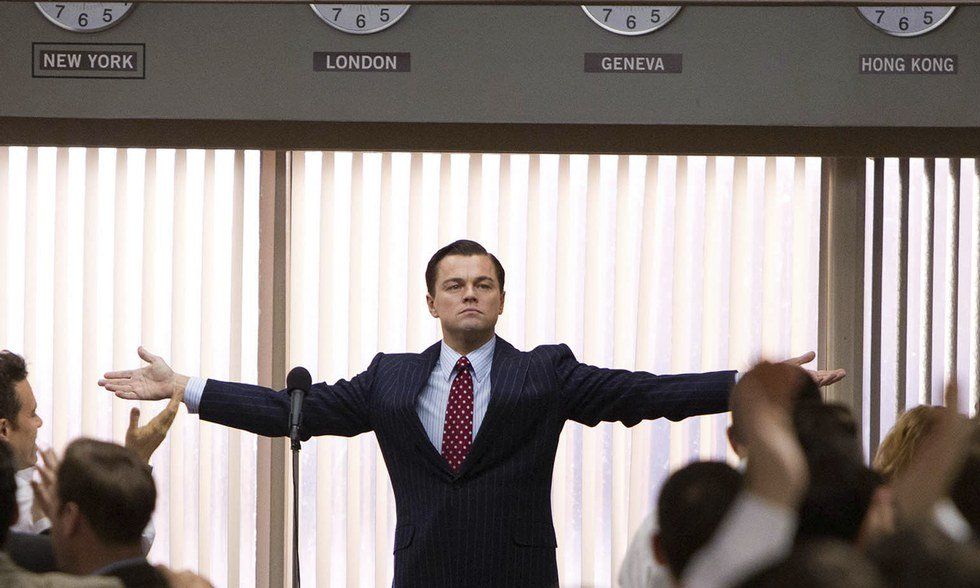
"The Wolf of Wall Street," director Martin Scorsese’s latest outrageous production, bams, snorts, swears and pows itself as one of the most shocking, yet entertaining movies of the decade. Like its predecessors "Goodfellas" and "Casino," "Wolf" looks at how money affects people, especially once-innocent people. But unlike Henry Hill or Ace Rothstein, these characters don’t bear guns, nor do they threaten their associates with hammers. What they do share in common, however, is the greed that corrupts them and the lifestyle that is too good for them to throw away.
The film is based on a memoir by Jordan Belfort (portrayed by Leonardo DiCaprio in the film), the Wall Street stockbroker who founded the Stratton Oakmont investment firm. With the help of his friends, Belfort experiences a perverted-rendition of the American Dream, evolving the company throughout the '90s from an informal and unsuccessful charade, to an informal multi-million dollar charade. What ensues on the screen as a result of their newfound wealth is a wild and abstract way of life not seen since Tony Montana and his little friend, with booze, women, irresponsibility and plenty of drugs.
Belfort is pursued by the only person in the film with an understanding of morals, FBI Agent Patrick Denham (played marvelously by Kyle Chandler). Perhaps by coincidence, but most likely not, Denham has the least amount of money of all of the characters. He tried once to have his way on Wall Street, but he failed, and now he has to take the subway home -- not ridiculous or immoral by any standards, but it is a point of criticism from Jordan that he brings up in one of the film’s most important and impressive dialogues.
As with many of his films, especially his crime ones, Scorsese has mastered the idea of the anti-hero. There is Tommy DeVito and Jimmy Conway from Goodfellas, Jake La Motta in Raging Bull and most famously, the antisocial and violent Travis Bickle from Taxi Driver. This time he has Jordan Belfort at his side. Jordan constantly cheats on his beautiful trophy wife, Naomi (Margot Robbie), he’s addicted to drugs, he’s materialistic, reckless, thoughtless and worse of all, selfish. And somehow, we see Denham as the bad guy, booing him as he does the job we would want him to do in real life, and scowling when he succeeds.
Jordan doesn’t run his con-operation alone. By his side are Rob Reiner as “Mad” Max, his easily-tempered father, and his best friend Donnie Azoff (Jonah Hill). Jordan met Donnie shortly after he had begun working with penny-stock. Noticing Jordan’s luxurious car in the parking lot, Donnie asks Belfort how much money he makes. “70,000 last month,” Jordan replies. With an astonished face of both disbelief and mild jealousy, Donnie tells him, “You show me a pay stub for $72,000 on it, I quit my job right now and I work with you.” Jordan pulls out the stub, Donnie calls his boss and quits right there on the spot, which even for Jordan, is a little strange. Donnie is responsible for many of the film’s comedic moments, and though he makes the audience laugh, he is also responsible in-part for Jordan’s downfall, snorting, swallowing and drinking beside him, as opposed to helping him.
This is DiCaprio’s fifth collaboration with Scorsese, and with "Wolf," both are at the top of their game. Leo’s maniacal performance is perhaps the most absurd and wild character he has, and probably ever will put to the screen. Whether he is trying to bribe the FBI, or lie to his wife, or rally his staff with unconventional, yet oddly touching speeches, DiCaprio is a wonder.
During one of those speeches, in which he addresses the Stratton Oakmont crew about how to approach the FBI investigation, Belfort exclaims “This is Ellis Island, people. I don’t care who you are, where you’re from, whether your relatives came over on the Mayflower or an inner-tube from Haiti. This, right here, is the land of opportunity.” The important part of his message then comes out, “Stratton Oakmont is America.”















