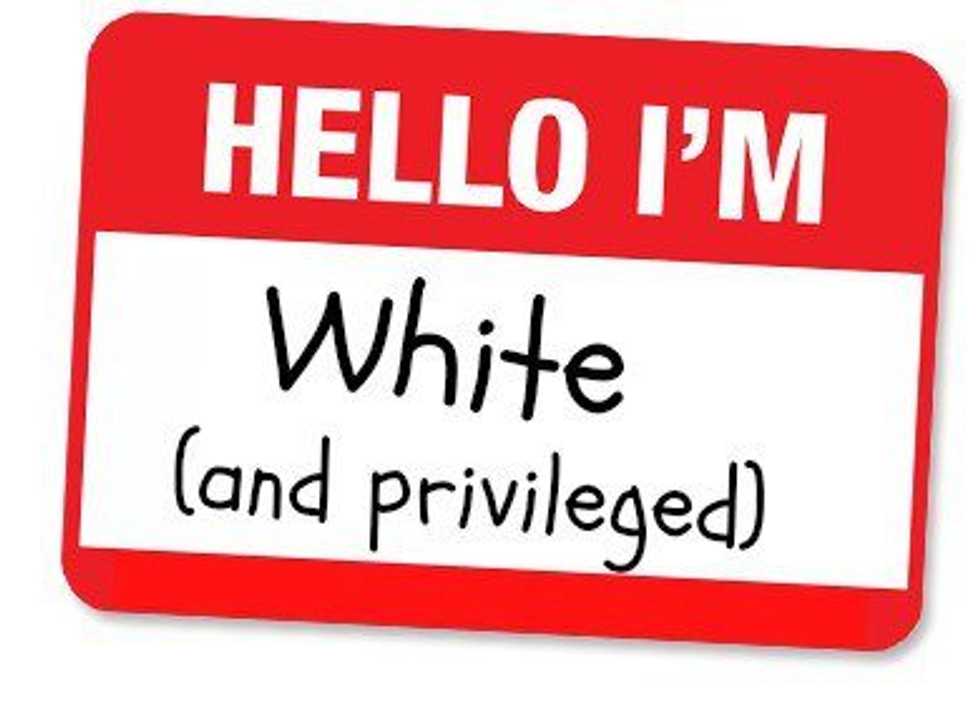
“White privilege doesn’t exist.”
Those four words make me cringe. It is difficult explaining the concept of white privilege to some white people, especially those of lower middle or lower classes. Their reasoning is that such privilege does not exist because they gain nothing from being white. This is where the problem lies. Some people’s perception of the word “privilege” when it comes to white privilege is distorted. In order to get a better understanding of the “privilege” that white people do possess, it is important to analyze not just whites but also African Americans, and how the contrast, the opposite, the yin to the yang affects and highlights their privilege.
Despite its prevalence, controversy surrounds the suggestion of white privilege within the American culture. Privilege is defined as “a special right, advantage or immunity granted or available only to a particular person or group of people.” The dispute among some white people about the concept of white privilege comes from the fact that they regard white privilege with the denotation of “privilege” in mind. White people argue that their privilege does not exist because such privileges and advantages are often intangible or unseen. White people are desensitized to the social advantages that they possess merely because of their skin color.
White privilege is a result of centuries of the oppression of African Americans; therefore, we can’t talk about white privileges and advantages without addressing African Americans’ disadvantage. African Americans have distinct social disadvantages in American society. These disadvantages are a result of centuries of oppression from slavery, segregation, and discrimination. As much as some white people hate to admit, the negative effects of those injustices over the centuries are still, very much so, evident today. The perception of black as something negative or undesirable is prominently embedded into American society. Since African Americans are viewed as "the other," whites are then viewed as the norm (i.e. the majority) these negative perceptions of African Americans correlate to the concept of white privilege. Society is desensitized to the notion of white as something better than black. Nonetheless, these general perceptions do exist.
An example of a way white privilege pit up against the African American disadvantage is prevalent in American society regards the media. When American culture thinks of ideal beauty, we often think of white or fair skin and long hair. The majority of models, both runway and magazine, are white. The dominant images in the media are white. White people set the beauty standards, and they attain the beauty standards. Self-hate among African American people exists because this society has been brainwashed to think that “white is right” and that white is more desirable than black.
An example of self-hate within African Americans is the idea that “light skin is the right skin.” This light skin refers to the lighter tones of brown among African American people. Some African Americans of darker skin tones may feel less appealing than those with lighter tones. Skin lightening creams exists and the idea that someone would go as far as trying to change their skin to make it lighter says a lot about how greatly immersed the concept of white ideal beauty is in society.
White people often deny white privilege because their disadvantaged and privileges aren’t always obvious or overt, but societal privileges do not only pertain to the disparity between whites and African Americans. For example, there is male privilege. Men have privilege over women just because of their sex. Woman face certain hardships that men do not (just like African Americans face certain hardships that white people do not). There is also heterosexual and cisgender privilege. Heterosexuals and cisgender people have easier lives than homosexuals or trans individuals. It baffles me how anyone can deny that these groups (whites, men, straights…etc.) have a distinct advantaged over others (blacks, women, gays, etc.)
In an essay by Stephanie Wildman and Adrienne Davis from White privilege: essential reading on the other side of racism, they say, “When we try to look at privilege we see several elements. First, the characteristic of the privileged groups define the societal norms, often benefiting those in the privileged group. Second, privileged group members can rely on their privileges and avoid objecting to oppression [...] both the conflation of privilege with the societal norm and the implicit option to ignore oppression means that privilege is rarely seen by the holder of the privilege [...] characteristic is the norm, those who stand outside or the ‘alternative.’” When it comes to white people and African Americans in society, the African American is always the other.
White privilege can be seen in many aspects of American culture today: White people do not have to worry about being marginalized in television and movies. White people don’t possess subconscious, internalized self-hate because their skin has been degraded for centuries. White people do not have to worry about being pulled over solely based on their skin color. White people do not have to worry about being followed while shopping under the suspicion of shoplifting. White people do not have to ever worry about their skin color hindering them from certain aspects of life. These are just some instances of white privilege. The privilege isn’t always overtly obvious, seen or recognized but they exist nonetheless.
So, if you’re a white person and are strong willed on the notion that your privilege doesn’t exist, and you’re “tired of hearing about your privilege,” you need to stop thinking about it in terms of something that your white skin does for you, but rather what it doesn’t do against you. How you are perceived contrasted to black is your privilege.