

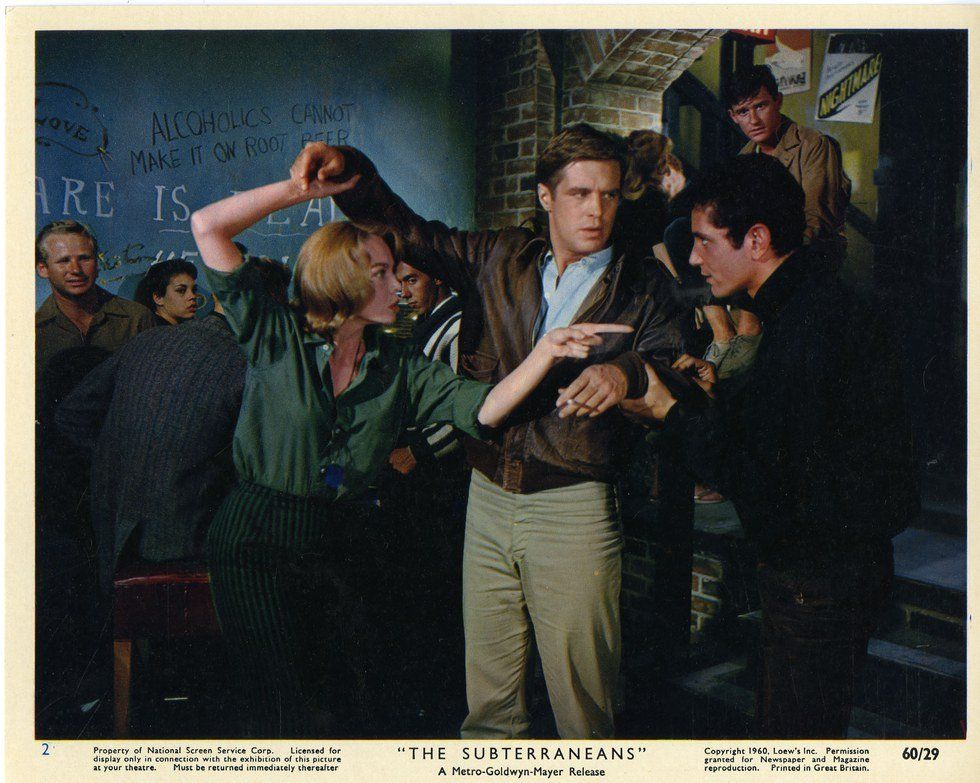
I began The Subterraneans with the intention of quickly making some conclusions on the writings of Jack Kerouac. The Subterraneans, written in about three days, was the most reckless of his novels and novellas- an autobiographical take on interracial relationships and the shallow love that grows from the obsession with the essence of a woman, rather than her entirety. The lack of edits and punctuation make your head run out of breath, as instead of reading a book you seem stuck in the mind of a disillusioned writer lacking a sense of purpose, among other things. His ramblings and tangents are indicative of the ever-changing world views of a beatnik. Kerouac’s supposed “fictional” character (the restless young man who is seemingly present in all of his works), begins to fixate upon Mardou, characterized upon her race and insouciance after seeing her among other subterraneans. After a couple of brief meetings, their affair begins abruptly, and oddly emotionally despite the overwhelming sexual and substance addictions of both characters.
Mardou’s unfortunate past involving sexual abuse and neglect is somewhat downplayed by the exquisite prose of Kerouac- his talent lying not in his plots that parallel his own experiences, but the sequences of words he can craft without hesitation or conscious thought. His syntax breaks all rules writers like Hemingway never dared to stray from, easily viewed as lazy, otherwise worshiped by Beat Generation devotees and male adolescents just breaking into literature.
It does not seem his feelings are inauthentic, but overridden by addiction and self-hatred, manifesting itself in the fixation on love and feeling something, anything, beyond the numbness of constant substance abuse. The continual rants and contradictory thoughts of Leo may indicate the state of Kerouac during the brief construction of The Subterraneans, the supposed discomfort inside Leo, or, more likely, a mixture of the two.
Despite the complicated desires of both Leo and Mardou they continue spending time together as it’s manageable. Leo believes he loves Mardou, but it seems to be her essence he really cares for, as Mardou herself states early on in the relationship. To love someone so deeply damaged and twisted would take more than one glance to become formidable, whether or not Leo realizes it. Kerouac and his characters are often aimless and lost, but by choice, not because they had to run away, but because they longed to. Mardou had no choice, being a minority and of mixed race, a large enough obstacle for the time. There is a not-so-subtle stream of racism in the romanticizing of African-American culture in the 1950s, as Kerouac places Mardou on a pedestal solely due to his desire to defy normalities and test his societal limits. His primitive understanding of interracial relationships quite possibly promotes his downfall and further sabotage of his self-fulfillment. Repeated appropriation undermine the intelligence and nuanced Mardou, meant to be further explored as an entire being rather than a simple concept. The conceptualization and poor construction of a relationship makes Leo feel free, as he longs to feel love but could never handle the thought of being trapped by a woman.
One way to justify the shortcomings of Leo are to simply accept the connection between novelist and narrator. Kerouac wrote what he knew. Nothing was planned or made up, merely spontaneously bled as he sat fused to his typewriter and wrote about writing. Before being a writer, Jack identified as a spiritual man, catholic, but also exploring Buddhism as he hiked through the mountains with fellow novelists. That is the beauty in Jack Kerouac. Not the story itself, but the effortless combinations of words and sentence structures that never seem to end, similar to the potential to analyze the ramblings and paranoia of the pioneer of a movement going beyond writing and into the philosophies of the newfound culture identified as the Beat Generation.