The country of Afghanistan has been war stricken for almost 40 years. Until recently, the country was ruled by the harsh regime under the Taliban. Although Taliban rule was lifted in 2001, the radical party still hugely impacts the politics and media in the country. The main focus of Afghan media today is the rebuilding after a time of complete darkness. The Taliban completely banned media including TV, music, and film. The Afghan people along with the help of westerners are partnering to create a new era of Afghan media. The people use music to fight for the rights of women and the right to vote in a free election. Journalists are dying on the street to report the truth. The struggle to promote and support Afghan media deals with the lingering power of the Taliban. The group holds power and still continues to threaten and attack those who move toward the globalization of Afghan media. (BBC, 2015)
The Taliban came to prominent power in Afghanistan in 1994. The Taliban rules root in a radical interpretation of the Sunni sector of Islam. They followed their own strict “Sharia” or Islamic law. Some of these harsh rules included the banning of music, TV, film, videos and dancing. The strict rule also included many rules that degraded and restricted women including the ban of cosmetics, and forbidding any women to wear brightly colored clothes, as they were considered to be sexually attractive. Most Afghans abided by the Taliban rule as disagreement would be punished harshly and usually fatally. Today the people are able to speak out as the power has been lifted.
Freedom Press Issues
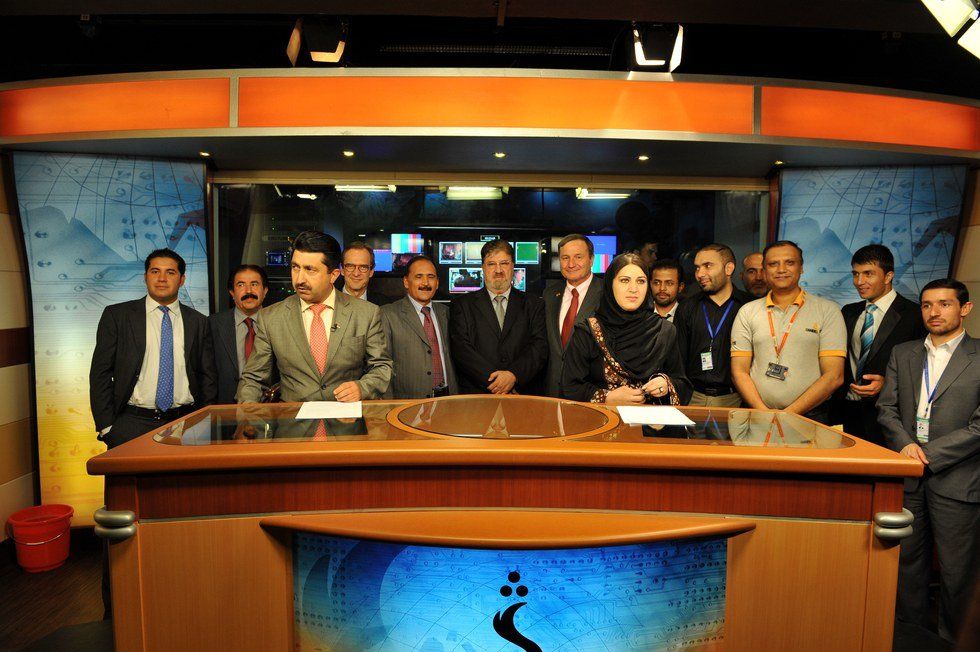
After the lift of the Taliban rule radio was the most popular outlet for news. Afghanistan made a deal in 2014 with a France based company Eutelsat that would allow the country to receive satellite and television connection. Afghanistan has over 90 public and private television stations and over 174 radio stations. Government and military funding is given to the public networks. Many privately owned channels are supported by other countries and by Co-International Companies including Australian-Afghan Moby Group. These outlets primarily play Afghan surrounding countries’ music and culture but they have adopted the structure from western media. This idea hails from Chapter 7 of Globalization and Media written by Jack Lule. He discusses this idea of blending different cultures. The structure of western TV mixed with Afghan content is an example of the term hybridity by design. Lule also mentions that hybridity is not only a mixing but also a business venture. These blended cultures can prove to be very lucrative and successful. (Lule, 133) Tolo TV is the most popular private television network in Afghanistan. The network has many successful shows including “Afghan Star”, “Shabake Khanda”, and “Zahra”. The television show “Afghan Star” is a primary example of how the country continues their values and maintains their cultural identity, but also adopts structure from western series. “Shabake Khanda” is a hidden camera prank and comedy show, which also incorporates performances from popular singers. The content of jokes and pranks are culturally very Afghan but the set up hails from western shows like “Impractical Jokers”, “The Jackass Movies”, and “Saturday Night Live”. (BCC, 2015) (Tolo TV, 2015) (Lule, 2012)
Although the Taliban rule has been lifted in the country there is still prominent influence of strict Islamic rule in the media. Journalists are consistently being threatened for reporting “untruthful” or revealing news. Freedom House releases a report of the world’s countries’ freedom press scores. In 2015, Afghanistan is still marked not free. It was rated 67 on a scale of 100 being the worst for press issues. “Local authorities have occasionally forced the closure of media outlets in retaliation for reporting on official corruption and other sensitive topics, and journalists face an acute risk of violence from state and non-state actors in the context of the ongoing military conflict” Freedom House, 8). This quote explains the partisan government influence on Afghan media even without the Taliban. Much of the influence is due to the funding by political groups who essentially have say on the content of the media. Censorship laws remain a major issue regarding the freedom of the media. “The 2009 Mass Media Law prohibits censorship and guarantees the right of citizens to obtain information. However, there are broad restrictions on content that is deemed “contrary to the principles of Islam or offensive to other religions and sects” (Freedom House, 2). While there are rules promoting the freedom of the press, they are not followed and loopholes have been found. (Freedom House, 2015)
A recent article produced from Reporters Without Borders discusses the continued struggle the Afghan people face with the Taliban and other radical groups even with promised free media. “The Taliban occupied government buildings and the headquarters of several news media, including Roshani Radio and TV, an independent broadcaster, where they torched and destroyed much of the equipment” (Reporters Without Borders, 2). Roshani Radio and TV broadcasts up to 20 hours a day, covering controversial issues especially those regarding women’s rights. The station also has majority female workers. Many reporters and journalists from the attacked city of Kunduz were forced out. This is just one example of how the government is at times completely overrun and influenced by these radical groups’ beliefs. Local authorities also tend to cater to these attacks making further investigations impossible. (Reporters Without Borders, 2015)
The attacks on Roshani Radio relate to the idea of cultural differentialism. Lule discusses this idea of “the clash of cultures” (Lule, 126). He discusses how some groups may act out violently in an attempt to keep the local cultures alive. Taliban, radical groups, and even local governments regularly attack media that is perceived as offensive or not following Islamic law. Roshani Radio was a primarily women run news outlet that covered news about women’s oppression. In Afghanistan, women still have little to no rights, and many young girls are sold as child brides. There is no surprise that the Taliban would target a news outlet that shared more westernized ideals. The Taliban attacked the source of the cultural change which was giving women power. Another example of differentialism was seen in reaction to an Afghan Star contestant Setara Hussainzada. She was shunned and attacked by many audience members, other contestants, and received threats from Taliban groups. The singer represented herself on stage with westernized culture including dance and showing her hair. Many reacted poorly to her attempt and socially exiled her. She tried to use western culture in her performance and it was received as a threat to the Afghan culture. (Afghan Star, 2009) (Reporters Without Borders, 2015) (Lule, 2012)
Afghan people need to get truthful news without censorship though this comes at a cost to the journalists. “According to the Afghan Journalists’ Safety Committee (AJSC), a total of eight journalists were killed in 2014, and 129 cases of violence were recorded, a substantial increase over the previous year” (Freedom House, 10). Human Rights Watch released an article in January discussing the growing danger that journalists are facing though the reconstruction of Afghanistan was supposed to promote freedom of the press. Journalists and news outlets that publish and cover controversial news topics are being attacked, threatened, and even killed by numerous perpetrators. The government attempts to persuade journalists to stop covering controversy. The Taliban and other radical groups frequently commit violent attacks on journalists. Sadly all of these attacks usually go unnoticed by police and are never investigated or brought to justice even when dealing with an act of murder. The role of leadership in Afghanistan is crucial as they have the laws but no protection to those who support it. (Human Rights Watch,) (Freedom House, 2015)
Aid From the West
The threats are continually getting worse for Afghan journalists and traveling journalists attempting to cover the controversy. The IMS (International Media Support) released an assessment of the current and post threats for journalists in Afghanistan and safety mechanisms for going about reporting in the field. The International Media Support is a non-profit organization that is run out of Copenhagen, Denmark. Their goal is to support and aid media in countries that are war stricken making media a dangerous task. The assessment goes into depth on each attack/threat for journalists. “The reduction in international security forces will put the lives of media personnel in danger, in particular those associated with international media organizations and other international NGOs” (IMS, 16). This quote from the assessment is very interesting as it touches on the American influence in Afghanistan. The assessment is warning media personnel that the cutback of America’s forces in Afghanistan will make their jobs more dangerous. While US involvement in Afghanistan did not create a perfect new government, the media was protected when the troops were in the nation. The assessment also touches on safety mechanisms journalists can use when reporting in highly targeted areas like Herat and Kabul. One of these mechanisms includes The Afghan Journalist Safety Committee. The committee is stationed in Kabul where the coordinators monitor the safety on the field. The committee is able to provide real time safety updates. Another main safety mechanism is the media safe houses. The safe houses are open 24 hours a day to provide services for emergency situations. Sadly they are not associated with the police, making them more vulnerable to attack. There are also mobile phone hotlines for emergency situations. According to the assessment the most dangerous media jobs in Afghanistan are field reporters and journalists. (IMS, 2014)
The US has also provided a role in aiding Afghanistan in the reconstruction of their media. In 2010 Peace Works released an Afghanistan Media Assessment. The report is a written documentation of a Peace Works meeting between the US and Afghanistan. The report, “assesses Afghanistan’s media sector through a new tool developed by USIP, which combines elements of a traditional media assessment with conflict analysis” (Fraenke, 1). The assessment states that media plays an important role in state building for the country. The assessment also touches on the idea of why donor support in Afghan media is so important for rebuilding the media sector in Afghanistan. The Media Assessment discusses how from donors, private media has been one of the most successful ventures in the reconstruction of Afghanistan in 2009 thus proving its importance. (Fraenke, 2007)
Another main point that the assessment covers is the use of the support. Afghanistan is still very much a developing country. “The type of support they need may be long lasting. Donors should support media institutions and infrastructure when that support would
facilitate the production and dissemination of socially constructive contents, and without
the expectation that these institutions or structures will become self-sustaining” (Franke, 2). This country is starting from the ground up. The assessment discusses that aid will help Afghanistan develop credibility in the film world but without help will not be able to compare. The assessment also discusses the training of media workers so that they are able to complete production. The people of Afghanistan need to be reassured of the benefits to media in their culture and every day life. Sources of trustworthy information are scarce in Afghanistan and the people are hesitant towards media. “Afghan perceptions of media content are based on their decades of exposure to propaganda” (Fraenke, 11). Much of the propaganda attacks westernization and provokes negative connotation of western culture. The Afghan people want “more of their own content in the media” (Fraenke, 14). Even though Taliban rule has been lifted since 2001 the people see the influence of these groups in the media and also in local authority. The main goal of this peace assessment would be to support Afghanistan with the help they need to become a credible part of the global media market without imposing on the culture making them “objects of development rather than subjects” (Fraenke, 12). (Fraenke, 2007)
The Afghan film industry needs to be rebuilt. Since the fall of the Taliban in 2001 Afghanistan has fully produced only a handful of feature films. The film “Osama” directed by Siddiq Barmak won a Golden Globe. Two other Afghan produced movies include “Zolykha's Secret”, and “Emaan”. There have been a few larger coproductions in the Afghan film industry with countries like the US and France. There are quite a few films produced by the French largely due to the deal made with the French Satellite company Eutelsat. One of the French produced Afghan films “The Patience Stone” received awards at many international film festivals. “The Kite Runner” a larger produced American film was shot in Afghanistan. Many US films that have used Afghanistan as a location are shot in other places due to unfriendly relations. For example, in “Taken 3”, Afghanistan scenes were actually shot in Lone Pine, California. According to the 2007 Peace works Media Assessment, Bollywood movies are largely popular in Afghanistan. However, they are considered very controversial as the morals and culture in Bollywood film can clash with Afghan beliefs. Much of the controversy roots in the women’s “loose” actions the films. (Fraenke, 12) (IMBD, 1990)
“Buzkashi Boys” is an Afghan film co-produced with a US non-profit organization the Afghan Film Project. This non-profit is run by Heidi Spencer a US citizen. She has a degree in film making and began this project after working with another non-profit who works with African people about producing film. The other board members of this project include an Afghan-Canadian, Ariel Nasr, and two other Americans, Lesile Knott, and Samuel French. The basic goal of this non-profit is to allow the stories of Afghan people to be told and reconstruct their film industry. “The mission of the Afghan Film Project is to provide the resources, experience, and opportunity to produce narrative and documentary films that tell Afghan stories, while training Afghan producers, directors and crews (grips, electrics, cinematographers, etc.) for highly skilled film jobs that build domestic capacity” (Afghan Film Project, 2). The most recent project “Buzkashi Boys” was nominated for an Oscar. This film tells a story close to the heart of many Afghans, as two friends from Kabul try to make a future in the war stricken country. The Afghan film project is an excellent western aid as it allows the voice of the Afghans to be heard while supplying them with the resources, skills, and equipment they need to produce films on par with the developed world. (Afghan Film Project, 2014)
US Influence in Afghanistan
US troops were stationed in Afghanistan for 14 years. After more than a decade of war American culture started to trickle into the Afghan population. Western ideas filled the minds of young Afghans influencing the music they listened to and how they dressed. An article released by the Washington Post in June touches on some of the major Afghan trends that can be attributed to American culture. Many bootlegged American movies and TV shows are sold in the streets in Afghanistan and are wildly popular. “In video stores around Kabul, bootleg DVDs of Hollywood films such as “Furious 7” and “Taken 3” are hot sellers. So are Walt Disney cartoons, which parents use to teach their children English” (Raghaven, 14). The article also mentions how many Afghan males are getting haircuts like Tom Cruise, an American film star. Samira Ahmadi, who was interviewed for the article discusses the personal freedoms he now can enjoy after the take down of the Taliban regime including mixed gendered parties. (Raghaven, 2015)
US hip-hop and rap music has had major influence on Afghan music. The youth of Afghanistan have taken on hip-hop to attack social troubles and political agendas. There are signs of major hybridity in Afghan rap music. American rap is inspiring these young artists to create a socially ethical genre of hip-hop music. The musicality behind the songs is reminiscent of westernized rap. The “gansta” culture that represents the genre is seen in the imitation of the artists in the music videos. The break down of rapper to singer to rapper is following a structure familiar to western ears. The blending of the cultures is found in the culturally appropriate lyrics in Afghan songs. These artists rap about ethical topics and use the music as a medium to promote their own ideas. (Raghaven, 2015)
Two Brothers Sami and Shaheed became the face of the 2014 Afghanistan election. They say that their music is influenced by late American rapper Tupac Shakur. The brothers rapped about the growing up in a war-tormented country. Their lyrics include terrible images of suicide bombers, sick children, and explosions. The main goal of their anthem was to encourage the population to go and vote in order to regain their rights. Another Afghan rapper Paradise Soururi says her biggest inspirations are Rihanna, Nicki Minaj, and Jennifer Lopez because her own country does not provide her with women empowered icons. "It is so hard," she says. "The mind of Afghan people is not ready for girls or women performing in public; people insult me and say I'm a bad girl" (Villamizar, 7). Soururi dreams of becoming a female hip-hop icon for the younger generation of Afghanistan girls. Her lyrics speak about an “era of women”. She wants to change the disrespect and lack of rights Afghan women have to deal with every day in Herat and all of Afghanistan. Not all of the population agrees with her message and she has been threatened, attacked, and even has plans to leave the country if necessary. Again, the responses to Soururi’s ambition show the cultural differentialism that permeates through media that shares westernization that is deemed disrespectful to the religion and culture. (Freidman, 2014). (Villamizar, 2013)
The youngest Afghan rapper, Sonita Alizadeh did an interview with Women of the World where she discussed the popular tradition in Afghanistan of families selling their daughters to men of all ages for marriage and also to eliminate debt they may have accumulated. Alizadeh shares a clip of her mother discussing the price of her daughter for a suitor. She was 10 when her parents began the process and at 16 attempted to sell her as a child bride. She discusses how the tradition makes Afghan girls feel worthless, and “like a doll that everyone can play with” (Alizadeh, 2015). Alizadeh released a music video on YouTube called “Brides For Sale”. The lyrics discuss the damaging effects of this horrible custom. They share a video of her talking to her mother in the car. The mother has no interest in her songs and tells her she wants to marry her off. Alizadeh replies, “You’ll waste my potential if you marry me off.” She knows her value to the world and stands to connect the marginality of all young girls fighting to be free of the selling of child brides. Her family did not force Alizadeh into marriage after her music video was released. (Women of the World, 2015)
Afghanistan is a country in need of leaders with power. The reconstruction since the fall of the Taliban regime has left the country opportunity to rebuild its media, but without the resources. Slowly Afghan TV, film, and other media are beginning to make small moves in the global media market with the aid of western assets. Unfortunately, the funding, workshops, and tools will never be enough. Afghanistan needs to regain the control of the government and overthrow local authorities that are still influenced by the Taliban and other radical groups. The fear and risk journalists have while reporting truth in Afghanistan cannot continue. Young Afghans, especially girls, should not continue to be punished for attempting to blend their cultural content with western structures and rights. Afghanistan has a potential to globalize its media to the world, but the political biased and unprecedented media censorship makes the task difficult and dangerous.