


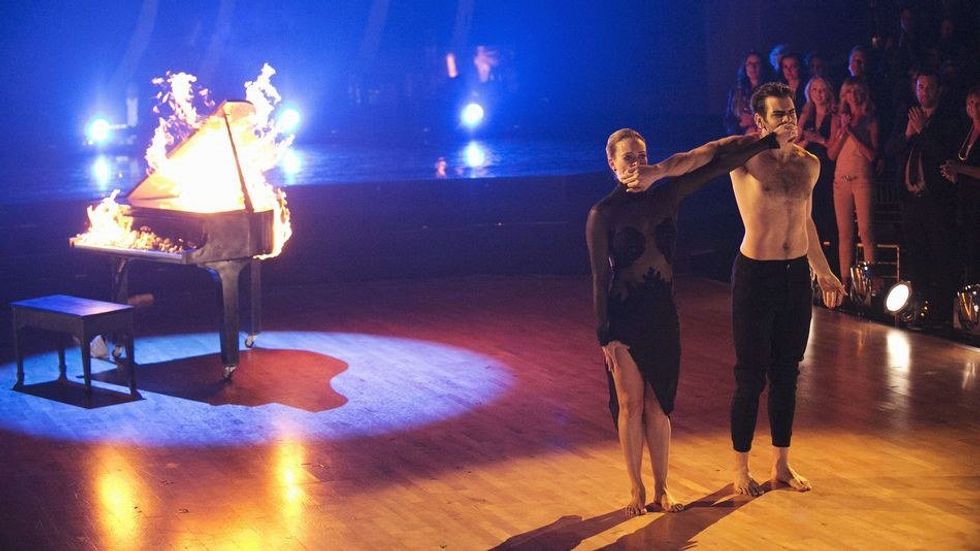
Can deaf people dance? That question was answered this season when Dancing with the Star’s first ever deaf contestant, America’s Next Top Model cycle 22 winner Nyle DiMarco, not only captivated millions with his musicality and impressive dance skills but also won the coveted Mirrorball trophy for season 22. Each week, DiMarco mesmerized the audience with his ability to perform some of the season's most intricate and awe-inspiring dances despite not being able to hear a single beat of the music he was dancing to.
Dimarco’s win has launched the deaf community, which numbers approximately 70 million people worldwide, into the spotlight, and he is using the attention to spread awareness about the lack of sign language education opportunities for deaf people through his Nyle DiMarco Foundation.
While DiMarco uses his newfound fame to broaden the reach of his foundation and bring the culture of sign language to deaf people across the globe, his time in the spotlight offers the perfect opportunity to start a discussion about American Sign Language (ASL) education in American schools and colleges.
On an estimated list of American colleges that will accept ASL as fulfilling the foreign language requirement compiled by Dr. Sherman Wilcox of the University of New Mexico, 184 schools are listed. Dr. Wilcox acknowledges that the list is not exact, although it is current, being updated as recently as May 15, 2016, but let’s says for the sake of easy math and the benefit of the doubt that we round that number to 200. An article from The Washington Post estimates that there are about 5,300 colleges in the United States, which means that about 25 percent of those colleges recognize and will accept ASL as a foreign language.
As the popularity of ASL grows—it’s currently the third most popular language in higher education institutions, following Spanish and French—the debate over whether it should be recognized as a foreign language heats up. Some people falsely assume that ASL is a gestural form of English, and therefore think it should not be considered a foreign language and others insist that it is better for deaf children to learn spoken language and lip reading from a young age and not ASL, so to teach ASL in schools would undermine their recommendations.
American Sign Language, which originated in 1814, is “spoken” in the United States as well as the English-speaking portions of Canada. ASL is a key part of Deaf culture, just like Spanish is a key part of the Hispanic/Latino culture, and it is a fully developed and complex language all to itself.
On a page regarding ASL on the Gallaudet University Library website the complexity of ASL is explained, “For a long time, it was thought to be either a crude collection of gestures, or to be an ‘inferior’ form of English. However, linguistic research beginning in the 1960s has shown that ASL is a true, complete and rich language in its own right, unrelated to English.”
Furthermore, literally translated ASL will sound like broken English because the sentence structure and grammar are different from English, as explained in a petition written by a college student at Eckerd College, Jason Paroline, who was writing to encourage Eckerd to allow ASL to fulfill their foreign language requirement. Paroline, who cites information from over 30 academic sources in his appeal, explains that a great deal of the meaning of a sentence in ASL depends on facial expressions, body language, and the location of the signer’s hands in relation to their body.
ASL is a developed language that stands on its own away from English, just as British Sign Language stands apart for English spoken in the UK, and French Sign Language stands apart from French. Not only do these forms of sign language differ from each other, but they also differ from the spoken languages in their respective countries in grammar, syntax, and sentence structure.
There is no question about the legitimacy of the language, but can it be considered “foreign?” The definition of a foreign language is, “Any language other than that spoken by the people of a specific place.” ASL is a fully developed, complex, and unique language that I do not “speak,” therefore, it is a foreign language to me and anyone else who does not “speak” it natively.
This is the part of the discussion about accepting ASL as a foreign language fulfillment course where the question, “How important of an international language is ASL?” usually comes up. As Dr. Wilcox puts it, if we’re concerned about students learning internationally applicable foreign languages, we should be pushing Farsi to the top of the most popular foreign languages list, not Spanish or French.
Dr. Wilcox explains why the argument of international importance seems hypocritical when applied to ASL, saying, “ASL does perform a critical function in today's world of deaf international affairs and is, for example, an important language in international meetings such as the World Federation of the Deaf. A language's international status, however, does not play a major role in its acceptance as a foreign language. Dutch has little influence in international affairs yet is acceptable as a foreign language.”
There are also those who disregard ASLs importance due to the opinion that it is better for deaf children to learn lip reading and spoken language. In a response letter written by the president of the Alexander Graham Bell Association for the Deaf and Hard of Hearing, Meredith Sugar, in regards to Nyle DiMarco’s comments about language deprivation among deaf children Sugar cites technological advances as the main reason the deaf children should be taught spoken language and not ASL.
Although it’s not directly stated in Sugar’s letter, she hints at the fact that because we now have access to Cochlear Implants and hearing aids, deaf people, children especially, should choose to utilize these advances to learn spoken language instead of ASL or fear having developmental delays. This is an invalid argument for several reasons.
First, Cochlear Implants (CI) and hearing aids are not going to be for everyone in the Deaf community. Cochlear Implants, which are marketed as being a “cure” to deafness, cost on average in upwards of $40 thousand dollars, depending on quality and whether the procedure is covered by insurance. On top of that, it takes a a great deal of hearing therapy and training for deaf people to gain the full benefit of a CI.
Second, in order for a CI to be a viable choice for a deaf person, they must have a functioning auditory nerve. By teaching deaf people with functioning auditory nerves to learn spoken language alone and not ASL as well, you are alienating the percentage of the deaf people who have no chance of receiving a CI and communicate through ASL alone.
There is no reason that deaf people should not have the choice to live without a CI or hearing aid, even if they are eligible for one, and bilingualism in the deaf community among deaf people who can learn spoken language and ASL should be encouraged as it allows them to “attain his/her full cognitive, linguistic and social capabilities.” Advancement in technology is no reason to discourage deaf people from learning the language of their culture, and to do so conveys the idea that spoken language is “true” language while ASL is a second-hand language of the disabled.
The argument that ASL should not be taught as a foreign language because we live in a day and age when there are technological advances to help deaf people speak our language is like arguing that American students shouldn’t learn a foreign language, and everyone else in the world should just learn English; lazy, ignorant, and flawed.
We are constantly making things in our country more accessible to people of marginalized groups. Larger font options on tablets, computers, and in books, ramps for handicap people to get in and out of buildings, gender neutral bathrooms and other efforts to decrease discrimination, so why are we not encouraging the learning of ASL, by hearing and non-hearing people, and the interaction with the deaf community in our own country?
By failing to recognize ASL as a foreign language fulfillment option in our colleges we are ignoring the legitimacy of ASL as a language and perpetuating the idea that deaf people are “broken” instead of recognizing their rich and diverse culture. Until ASL is recognized as fulfilling the foreign language requirement at all colleges in the United States, we as a nation are complacent in enacting a mindset of ignorance towards our deaf neighbors.

















