So there’s this scene in the second season of Master of None: it’s the final moment of the episode; Dev (played by Aziz Ansari) has just had an unbelievably romantic and fun night with a friend, and just then his friend realizes—alas!—she has plans with her boyfriend and is actually flying home on Sunday, so really, this is goodbye. They hug, she gets out of the car, and boom, Dev is alone.
Now, if Master of None adhered to the conventions we’ve come to expect from half-hour comedic television, this would be the moment when the cab driver leans back and spouts off something like, “Oof! That was rough,” effectively puncturing the emotion of the moment. Canned laughter, credits roll. But no. Instead, we remain with Dev as the car pulls away. We sit with him in his silent disappointment, in his heartbreak, for three whole minutes, the camera unflinching, the take only broken as he checks a single text message. Like it or not, we are with Dev all the way home.
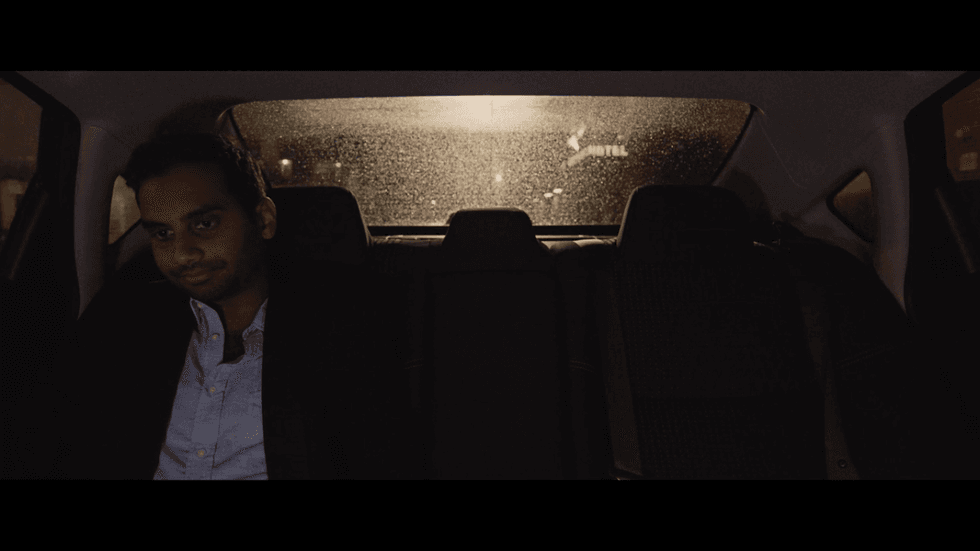
When I watched this scene play out, I went through a weird progression of emotions. At first, I sympathized with Dev. But as the scene went longer and longer, I found my sympathy wearing thin. I started to get uncomfortable. There was nothing ironic or comical about this scene. It was painfully, mercilessly real. And as the scene reached its third minute, I was reminded of a passage from David Foster Wallace’s novel Infinite Jest that could quite easily serve as a voiceover summary for this entire sequence:
“Hal...theorizes privately that what passes for hip cynical transcendence of sentiment is really some kind of fear of being really human, since to be really human (at least as he conceptualizes it) is probably to be unavoidably sentimental and naive and goo-prone and generally pathetic…” (Wallace, 694-5)
What’s fascinating about Master of None is that, like the very best situation comedies, it looks at the world ironically. It points out the flaws in our institutions, societal norms, and beliefs. But there is no “hip cynical transcendence of sentiment” in this scene; Dev is not witty or quippy or skeptical; his depiction is, as Wallace writes, “unavoidable sentimental” and “goo prone.” The note this episode ends on is decidedly sincere. In that, Master of None proves that it is more than just unconventional. It is revolutionary.
Let’s talk a bit about this “sincerity,” because that’s a word that keeps cropping up more and more in recent years, in regards to art, culture, and the millennial generation.
First of all, when “sincerity” is referred to, it’s frequently in contrast to postmodernism. Yeah, we’ve all heard that we’re living in a “postmodern” world, but do we know what that means or looks like? Simply put, postmodernism is a twentieth-century movement defined by attitudes of skepticism, irony, or distrust toward grand narratives, authority, reason, objective/universal truth, and ideologies. Postmodernism says that our truths and beliefs are socially constructed, that there are layers to what we believe. Let me say this now—postmodernism is not evil. It’s extremely useful for seeing the flaws and hypocrisies in our ideologies, because we’re flawed, hypocritical creatures. But like anything, postmodernism should be taken with moderation. It’s a half-measure. That’s where sincerity comes in.
Cultural critics, philosophers, and people who think about this stuff have struggled to characterize this current age, the one we’re living in now. We seem to be moving beyond postmodernism—hence post-postmodernism—but where are we going? Again and again, the answer seems to be sincerity. The term New Sincerity has been used to describe a new generation of artists, thinkers, and citizens who, as Robert L. McLaughlin writes, “seek in general to acknowledge but penetrate through the layers, aiming...to reconnect with something beyond representation, something extralinguistic, something real” (213). It’s not that they don’t believe in the facade or see the flaws. It’s just that, at the end of the day, they crave and believe in something genuine. Things still matter. That’s what New Sincerity is about.
The question then becomes: has New Sincerity arrived? We’ve seen the signs since the mid-1980s, but the movement has never been overwhelmingly widespread. Sure, we’ve gotten books like Infinite Jest and A Heartbreaking Work of Staggering Genius, films like The Royal Tenenbaums and Eternal Sunshine of the Spotless Mind, and music from artists like Arcade Fire and Neutral Milk Hotel. But what about the most pervasive medium of our generation? What about the thing to which average Americans gives five hours of their day? What about television?
In his oft-referenced essay, “E Unibus Plurum,” David Foster Wallace criticizes television for its use of irony in appealing to viewers, asserting that “irony's singularly unuseful when it comes to constructing anything to replace the hypocrisies it debunks.” In the wake of television Wallace argues this:
“The next real literary ‘rebels’ in this country might well emerge as some weird bunch of ‘anti-rebels’... who have the childish gall actually to endorse single-entendre values. Who treat old untrendy human troubles and emotions in U.S. life with reverence and conviction. Who eschew self-consciousness and fatigue.” (Wallace, www.thefreelibrary.com...)
Wallace predicted this in 1993, and in a very big way, he’s right. The movement is New Sincerity, and in this revolution, the rebels care about what’s real and genuine. But perhaps most surprisingly, “the next real literary ‘rebels’” at the forefront of the movement are appropriating the very medium Wallace classified as “passive and cynical.” New Sincerity is being televised.
Which brings us back to Master of None and the scene I described to you. Master of None is a Netflix original series, created, written, and directed by comedian Aziz Ansari and his writing partner Alan Yang. The show’s concept is simple enough: a 30-something Indian actor is trying to make a life for himself in New York City. The show is important for plenty of reasons—the diversity of the cast, the social issues it explores, the music, the writing, the cinematography, the comedy—but even beyond all that, there’s something special about the show. And here’s what it is: IT CARES. Beneath everything, there’s a warm beating heart that believes certain things still matter. Things like community, and heritage, and romance, and family. Master of None may point out the hypocrisies of our culture, but it does so with the most genuine of intentions.
Another episode in the second season, “Religion,” makes fun of the way in which young people feel pressured to go through the motions of their belief systems in order to appease their parents. The episode is supremely ironic (and hilarious), as Dev and his cousin ditch prayer with their Muslim parents so they can attend a barbecue festival and consume copious amounts of pork, a forbidden food. For all of its irony, though, the episode ends on a surprisingly sentimental note, cutting back and forth between Dev’s parents at mosque and Dev spending time with friends, suggesting that the community provided is necessary and fulfilling for both parties. Once again, it’s not played for laughs. Master of None is a pioneer of sincerity in the televisual age, and it’s nailing it again and again.
Of course, you may be saying, “Okay, but that’s just one show that not many folks have seen. How does that prove anything?” And yes, Master of None is just one show. But it’s not the only television show to adopt sincerity as its ethos. Take, for instance, the cultural zeitgeist that is Stranger Things. The world fell in love with a television show about a bunch of kids who defeated a monster through the power of friendship. And it wasn’t a joke. But we ate it up, we loved it. Why? Because we crave the real and genuine. The list goes on. Atlanta, Donald Glover’s breakout comedy about the rap scene in Atlanta, plays between irony and sincerity so frequently that it’s difficult to tell if it the whole thing’s a comedy or drama. And who cares? It’s amazing. Breaking Bad taught us that morality plays can exist in the twenty-first century and still be personally convicting. The list goes on and on—Community, Parks and Recreation, Broadchurch (oh man, watch this show, please), etc., etc...
The point is, New Sincerity has been here for a while. We've got the books, movies, and music to prove it. But I think it's important that our dominant form of media, the one consumed by the most people, the one that Wallace critiqued as a promulgator of "despair and stasis in U.S. culture," is now treating "old untrendy human troubles and emotions in U.S. life with reverence and conviction." Those three minutes of silence in Master of None were some of the most sincere I've ever experienced from a television show, and all I can say is:
Let the revolution begin.