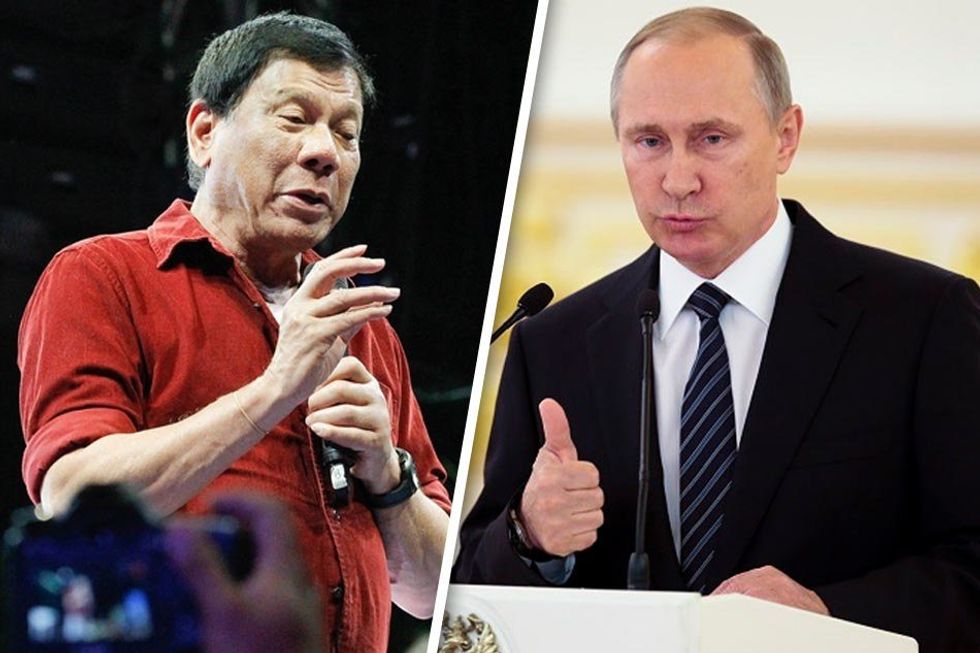
One complaint of every American regarding the federal government is that if a member of the opposite party they affiliate with is in charge, the government will be overstepping its bounds and poses a threat to liberty. This subjectively true idea is humbled by the objective truth that there are people in the world unable to criticize their government due to their complete dominance over a large portion of an individual’s life. In Russia, for instance, a couple put a flowered wreath on the steps of the American embassy after the Orlando attack with a note card saying, “Love Wins”. That couple is now in prison awaiting trial for spreading “pro-homosexual propaganda” and disturbing the peace. This is one of the latest disturbing instances of Putin encroaching on the daily lives of his citizens.
Another would be his desire to combine the Federal Security Bureau (FSB), the foreign intelligence branch akin to our CIA (SVR), and the Russian equivalent of the National Guard, the FSO. On the surface this doesn’t seem to pose much of an issue, one of Russia’s key leadership traits is the centralization of command and control functions. What’s worrisome about this act is that Putin would designate it the MGB, the State Security Ministry, which is exactly the name Stalin used for his security services before changing to the KGB. He would also expand the powers of the newly minted MGB in order to allow them to prosecute “enemies of the state”, which in Putin’s Russia means anyone he doesn’t like or anyone who opposes him or his policies.
Critics of this security merger are powerless to act; in the latest parliamentary elections, Putin’s United Russia party won over 75 percent of all seats, with the opposition Parnas and Yabloko parties unable to meet the 5 percent support necessary to enter parliament. According to parliamentary workings, this means that the Duma (lower house in parliament) can override the rejection of a bill by the Federal Council (upper house), and send any legislation forward to Putin’s desk. Here’s a possible scenario of this going up in smoke. Suppose the Kremlin wanted to grab the rest of the Ukraine (they already have Crimea which they illegally annexed) and a bill was brought forward in the Duma to send in troops. The Federal Council can reject the bill on the premise of, “Why do you all want to invade former Soviet territory?” and the Duma can override this rejection on the premise of, “Because we can.” The bill would then end up on Putin’s desk, who would gladly sign it with a grin, because his hope for a stronger Russia in the mold of the Soviet Union is coming closer to reality.
Speaking of people who are centralizing power in order to strengthen their position at home, jail dissidents, and override opposition, have you heard any news of Philippine President Rodrigo Duterte? Whether it’s the over 3,000 people killed in the two months of his tenure, the 700,000 surrendering to police, or his casual praise of Hitler, Duterte is driven to fulfill his campaign promise of reigning in drug crime. Of all the issues facing the Philippines, Chinese encroachment in Philippine affairs and the South China Sea, a sagging economy, and impoverished conditions in some parts of his country, Duterte has decided to pursue a violent campaign against those affected by drugs in his country. During his presidential campaign, his brash comments drew harsh criticisms of his personalities; he once said he “should have been first” in the rape of a missionary in Davao, where he had been mayor, and called his daughter a “drama queen” when she told the press she had been raped.
Several NGO’s have interviewed Philippine citizens and have found that many in the country not personally effected by these anti-drug policies fear for their personal safety. This could be due to the fact that Duterte has sworn to do everything in his power to protect police officers accused of killing drug-affiliated citizens and people attempting to hurt police. Police, in turn, use the cover of “evading or resisting arrest” or a possible drug link as an excuse to shoot to kill anyone who may come in contact with the police. This push towards a more militant response and “stronger” action on the federal level in response to a crises will only lead to a more restrictive legislation being passed by the President.
Here’s the thing though, drug use, specifically methamphetamines, has been prevalent in the poorer areas in Philippine society for some time. The same areas where there are open sewers, unpaved roads, unreliable electricity, and scant resources for healthcare, are the areas where people occasionally use drugs to escape. Duterte’s answer to this? Kill them because they’re the scum of society. Because there’s no other way, not rehabilitation programs, decriminalization, jobs programs, infrastructure investment, food or healthcare reimbursements, increased access to education, or anything else that could possibly benefit society more than killing drug users.
But that’s nature of autocrats; exploit an issue in society that will allow you to polarize citizens and ramp up your support, then call for more emergency powers that allow you to silence critics and give you unprecedented control over society. Pretty funny, huh?