


Beauty is in the eye of the beholder. Or, it used to be, anyway.
In a world where beauty is often debated, disputed and altogether a dubious subject, the beauty of life seems to now fall in the self-conscious fingers of anybody with an internet connection.
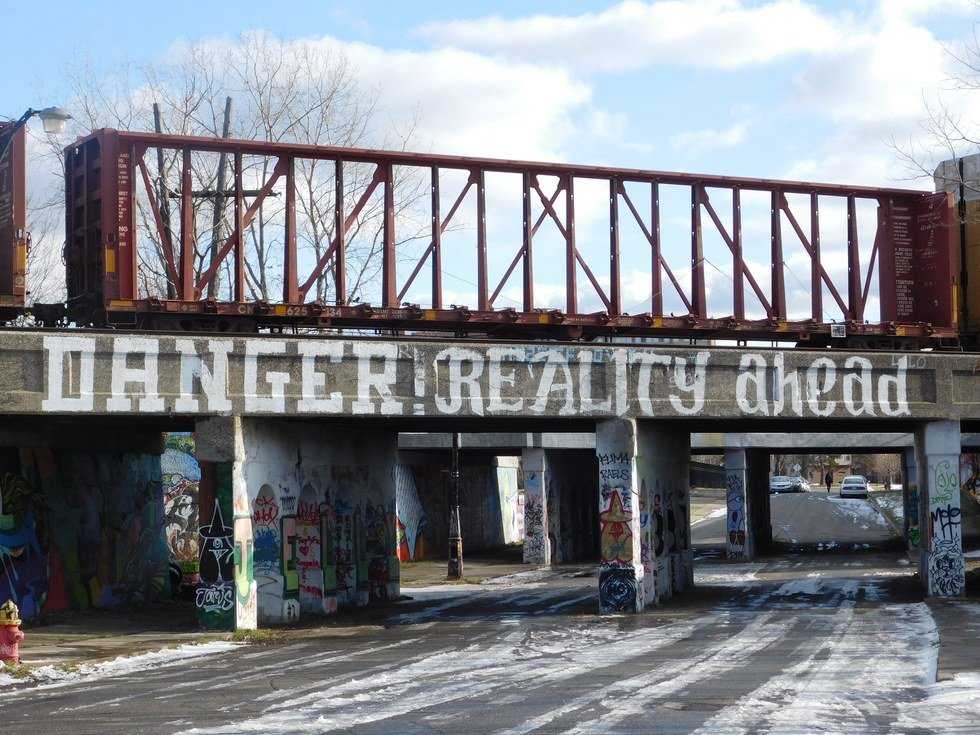
Near the corner of Lincoln and Marquette on Detroit’s east side lies a stone overpass that was built for the transportation of trains, but over the years has been altered to transport thoughts and ideas. The supports of the bridge act as canvas for independent works of graffiti art, many of which are personal messages that are addressed to no one – or maybe everyone. Among the various works of art that tint the structure’s original color, one conspicuous message stands out among the rest: DANGER! Reality ahead.
The message is simple. The message is blunt. The message is an assertion of a notion that people experience in early adolescence that’s often enforced by starting with the phrase, “In the real world…”
However, hidden behind the pressurized dispersion of white primer, rests a desire, rather than a warning. It’s a desire to be accepted without an ultimatum placed on natural human adaptation. It’s a plea for individuals to come as they are, and accept those for how they come.
Far too often, the idea of change is brought about in the hopes that someone will be better for others, rather than better for themselves. An underlying fear of being left behind due to an inability to conform or impress engulfs the very beings that once contained a load of self-confidence.
We no longer work toward improving the quality of our lives, but rather the appearance of the quality of our lives.
Social media outlets such as Snapchat encourage users to share experiences in real time. And when we do, we’re not immersing ourselves in the moment. But living through a camera lens is not reality. Limiting involvement in life-changing events due to capturing, deleting, and recapturing ten second videos is a painful reflection on the insecure tendencies that human beings have to woo others in hopes to gain acceptance or prominence among their group of friends.
Long gone is the ability to feel the reality of adversity, as well as uncontested bliss.
“If you laugh, you think, and you cry, that's a full day. That's a heck of a day. You do that seven days a week, you're going to have something special.” Jim Valvano was battling cancer when he gave this speech at the ESPY awards in 1993. At the time, his words inspired millions watching on their television sets at home. But they might be more important now than they were 23 years ago.
The documentation of our lives as we portray them to others has deprived us from the ability to elicit emotions from them as we would through our own eyes.
The lack of attentiveness in verbal communication as we scroll through our phones instead of looking someone in the eyes prevents us from laughing until we cry, and crying until we laugh.
The ability to contemplate a response for the better half of an hour in a text message conversation destroys the language in which we love each other, and replaces it with simplistic dialogue that has been revised several times, stripping it of its authenticity and meaning.
It is somewhat ironic that the only appearance of the flawless blue sky in the image is set in the transparency of a box car that has been stripped down to nothing but its supports. But it relays an important message: in deprivation, there is hope.
Only when we can see the opportunities that wait on the other side of an unfortunate circumstance can we make a conscious decision to change for the better. Not for the sake of others, but for the sake of ourselves. For the only ones who will get to experience the visions of an endless atmosphere are the ones who proceed through the overpass.
There is no danger in reality. But there is danger in refusing to experience reality. Because the “real world” is not something you arrive at, but it may be something you’ve already passed.
















