


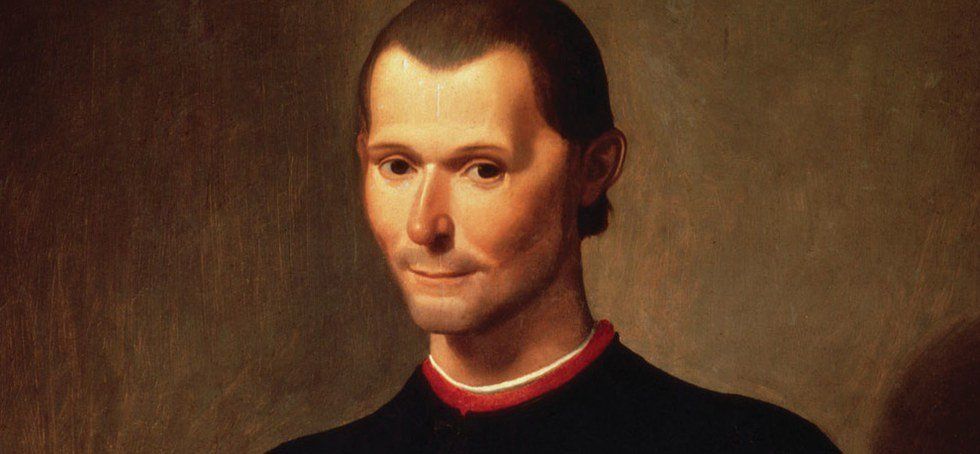
In the modern world of politics where each issue is as controversial as all the others, it is quite difficult to come to decisions without upsetting anybody. However there is a solution to the complex web of modern politics that each of us is entangled in. The solution has been proposed as far back as 1532: I am of course talking about the well known work, The Prince, by Niccolo Machiavelli.
The Prince itself talks about the ways of proper ruling from a ruler to his people, along with the dos and do nots of said ruler. The overall message of The Prince was the famous saying “the ends justify the means,” meaning that a ruler must do anything they must in order to preserve order and grow their society. Some of these means, however, were not pretty; beheadings, castrations, public executions, extended periods of torture, and ghastly instances of assassinations plagued the Italian renaissance politics.
Nonetheless, the message was still there, focus on your own people first, preserve the safety by any means necessary, and never bite off more than you can chew. Yet, the most potent message Machiavelli tells us is that the ethics of a politician must be far different than the ethics of a regular person. A politician must be able to build schools, hospitals, and libraries for the benefit of their people, as well as enact some laws that will, in the end, prove beneficial to those same people, despite its rancor. The politician takes on a completely new plane that is unknown to the civilian, and new platforms means new ethics for getting the job done.
In our time however, we may have progressed past the point of skull crushing and political prisoners (I hope), but there is a new frontier we must cross, that of letting politicians do their jobs. The recent elections of the United States has proven that people want a politician that can do the job, along with being a virtuous person, and you can’t have one or the other. Of course some qualities of candidates are more desirable than others, but what matters at the end of the day is how they perform the job.
One of the biggest questions Machiavelli asks is whether it is better to be feared or loved. The answer according to Machiavelli is to be feared above all. As Machiavelli describes humans as “ungrateful, fickle, dissembling, anxious to flee danger and covetous of gain” (Machiavelli, 60) it is necessary to have a good, strong leader, to bring his people together and unite them under one common cause. A politician may not be the nicest or the most approachable, but it is because of this same fear, that he unites his people, lest they go astray and subdue themselves to anarchy. Yet, they need not be so cruel as to cause his own people to leave them, a politician must find that delicate balance between good works and instilling fear; if one slits the throats of all his opponents and cuts taxes, it is going to have mixed results, but ultimately, it is the taxes that the people will most likely remember.
Yet, since we live in a democracy, where opinions are (questionably) freely expressed, there are bound to be opponents all around, nonetheless, a politician must still do their job. When it comes to the people they represent, they always come first, no question about it, whether they are a local politician, a representative, senator or even the president, that leader must do whatever they can to ensure that their people are safe at all costs, so long as there is a threat that exists.
Nonetheless, the politics of any given nation are nothing short of a difficult endeavor, where even the slightest mistake can be costly. That is why a politician must be firm, feared, and confident, as Machiavelli states:
“Since a prince is, then, is required to know how to assume a beastlike nature, he must adopt that of the fox and that of the lion: for a lion is defenseless against snares, and a fox is defenseless against wolves” (Machiavelli, 62)
A politician is a middle ground in what people want and what people need, and sometimes, those two concepts do not sync up. The politician should serve as a parent figure to their constituents, they may be kind and generous at times, but overall, they must be firm and respected before all. Obviously some politicians held up their task better than others, but the point still remains: a politician must govern with a pen in one hand, and a sword in the other.

















