According to Asma Khalid of NPR, “Millennials are the largest generation in the country [w]ith an estimated population of 83.1 million,” but time and again, they don’t turn out to vote, “partly because political campaigns aren't tapping into the potential power of young voters.” Candidates and campaign strategists are always trying to figure out how to win the youth vote. Social media has changed the way young people communicate. If there is a reliable connection between online popularity and ability to win a primary, it could advise future campaigns.
I was curious (and it worked for my poli-sci research project), so I created a database that I used to track the critical facets I identified of each candidate’s popularity on Facebook and Reddit, as well as a spreadsheet of primary and caucus results. I was expecting social media popularity to motivate young people to vote, which would increase voter turnout and boost the support of the candidate that best understands how to use the internet to their advantage, but online support does not necessarily motivate people to actually get out and vote.
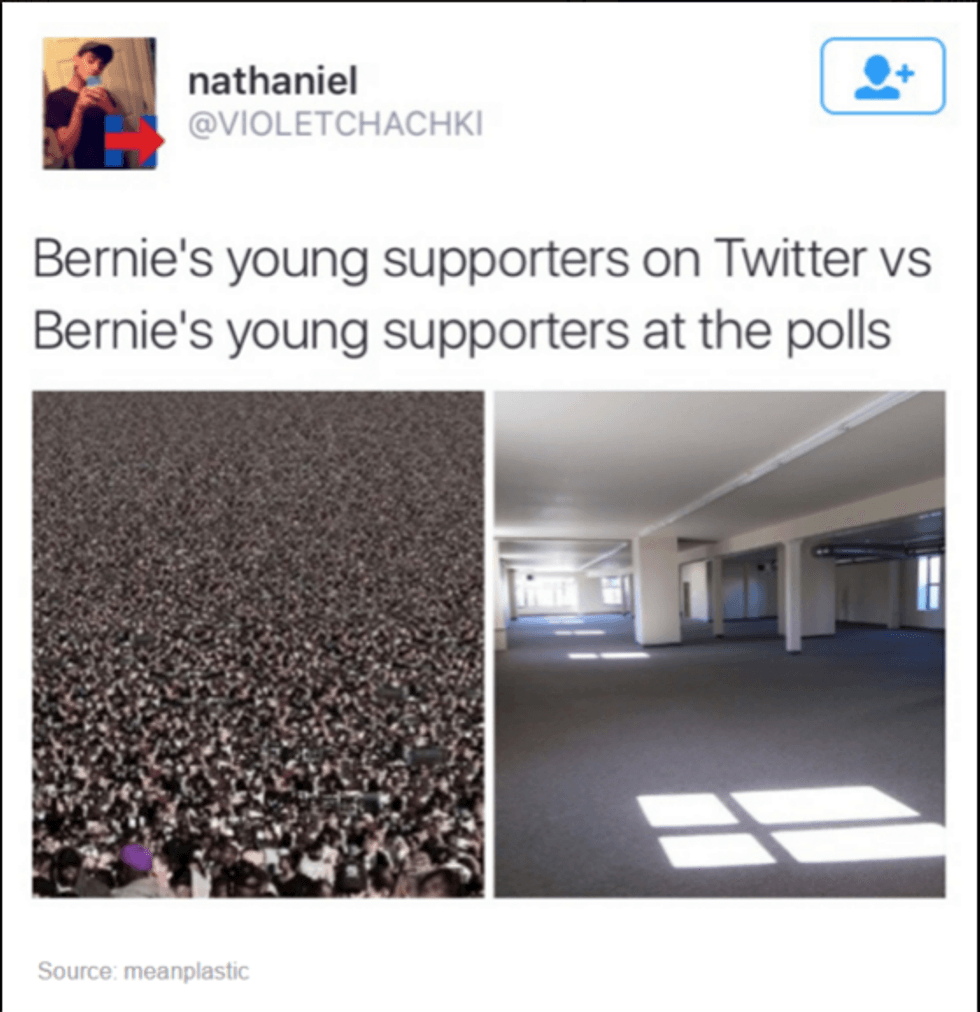
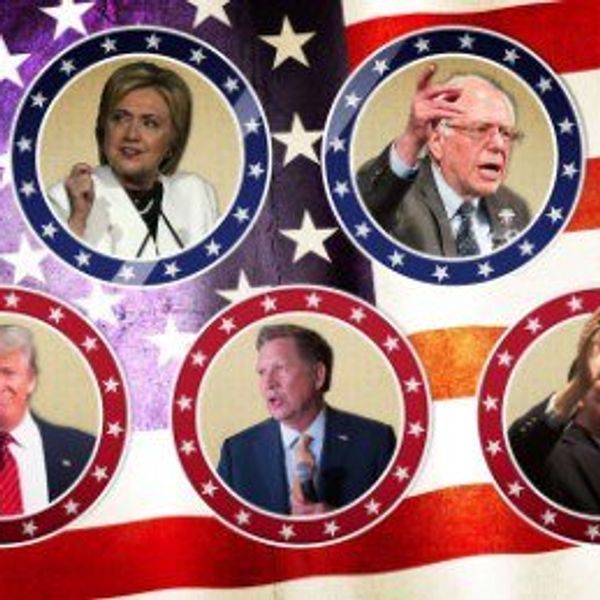
Currently, Clinton has more than 25 percent more pledged delegates than Sanders, and many see her as a shoo-in for the nomination. But, for an anti-establishment candidate originally polling at around 2 percent, Sanders is putting up a heck of a fight.
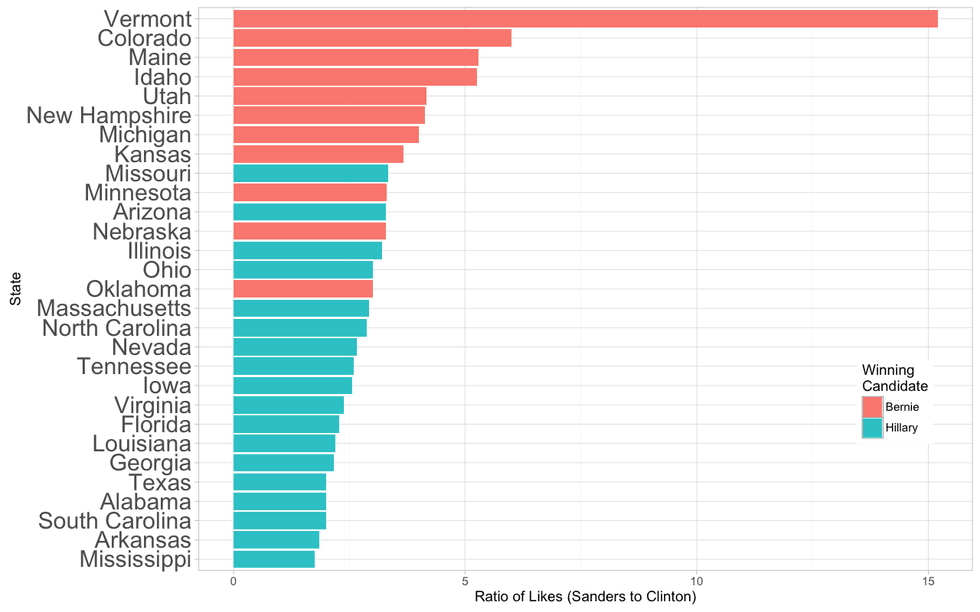
On Facebook, more people are “liking” Sanders than Clinton. In states where more people “liked” Sanders in proportion to Clinton, for the most part, he was winning more.
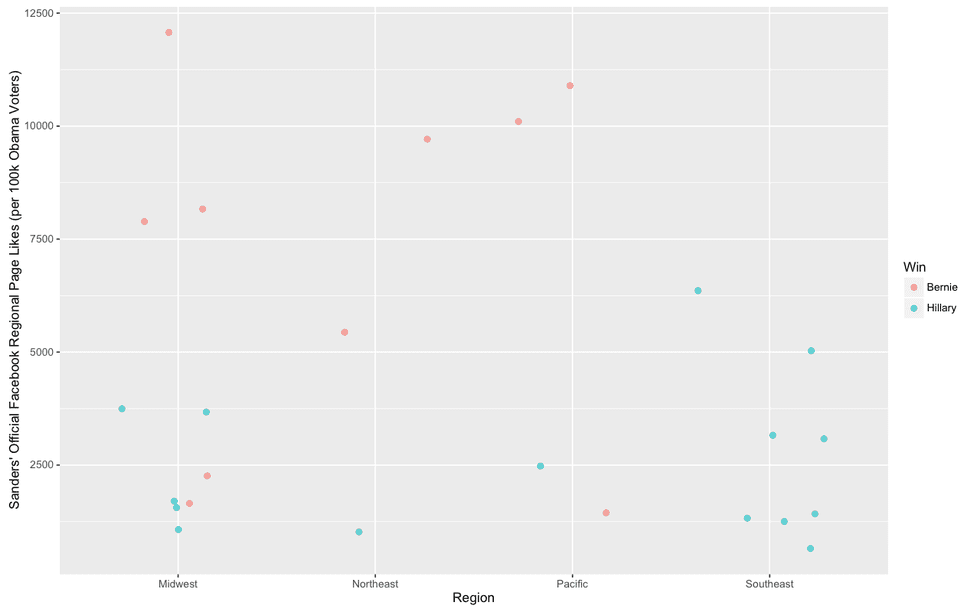
Sanders also has pages for different regions of the US — “Midwest for Bernie Sanders,” “Northeast for Bernie” and so on. I standardized the “likes” on each regional Sanders page to the 2012 Obama voters in states in those regions, essentially standardizing the “likes” to the Democratic electorate in each state. Except in the southeast, where Clinton’s political ties all but guaranteed her wins, Sanders’ wins correlated strongly with a larger proportion of regional page likes.
Looking at Reddit, there are a lot of Reddit pages in favor of Sanders, while certain pages that you would expect to support Clinton (like r/Hillary) actually bash her. Pro-Sanders pages have more readers and are more active than pro-Clinton pages.
Beyond this, among pro-Sanders pages, there is evidence of actual political participation resulting from Reddit. A Sanders campaign volunteer organized people to volunteer for Sanders before the Iowa Caucus, using the r/SandersForPresident subreddit. He called this “Operation Iowa,” and it resulted in hundreds of out-of-state volunteers canvassing and phone banking in rural Iowa to get out the vote.
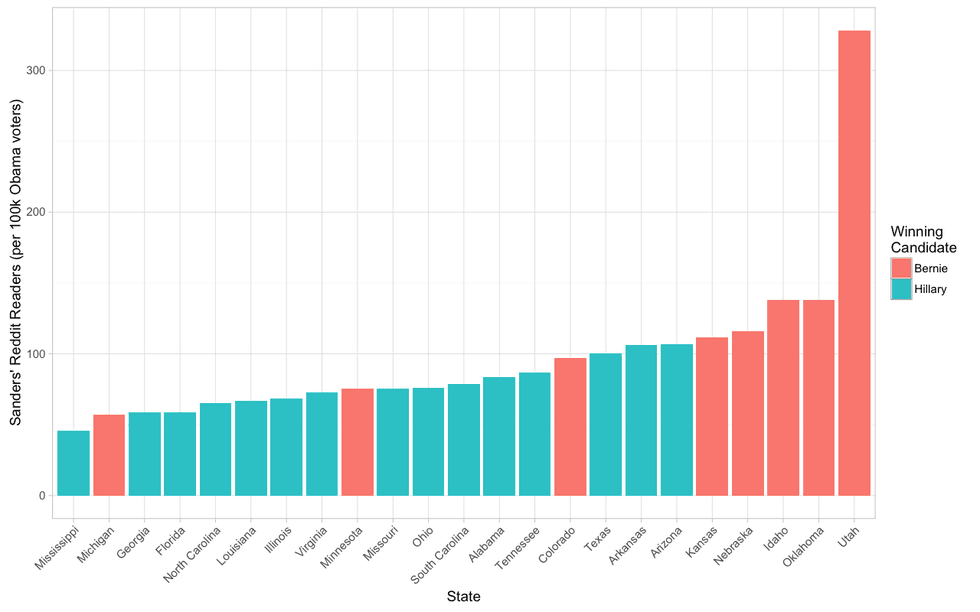
r/SandersForPresident has hundreds of thousands of readers, and it has subreddits for each state. Here we see that Sanders won states with a larger proportion of Reddit readers in comparison to the democratic electorate.
Sanders has also used Reddit for official purposes. He did an “AMA” (“Ask Me Anything”) to talk to his supporters about his campaign platform, kind of like a virtual meet-and-greet. Clinton doesn’t officially use Reddit, perhaps because it’s harder to control her image, and she wants to limit vulnerability and exposure. Unlike Facebook, Reddit would not allow Clinton to delete posts or comments on her page that she may not like, and because "upvoting" allows more popular material to become more visible, she would run the risk of having her official page flooded with negativity.
This is just one of the many examples of Clinton using social media in a more obviously calculated way. While Sanders comes off as a passionate, factual, cool candidate who gets young voters, Clinton’s official pages show an overwhelming attempt to look cool, but social media users aren't buying it.
Why does this matter? Reaching more people online can increase public interest. If a candidate can gain online support through forums that encourage participation — for instance, Reddit pages that promote volunteer opportunities — that can impact voter participation.
What does this mean for campaigns? It’s not black and white. Social media isn’t everything, but it does help. Candidates still need to be cool (and they can’t look like they're trying too hard). To succeed, a candidate's social media usage should be targeted to their audience, and it needs to offer easy ways for supporters to get involved in the campaign.