



Growing up as a girl, I have lived in a society to be ashamed and or self-conscious about everything. From my body, to my personality, to my values, everything about a woman is scrutinized. So of course along the way, I became a victim of low self-esteem. Granted, there are other issues I have faced that contribute to my self-esteem issues, but I know a lot of other women can relate to struggling to love themselves at some point or another.
But what I want to talk about is not just for women, but all people who have struggled or still struggle to love themselves.
We’ve all heard it from someone. Whether it was a friend offering advice, someone on television uttering the words, parents, a counselor, a romantic partner, and so on, most of us have heard this little piece of advice. And I’ve heard this more than once.
“You have to love yourself before you can expect someone else to love you.”
Hearing that sentence always put me in a sour mood in an instant. I have always hated that phrase and my hatred for it has only grown with age. I don’t know how many times I came home crying to my mom just because I felt so unwanted. I always felt like an outsider for some reason in any group of friends I had. I felt like the forgettable girl, the girl nobody wanted to invite to hang out or be part of the group that went to dances together; I had to try and do that for my own. I felt replaceable.
And then boys came into the picture around the dreaded age of 16 and that became a mess and a half of its own.
But I would come home and the conversation would somehow always steer into a way where I would hear that phrase. It was typically when I got hysterical and started bashing myself, calling myself horrendous things and probably becoming the biggest enemy I ever had to face.
“Jess, how can you expect others to love you if you can’t even love yourself, first?”
The question that always came to mind in rebuttals was, “How can I even love myself if nobody else wants me?” Hearing that made me feel hopeless. I’ve tried so hard to not beat myself up, to learn to fall in love with myself like I was always taught to do to try and make it in a society that was hell-bent on bringing me down. And when I failed every time, I was in a cycle. I couldn’t love myself, so everyone around me says nobody else can love me so much. Or in my mind, everyone hated me so I should hate myself like everyone else.
I even remembered giving that advice to my best friend when she had similar issues. Not because I believed it, but because that was what I was taught to say in those situations. I felt like I had been lying to her because I was so against believing that you had to “love yourself before others can love you.”
And maybe, just maybe, we really have been going about that all wrong.
Abraham Maslow was one of the greatest American psychologists of all time. He was famous for looking at people with psychological issues as people, and not their issues. But more importantly, he was known for hi theory, the hierarchy of needs. It was a diagram he created that is still used in countless professions, including my own: social work. The diagram looks a little like this:
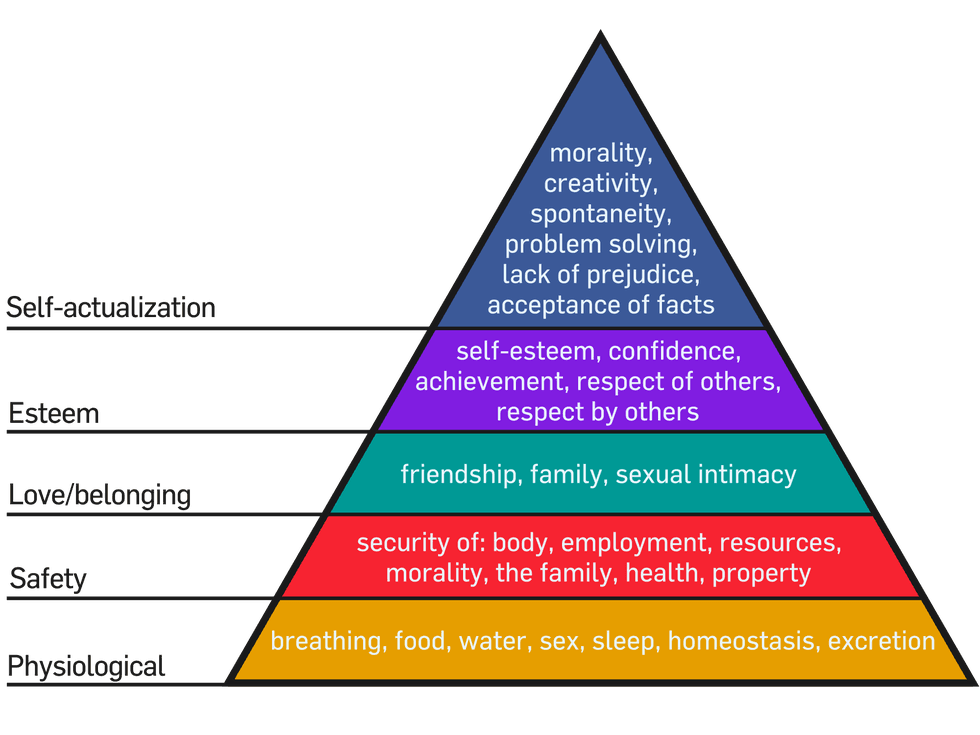
The theory believes that for a person to meet any needs at the top of the pyramid, one must have fulfillment in the lowest part of the pyramid, followed then by the second block, and then so on all the way up to the top.
So, one needs to have the basic needs for survival: water, food, oxygen, shelter, sex (in this case it’s purely for reproduction, not intimacy,) before being able to meet his or her own personal need for anything else in the pyramid. Then, that person needs security, whether to feel safe from the dangers of the outside world or safe enough to be comfortable with the people he or she is surrounded by.
If you look at the next two, it says the next need to be met is “love/belonging” BEFORE esteem comes into the picture. And for those who think it’s speaking primarily of romance, think again. It extends to friendships and healthy relationships with other family members.
And when you look at esteem which comes after that, it clearly states the respect for others and the respect BY others.
So why is it, we’ve grown to teach people that they have to love themselves before anyone else can love them, when it is very likely this is not the case? Could that be why I was never satisfied with that answer?
Maybe we need to look at the people who struggle to love themselves in a different light. We need to look deeper and see what the underlying issue really is. Are the issues completely internal, or are some of those people justified in their feelings?
















