
Since its 2011 inception, Ryan Murphy and Brad Falchuk's "American Horror Story" has been chilling viewers to the core. FX's hit horror anthology series always opens up to a new theme of perspective, whether it be a murder house, an asylum for the criminally insane, a coven of witches, a circus freak show, or a haunted hotel. But, unlike seasons passed, the show's sixth installment remained shrouded in mystery.
Every promo reel driving away from any singular theme -- leaving the audience in a constant suspension of guessing. Trying desperately to connect the dots; to find some sort of resolution among the madness of demonic babies, malformed monsters crawling out from heavy mists, eyeballs in mouths, and yes, the return of Asylum's most infamous unsolvable — aliens. The most straightforward of these leads being that of the insinuation that season six was finally going to morph these anthologies to one conglomerate mythology, as previously mentioned by Ryan Murphy in countless interviews, otherwise, there was seemingly no clear distinction in sight.
Season six was going to remain, as it clearly denoted in gory detail, a well defined question mark.
That is until this past Wednesday's premiere offered a subtle taste of what's to come. Sort of.
"American Horror Story: My Roanoke Nightmare"'s new documentary framing device is more than just a fun diversion from previous seasons. It's an invitation to unreliability. From the beginning, we're presented with two sets of characters telling overlapping stories. And what they're saying doesn't always add up.
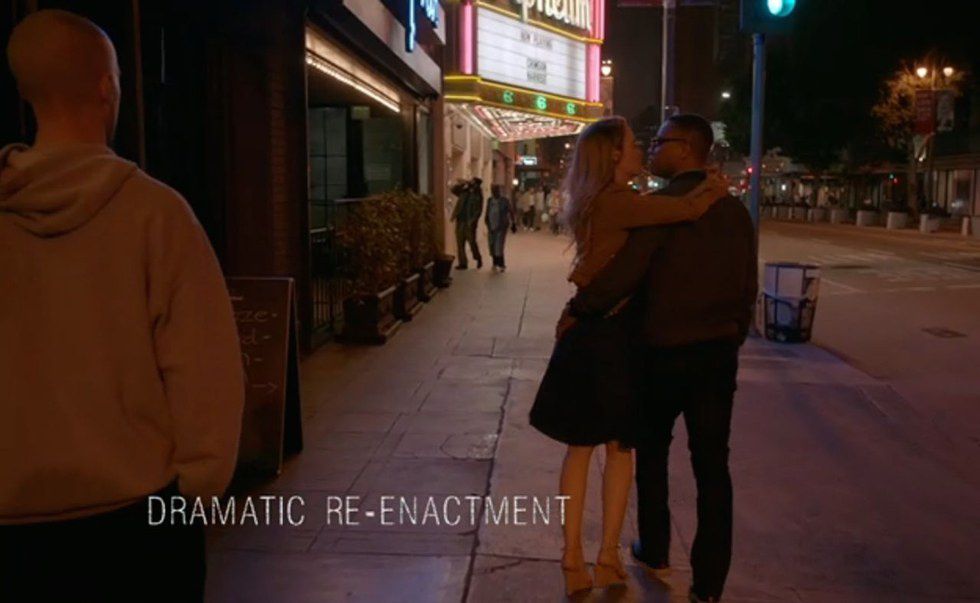
The most striking of these juxtapositions -- when the imaginary Shelby Miller (Sarah Paulson) begs her imaginary husband (Cuba Gooding Jr.) to believe her. Soliciting a very strong response, "Shelby. Absolutely not. No I believe you 100%. I'm sorry." Kneeling at her side, crooning his remorses, "I believe you, I believe you."
Only to have the real Shelby (Lily Rabe) cut through the recreation, "I felt so guilty, because I couldn't tell Matt the truth."
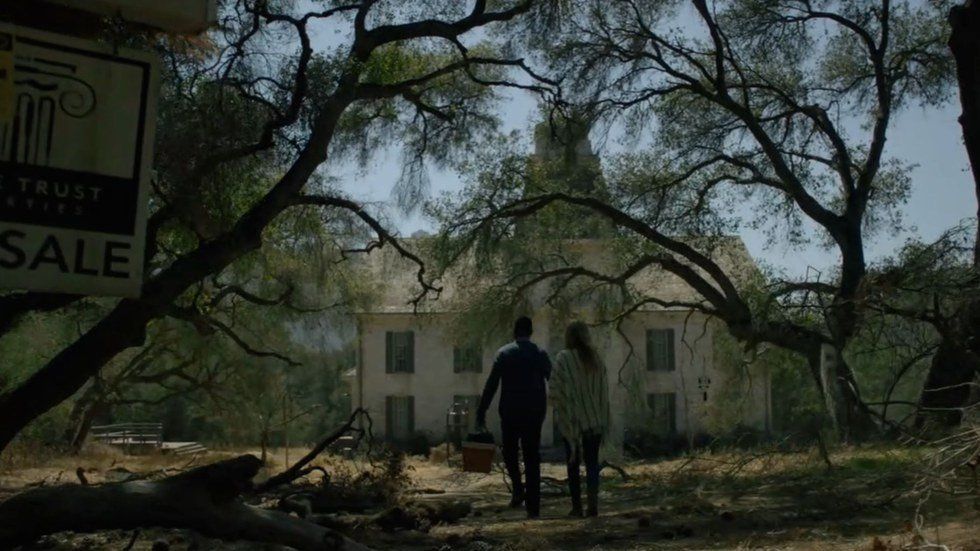
But the real Matt Miller (André Holland) has secrets of his own. Finding a dead pig laid out on their doorstep in the middle of the night. Choosing to bury it not too far from their new home as opposed to telling Shelby about the incident.
An air of disbelief leaving us hovering over the story. Trying to decipher the real from the fabricated. Looking to pull the truth from the self professed lies of our narrators. Trying to catch them in the constant game of cat and mouse they play with each other. To decipher just who is pulling the wool over the other's eyes.
But most importantly -- Why?
For a self professed "perfect couple," or at least that's what Shelby recounts, what cold divide inspired such deception?
Even in our earliest scenes it can be noted that the two hold a certain distance. There is a vivid lack of connection here, and not only because the real Millers are telling their stories separately, straight to the camera.
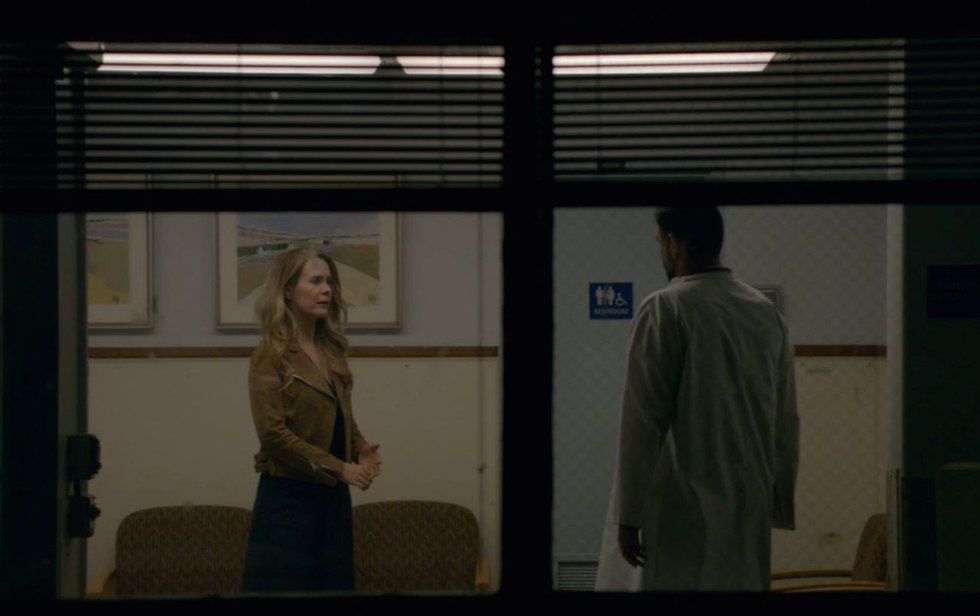
We see a schism set between our protagonists right off the bat. Even in the most climactic of our prequel retelling, as Shelby waits to see Matt after a freak gang related assault. In the hospital scene, Shelby sits alone near the edge of the frame, a broad, blank expanse of wall behind her. From another audience perspective, the camera watches her from an interior window. Even when the doctor emerges with an update, she is closed off, isolated.
The cinematography is going out of its way to present such a visual division.
We can't help but take it into account.
Despite the lighter moments, we also must keep in mind that this documentary frame allows for the question of conflation between reality and dramatic television presentation. A very striking commentary on the reality television business itself. Reminding us this isn't just a story -- but, a story within a story. Prodded into shape by participants and producers alike. A real life experience being forged into legend. 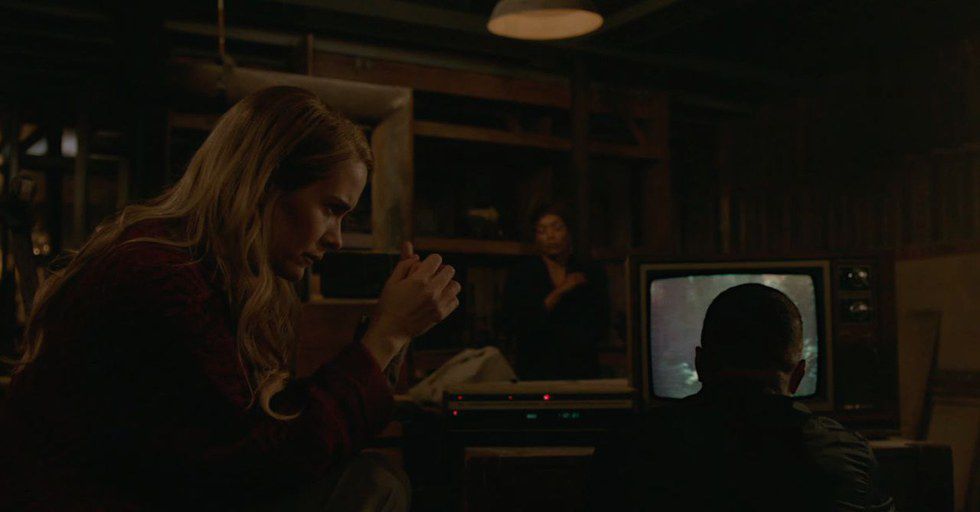
Alcohol and drug use even take a centric thematic hold on the story. Represented most vividly in the character of Lee (Adina Porter/Angela Bassett), a cop discharged due to a heavy addiction to not only alcohol, but prescription painkillers after being shot on duty. While Lee at present is sober, the full disclosure of her addiction backstory can't help but set off red flags. Especially with the openly expressed drinking habits of both Shelby and Matt. Out of sight of Matt, Shelby is constantly with wine glass in hand. Perpetually lipstick stained as she pours one after the other. While out of sight of Shelby, Matt pulls at a bottle of his own poison while in a hotel room for a business trip.
Pulling even more at the thread of manipulation and unreliable storytelling. Not only to each other, but to us... The audience.
Creating a whole different kind of horror.
Straining the psychological thread connection between characters and their recipients. Leaving us to question our own handle of faith in our narrators.
But, most questionable-- if such a heavy disbelief is built, if the tales ring true... Who's going to believe them? Not just in the moment of our retelling, but through to their future. Showing off the real toxin of reality television upon real life human beings. It turns them into an unreality. An unbelievable piece of corporate styling.
Even with the spooky happenings of raining teeth, raids by ghastly images of invading souls in colonial outfitting... Maybe the true horror is the mirror reflection looking back at us.