


They're terribly bleak to look at.
Three off-beige walls.
The depth and width of a broom closet.
Cheap foam shells on the walls, to dampen noise.
A decrepit, battered, but usable Yamaha upright to your left.
Beautiful Steinways next door, but inaccessible because you aren't in a piano teacher's studio.
Ahead to your left, a sad, slightly skewed music stand.
Beyond that—a body-length mirror, covered with dried flecks and mineral deposits left by the tears and sweat of uncounted multitudes of practicing sessions.
This is an example of a practice room—albeit one of the nastier ones.
Charming.
Yet beyond that cheap teal-green carpeting, chipped paint, and wire-reinforced windows, I see a safe haven. The spartan setting and underground nature of my practice room weeds out the usual distractions—text messages, GroupMe summons from all the people from your entry or campus organization, Snapchat notifications from your best friend from back at home/cousin/old sweetheart, endless pressing emails to respond to from what seems like all the faculty, Student Organizations, and clubs all at once. There's no laptop that beckons to a bottomless void of Tumblr-surfing, Vine compilations, news articles, blogs about just about anything by anyone, or my personal weakness, XKCD. There's you, your sheet music, your instrument, a clock. Nada mas. Bare. Elegant.
(a fair example) 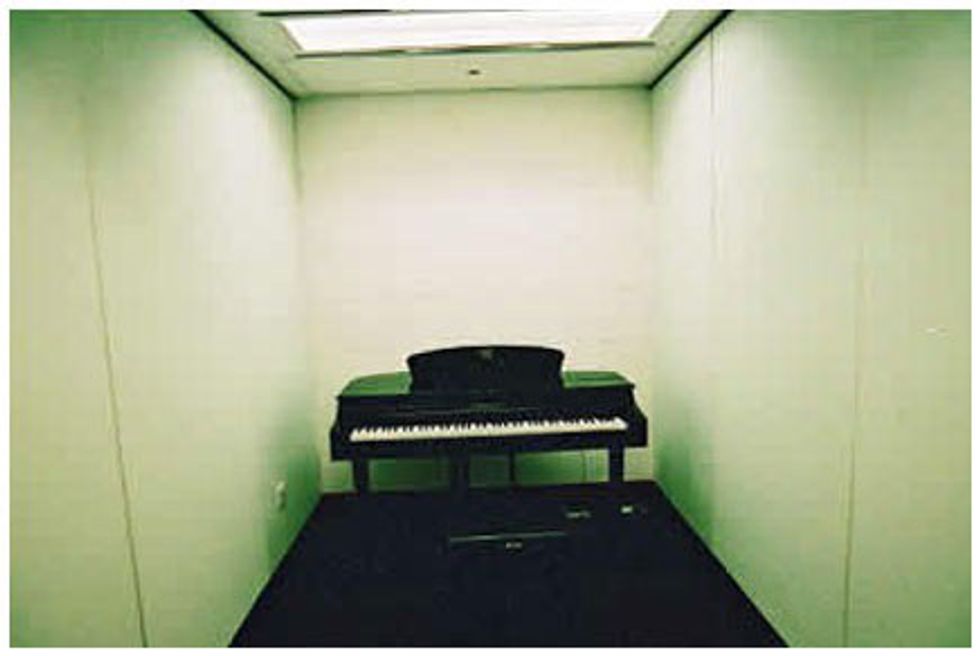
I often flee to the practice room to escape my surroundings. Within the walls of my refuge, there is room only for my soul, and my sound. The outside world is set aside for the moment, and I am left with my work, my turbulent emotions, and an outlet. I often spend hours alone—B.O. gets real, my ears ring, my fingertips become rough and callused, but I am content. There is no room for others here.
For introverted music students like myself at a middling-size private liberal arts college, this is a haven for productivity, self-improvement, and growth. In the common rooms, suites, and rooms of freshman housing, privacy is an elusive thing—the doors are so thin, I can hear everything but whispers two rooms over and feel footsteps one floor above and below me. In stark contrast, the basic etiquette of the practice room prevents random strangers from barging through your zone, oblivious to the sudden turbulence left in their wakes. In this bubble of safety, many do homework, compose, and rehearse late into the night, and have to be evicted by building security in the dead hours of the early morning.
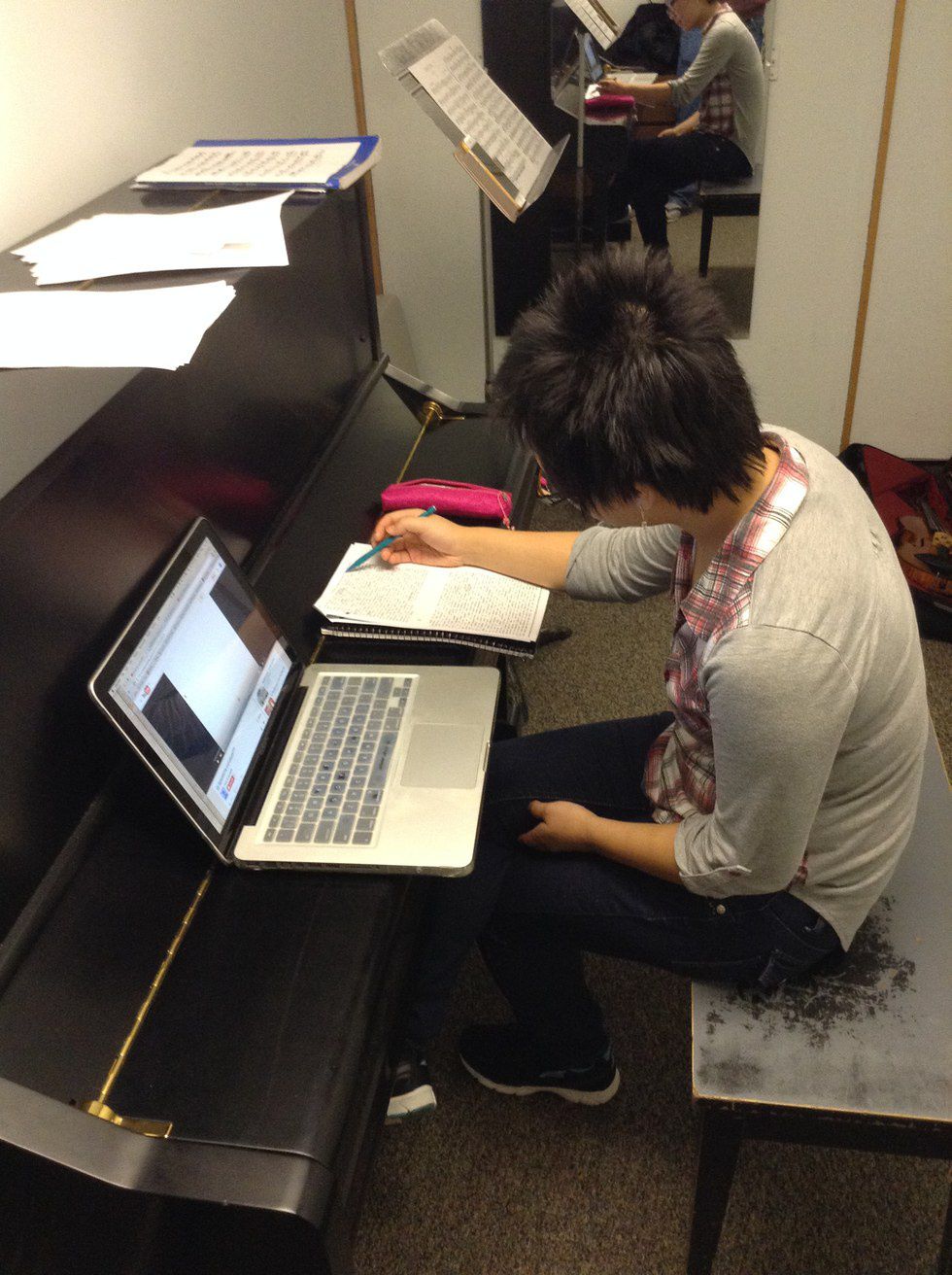
(Shostakovich and Russian homework pair well on the practice room palate)
In an environment nearly devoid of external stimuli, it becomes extraordinarily easy to buckle down on your work. Your breathing and heart rate are nigh-audible; time jumps forward in jagged breaths, and hours can pass in what feels like 15 minutes. Your strength eventually flags, but when you step back, you see just how much you've improved. Every session you spend in the space re-forges your self-discipline and determination to exceed who you are now, and explore how much you can grow. The practice room is a place to focus on and hone character—not just the mere technical and musical aspects of playing an instrument.
Despite their blemishes, odd smells, depressingly low ceilings, and sickening fluorescent lighting, house centipedes (hello, winter), veneers of rosin dust, and finger-yellowed piano keys, practice rooms are and always be a place for seclusion, contemplation, and self-improvement.
Time to head back, now.















