
Almost 50 years after the 1967 Supreme Court case Loving v. Virginia, which legalized interracial marriage across the U.S., the historical drama film Loving was released into theaters in Nov., 2016. Based on the true story of the marriage between Richard Loving, white, and Mildred Jeter, a woman of "mixed African and Cherokee heritage," the film highlights a major civil rights victory: the basic human right to love, regardless of skin color. Loving pulls on the audience's heartstrings while at the same time focusing on a case that increased marriage rights, threatening a sacred tradition of marriage that people held and continue to hold dear.
While the film informs, entertains, and invokes the audience to think about and perhaps form more positive perceptions of interracial couples, newspaper coverage of Loving v. Virginia functioned not only to inform the intended audience, but as a tool to spark social change. Six articles published before, during, and after the Supreme Court ruling shows how press coverage and public perceptions of the legalization of interracial marriage changed over time.
1. The Afro American (1928)
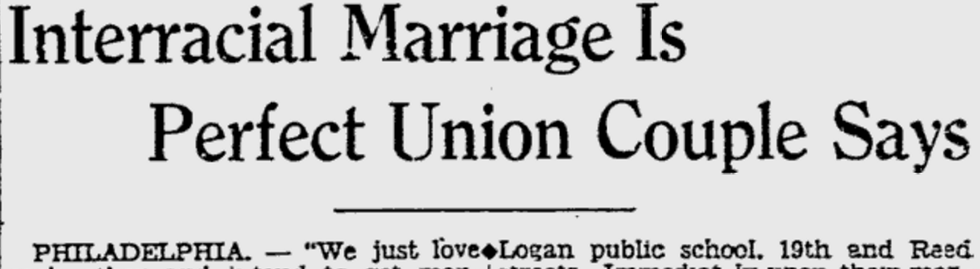
In 1928 The Afro American published "Interracial Marriage is Perfect Union Couple Says." Since the case for the legalization of interracial marriage was often perceived as a black civil rights victory, it makes sense that The Afro American, which targets an African American audience, used a headline supporting interracial marriage. The article is heartwarming, opening with a quote from a loving couple: "We just love each other and intend to get married despite criticism." Interracial marriage was legal in Pennsylvania, so the couple featured in the article legally married in Philadelphia.
The beginning of the article largely focused on the appearance of Miss Matilda A. Yockel, noting that she was "described as pretty and unusually refined," and the journalist strangely identified her race as white without identifying the race of her husband, Alfred O. Hodge. Hodge is assumed to be African American because the article is evidently about an interracial marriage, and because it was printed in The Afro American.
While the first half of the article focuses on "Love Romance" the rest of the article, under the subheading "Married before," oddly emphasized the fact that the African American man, Hodge, was previously married. The race of the woman he was married to prior was not mentioned in the article. The end of the article states that Hodge was previously divorced after four years of marriage to another woman, implying that this marriage would not last either. Though the article begins on a positive note, the ending is rather negative to a 21st century reader.
2. Prescott Evening Courier (1947)
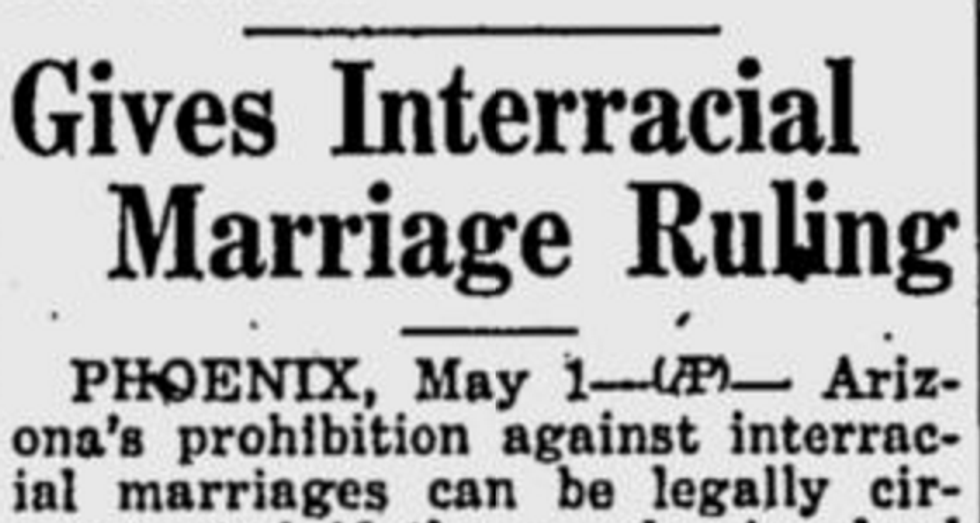
An article written in the Prescott Evening Courier 20 years prior to Loving v. Virginia discussed interracial marriage laws in Arizona and how couples could have circumvented these laws. The article, "Gives Interracial Marriage Ruling," states that according to Attorney General John L. Sullivan, people could have married in a different state to avoid Arizona's miscegenation laws and "live in a married state in Arizona if the ceremony was performed in another state where it was legal." While this may have been successful for couples who lived in Arizona, Richard and Mildred Loving took these exact steps by marrying legally outside of Virginia and were arrested when they returned to their home state.
The article used outdated language, which could be considered highly offensive today: "Under Arizona law, the marriage of a person of Caucasian blood with a Negro, Mongolian, Malay or Hindu is null and void." A clear contrast can be made between the wording "a person of Caucasian blood" and the one-word terms used to label people of other races and ethnic groups, which do not include all of the races, as not everyone would fit into those racial categories. The terminology "A person of Caucasian blood" indicates the person first, followed by their race, while the other derogatory terms combine the person and the race of the person into one label.
3. Herald-Journal (1965)
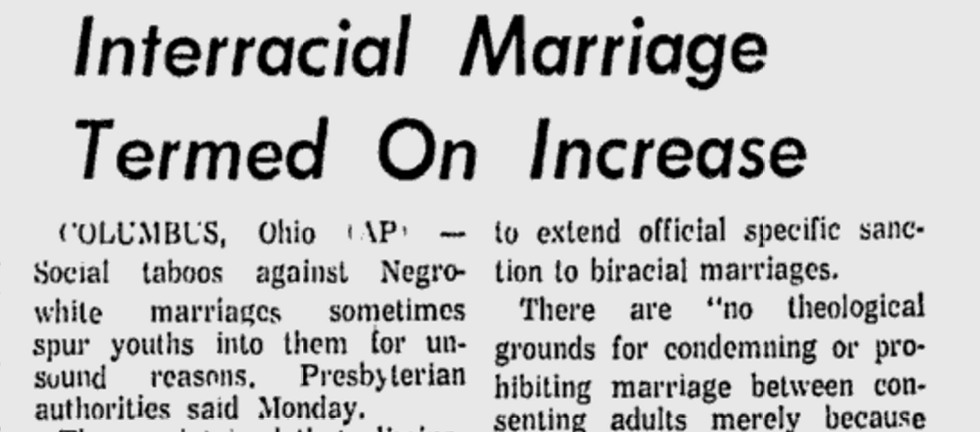
Another article that used racially offensive language, "Interracial Marriage Termed on Increase," was published in the Herald-Journal in 1965. The first sentence of this article, a quote by Presbyterian authorities, states: "Social taboos against Negro-white marriages sometimes spur youths into them for unsound reasons." These authorities implied that the elimination of such taboos would be beneficial in reducing these "artificially motivated marriages," reflecting a negative perception of interracial marriage. The quotes suggest that these Presbyterian authorities felt threatened by a change in the institution of marriage.
The article also recognized that interracial marriage was becoming more common (hence the title) and that social acceptance increased on a daily basis: "the problems of social acceptance are 'less today than they were yesterday and they will be less tomorrow than they are today." To conclude the article, the journalist clarifies that the Presbyterian church held that there was no theological grounds to condemn a marriage based on race though it did not appear that the Presbyterian authorities who were interviewed recommended interracial marriage, especially in youths.
While all three of the above articles published before Loving v. Virginia expressed positive public perceptions regarding interracial marriage, there appears to be an underlying tone that interracial marriage is difficult, "artificially motivated," and out of the norm.
4. NY Times (1967)
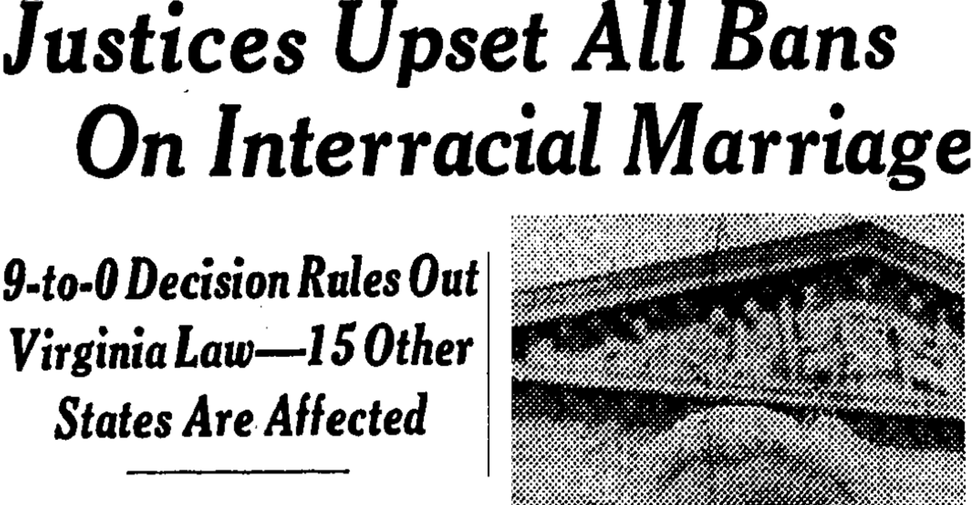
Published by the NY Times a day after the Loving v. Virginia victory, "Justices Upset All Bans On Interracial Marriage 9-0 Decision Rules" contains a detailed account of the Loving v. Virginia Supreme Court ruling. The article contains sufficient background information and relates Loving v. Virginia to court case rulings of previous civil rights movements, such as Brown v. Board of Education, in which Chief Justice Warren also declared the segregation of public schools illegal in 1954.
The journalist, unnamed, appeared to express bias against Chief Justice Warren. Warren. Instead of consistently mentioning how the decision was unanimous, the journalist kept referring to the Chief Justice in terms of his "opinion" and the prior reasoning that "he rejected." For example, the second sentence states: "The opinion by Chief Justice Earl Warren was directed specifically at the anti-miscegenation laws of Virginia." Another sentence reinforces this point: "Chief Justice Warren completed the process that he set in motion with his opinion in 1954 that declared segregation in public schools to be unconstitutional." The latter sentence makes Chief Justice Warren appear to have had a set agenda and his own opinion that may or may not have contrasted with the opinions of the majority of the U.S.
Overall, the article was written with a informative tone. It did not express excitement for the Loving v. Virginia court ruling, as it announced the victory in an factual tone: "The Supreme Court ruled unanimously today that states cannot outlaw marriages between whites and nonwhites" (Justices, 1967). Similar to articles written before the national legalization of interracial marriage, this article also used outdated terminology to describe Mildred's race, but the term "negro" was deemed correct and appropriate until the 1970s in the U.S. Though the language is outdated, it may not have been intentionally racially offensive.
5. Los Angeles Sentinel (1967)
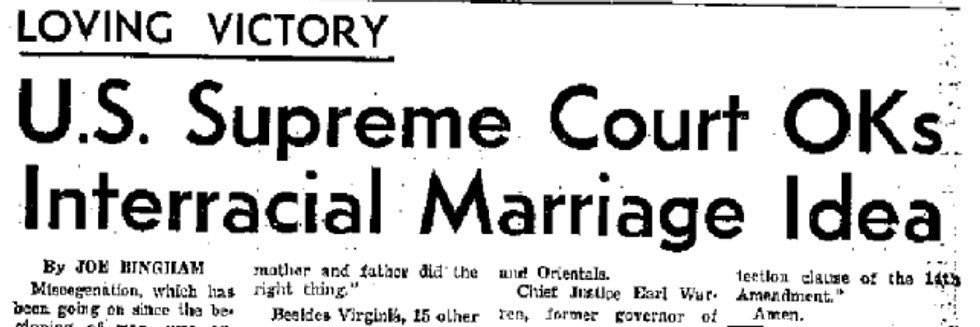
"Loving Victory: U.S. Supreme Court Oks Interracial Marriage Idea," published by the Los Angeles Sentinel at the time of the Loving v. Virginia ruling, expressed a more normalized outlook on interracial couples. The article belittled the Supreme Court by introducing the idea that marriage isn't something that should need approval in the first place, as the author wrote "Miscegenation, which has been going on since the beginning of man, was approved this week by the Supreme Court."
In addition, this article contained heartwarming quotes directly from the Loving couple, who said "'We don't know what we will tell the children … but we know that they will be happy that their mother and father did the right thing." Unlike the previous article published by the NY Times, Joe Bingilam,the author of this article, was not afraid to place his own opinions and positive outlook throughout the piece, ending the article with "Amen."
6. St. Petersburg Times (1979)
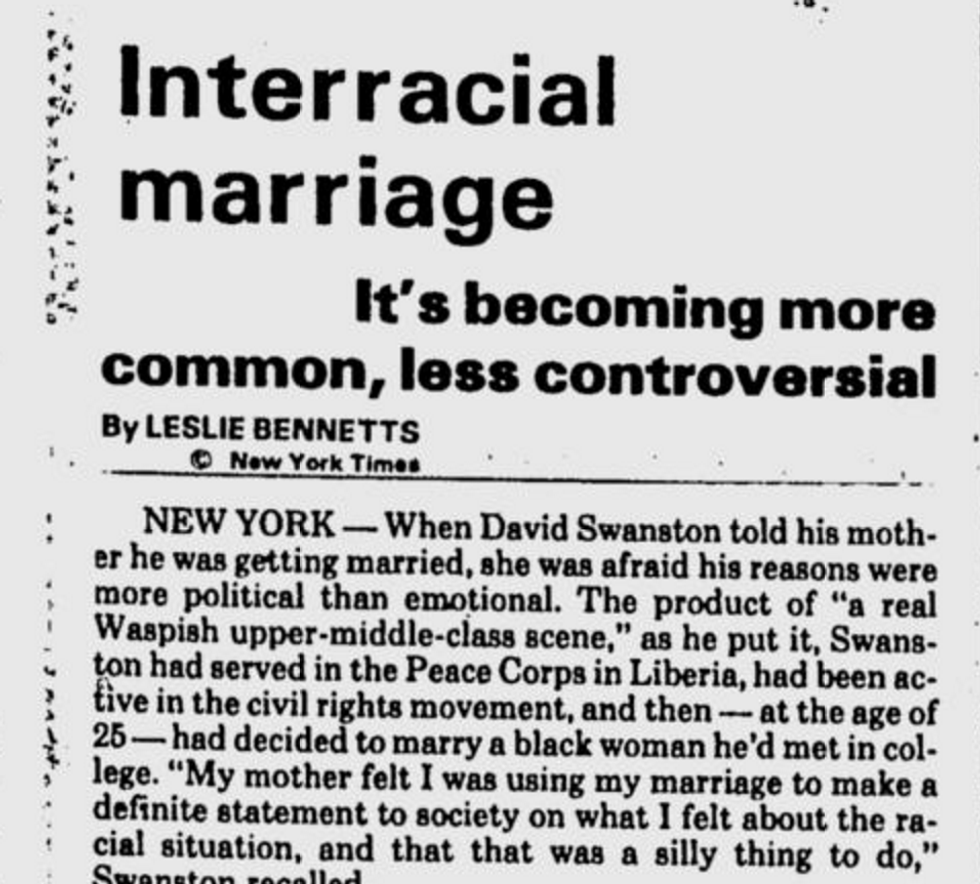
Over ten years after the ruling of Loving v. Virginia, interracial marriage was becoming more accepted by the press and society. This is evident in the article "Interracial Marriage: It's Becoming More Common, Less Controversial" published by the St. Petersburg Times. The article began with a personal account of David Swanston, who served with the Peace Corps in Liberia and was getting married to a black woman he met in college. His mother feared that her son was marrying for political over emotional reasons for marriage; she feared he was trying to make a radical statement of acceptance. David married his wife in 1968, and they had two children together. His mom claimed to be very close with his wife, but it appears that it took her time to warm up to the idea of interracial marriage, that it was not something initially acceptable.
A strange remark from the journalist was: "Actually, what negative responses the Swanstons have experienced over the years have more often come from blacks than whites." This racially offensive comment did not quite capture what was actually quoted by the couple.Overall, the article is very positive and pulls on the audience's heartstrings by bringing in direct quotes from other interracial couples as well. The author addressed common fears and concerns of interracial marriage of the time period and attempted to reassure the audience by using emotion to calm their concerns.The Swanston's said there was no radical difference between them, and that race was not an issue in their relationship. The couple felt that southern states may have been more opposed to their relationship.
Toward the end of the article, the journalist offered statistics that showed a 92% increase in interracial marriage since 1970, though it is unclear if this is because interracial couples could finally obtain a marriage certificate legally or if interracial marriage was actually becoming more common.
In conclusion, the media facilitated the progress of the acceptance of interracial couples throughout print coverage of Loving v. Virginia. News coverage of the portrayal of interracial couples changed throughout the 1920-1970s, and although stereotypes may be reinforced in the media, the press also has the ability to dispel common stereotypes. The use of personal accounts and quotes in news articles were especially influential in spurring social change necessary to grant the freedom to love and marriage regardless of race.