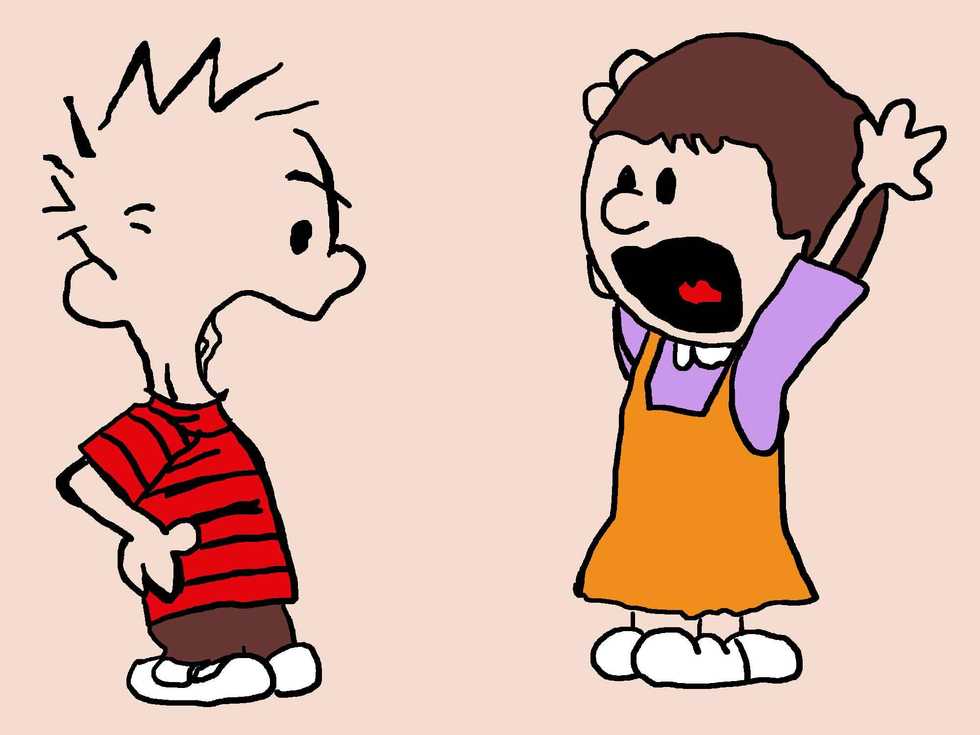
“Aggression only moves in one direction - it creates more aggression.”
This week I had a discussion with my roommate on the hardwood floor of his bedroom. He had originally invited me in to sell me his used clothes, complete with pre-made outfit deals. He opened his closet doors to a twinkling of Christmas lights that lit up every shelf in the closet that was stocked with organized and folded clothes. He paraded around the closet, his entrepreneur knob turned all the way up to “Desperate Used-Car Salesman” and his sashaying knob cranked to “Vanna White.” Despite his best efforts he couldn’t convince me to buy any of his clothes, but he did convince me of something more important than any material item.
I had just arrived home from a long day of work and was exhausted. It was Wednesday and I was firmly stuck between the restful weekend of days past and the relaxation of the weekend to come. I had just read that day about Mark Zuckerberg’s crusade to bring all 7 billion people on the planet to Facebook and was appalled at that news. I, the Luddite that I am, offered a boisterous argument for why I disagreed with Mr. Zuckerberg’s behavior. My friend, a pragmatist, offered well-articulated points for the benefits of the whole world being on the internet. Despite this, images of “Terminator” and “The Matrix” kept percolating through my high-strung but low-functioning brain. We both put forth our positions, considered the other, but didn’t budge.
I’d like to say that the next day I woke up after a full eight-hour rest, refreshed and optimistic to see all seven billion of us on Facebook. What wonderful conversations I’d have with people from the ice-tundras of Antarctica, the scorching heat of the Sahara. I could Skype with the Pope and see the Vatican! Instead, I had a nice round FIVE hours of sleep and no such fairy tale existed. I shuffled off to work, juiced up my body with caffeine, and was off to the races.
Lunchtime comes and I’m talking to a coworker about Dave Chapelle’s new Netflix special, which leads to talk of Bill Cosby (the centerpiece of the special), which leads to a conversation of Donald Trump, which THEN leads to us talking about the sexual assault allegations that surround both Trump and Cosby. My coworker puts forth his position that the women were trying to tarnish Cosby and Trump’s names.
This is a coworker who I see for about two minutes every day: a consistent presence but not a relationship that has had much time together. When he says this I’m offered with two options. One is to nod in agreement and end the conversation, the path of least resistance. The other is to put forth my own position because I don’t agree with that stance. So my question becomes “Do I risk upsetting my coworker because I disagree with him?”
And this is a question I often find myself asking: is it worth saying something when I disagree with someone? And there are two worlds this question pops up: online and in-person. Digital reality and, well, reality.
In digital reality, I don’t think twice. Like a horny guy at the bar, I jump in head-first to any situation of arousal I can find. You have a political opinion different from mine? Do you disagree with my opinion? Are you taking yourself too seriously? In the words of The Doors, “Come on Baby Light My Fire.” I’ll dive in head-first to an argument you wave in front of me.
But that’s the internet where there is anonymity and zero consequence for my actions. No one knows me and I don’t know them so why not ruffle some feathers? It means nothing to me because the person behind the username means nothing to me. There’s not even a face, just a concept of an idea of a person whose entire identity is being drawn crudely by me based on one. Measly. Post. That’s the digital-reality disagreement.
In actual reality, things are different. To start with, if I mouthed off like I did online I’d get slapped down by the person I was talking that way too. And for good reason. You cannot escape the physical intimacy of an in-person conversation and it’s effect. It’s why asking a person out face-to-face, even if I bumble my words, is much more effective than any perfectly formatted text message I may be able to conjure up. There’s a danger to face-to-face conversation, a real and inescapable humanity to it.
In real-life conversation, there are also two human beings present with faces, lives, and imperfections. It’s not, as it is digital, a username/avatar/profile that supplements defined characteristics of human beings, entities that are as far from understandability as the layout of an IKEA.
With this coworker, I also have a built-in relationship that contextualized that conversation. He knows my life, I know his, we make office jokes, and we certainly respect each other more than if we met online in some chatroom with our usernames as “dingusbreath69” and “Dr_Doggo45.” I’ll let you guess which one I am.
So with the real potential of being hit if I mouth-off and the respect I have for my coworker enough, I now had one last question regarding if I should disagree: will my disagreement upset him?
Our species has waged too many wars to say we were ever good at conflict resolution, but I will say that we’re making our conflicts more ideological ones than we used to. Wars used to be fought over just money and power. Our country has had a tradition of fighting ideological wars, the newest one taking place on the internet where we burn bridges every day over disagreements over politicians, abortion, and race. But, as a pacifist, I would prefer to avoid warfare, though I’m not convinced we can as long as we succumb to our animalistic emotions. So, in response, here are recommendations from Children’s Health Magazine to a group of people that often use their fists to resolve conflict: children. Exactly what we are on the internet:
- Don’t Make it Personal. (You know, like when you start talking about people’s mothers).
- Avoid Putting Down Other People’s Beliefs. (Bill Maher, I’m looking at you)
- Use "I" statements to communicate how you feel, what you think, and what you want or need. (I feel like I project my insecurities by always saying “WE” to frame my opinions)
- Use "I" statements to communicate how you feel, what you think, and what you want or need. (I feel hungry and am going to get the new Burger King© Chicken Fries (this post sponsored by Burger King).
- Stay Calm. (You know, like all those freaking posters from 2008 that reminded us to “Keep Calm and Carry On”?)
I now had to either respectfully disagree with my coworker or keep my mouth shut. As my palms became sweaty, my knees weak, arms heavy, and my shirt covered in vomit from spaghetti my mom sent me, I opened my mouth and respectfully disagreed with my coworker. And, we had a thoughtful conversation that ended with us having a good laugh, both of us seeing where the other member was coming from in the disagreement and finding some common ground.
After work that day I arrived home, my roommate I had disagreed with the night before already home. I step in and he asks how my day was. “Well, after our talk last night I realized I was projecting my own anxieties about the the internet onto my opinion of Zuckerberg’s attempts to ‘internet-ize’ the world,” I told him. “I realized I was being a grumpy old-man and when I did I was able to lighten-up.”
“Well,” he says, “I hope I didn’t come-off that I didn’t value your opinion or respect it last night. I know where you’re coming from.” And I think that’s the heart of this argument for me: a disagreement can be healthy if it’s approached from a place of respect. I’m lucky that my roommate and I have been friends for four years and at this point respect one another. There was always a worry to me that disagreeing with someone was a sign of disrespect, that if you disagreed with their opinion you were dismissing them. Now I realize that telling someone you disagree with them is the biggest sign of respect you can offer someone. It means you care about them so much that you’re willing to question what they believe because you feel it’s getting in the way of them seeing life in a more enlightened light. There’s nothing bad with disagreement if you’re open conversation: you’ll either defend your position well and have that opinion strengthened or you’ll view that issue with a different opinion but one that takes more into account than you did before.