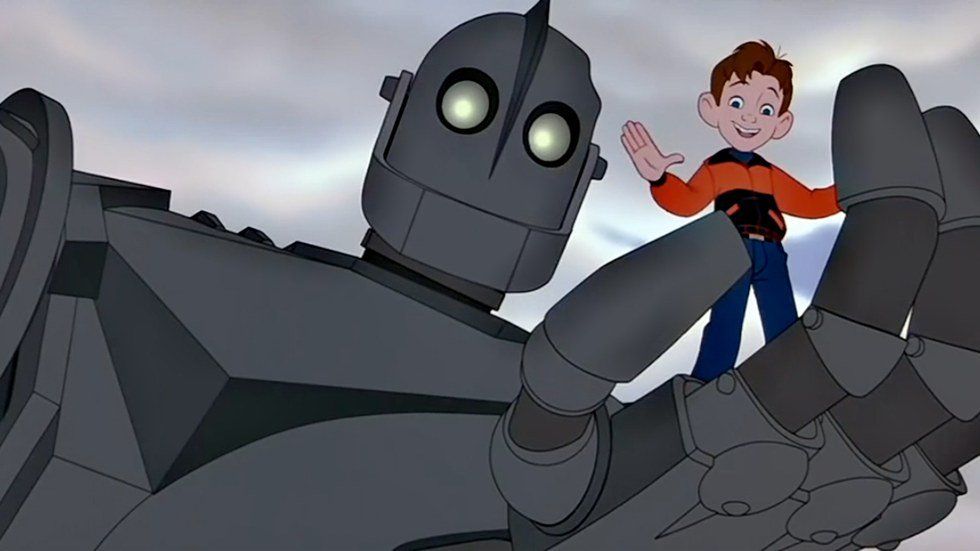
One of the most talented people working in the world of animated film these days is director Brad Bird. He is the man behind such classics as Pixar's "The Incredibles" and "Ratatouille." However, one of his best films was also one of my favorites growing up as a child: "The Iron Giant."
"The Iron Giant" was a film that I watched constantly as a child alongside my other childhood favorite "Toy Story," but that's a topic for another time. To this day I still love its characters, humor, animation and story (it also doesn't hurt to have a giant robot with lasers and the ability to fly; what seven-year-old wouldn't like that). While re-watching the film recently, I stumbled upon another quality about the film that I had never noticed as a child. The film subverts very common archetypes and cliches found in many Hollywood films.
The first time I realized this was during the climax with the character General Rogard (voiced by John Mahoney). If one were to judge Rogard on face value it would be safe to assume that the man is an overly-aggressive military leader who would rather act through aggression and violence rather than skill and tactics. When the audience is first introduced to Rogard, it is over the phone while he is at home. He sits in a large chair with a mounted buffalo head behind him. He drinks alcohol while watching a black-and-white cowboy show on his T.V. He wears his general uniform at all times, has a traditional military buzz-cut, and usually has a scowl on his face. On the surface, one could suspect him of being an aggression minded "military jerk" that are often used as antagonists.
Such cliche antagonists have been used often throughout Hollywood. The best example I can think of is Colonel Miles Quaritch (Stephen Lang) from the film "Avatar." Quaritch is an overly aggressive military minded person who sees brute force as the only way to solve the problems with the Na'vi. More recently a film like "Pixels" (you know — that Adam Sandler abomination) had this cliche bully of a character (played by Brian Cox) who was so unreasonable that he actually contemplates whether letting "nerds" save the world is better than being defeated by the aliens. Yet despite the setup for another military bully, I noticed Rogard is the farthest thing from that cliche.
Sure, he fires on the Giant when he first sees it, but that's understandable (if you saw a hundred foot metal man stomping around you would probably shoot at him or be like me and run away scared). However, Rogard does not come across as a "military jerk" in the climax. When the Giant transforms into a giant destructive weapon that rampages through the town, Rogard is reluctant to use an atom bomb to stop him. It is only after the true antagonist, petty government agent Kent Mansley (Christopher McDonald), tells him they could lure the Giant away from the town and then fire the bomb. Also once the Giant (voiced by Vin Diesel) shows he is not a threat by presenting his friend, a human boy named Hogarth (Eli Marienthal), is alive and was not killed by the Giant, as Kent led them to believe. Upon learning this Rogard orders the troops to stand down. Rogard is still a military leader, but through his actions we also see a multilayered human being who is capable of caution and can be reasoned with.
Hogarth's Mother (Jennifer Aniston) also subverts the typical idea of a mother in the 1950's. Instead of a stay-at-home domestic housewife who cooks and cleans for her "nuclear family," she is a widow who struggles working long shifts at the diner and raising Hogarth alone. These subversion give the characters extra layers of dimension and allow us to relate to them better. They feel more human and real. "The Iron Giant" stands as a proud example using cliches and archetypes as foundation to build more human characters on. It also has a wicked cool robot that can fly.