
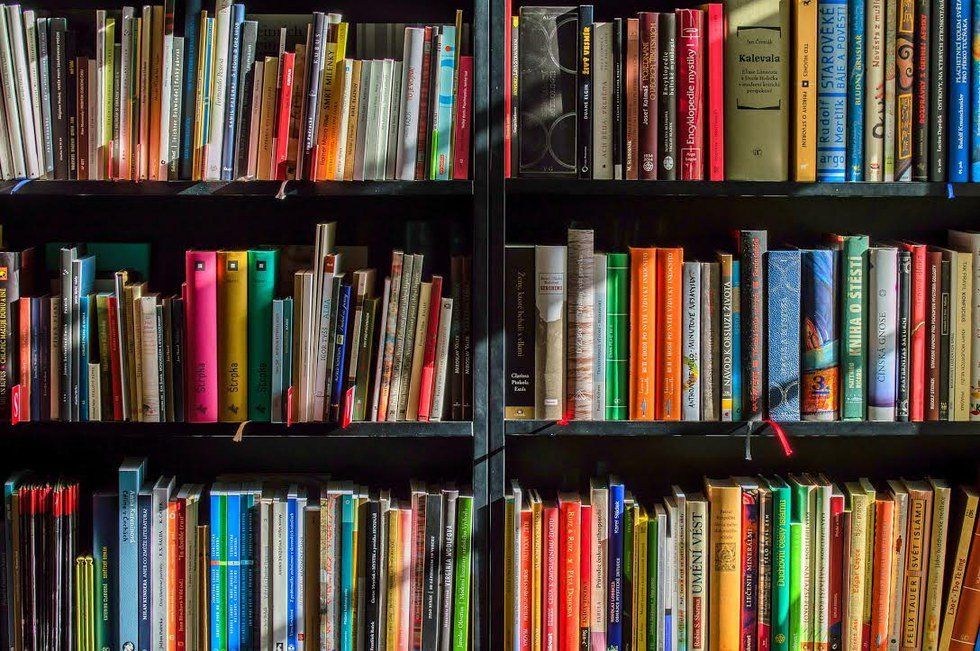
Bookstores are spiritual experiences. That isn't hyperbole. When I say "spiritual experience," I mean something that takes you out of your mundane life, your habitual ways of thinking about and perceiving the world around you, your convenient sense of self and your everyday concerns. Spiritual experiences happen, of course, by accident from time to time. However, we don't have many ways to deliberately induce them that don't involve drugs.
Places of worship are supposed to do this, to be a space where you can momentarily feel free to connect with and contemplate transcendental truths, rather than your bills or whether or not people like you. Temples, churches and mosques would provide a complete sensory experience with music, incense, art and architecture to accomplish this. These days, perhaps because they feel uncomfortable in our age, new places of worship try to fit into ordinary life. But ordinary is exactly what religion should not be.
Bookstores are temples in their own way. If you're a person who isn't inclined toward traditional spirituality, few places could be more sacred than one containing the collective knowledge of humanity. And even if you're the kind of religious person who doesn't think of places other than literal temples as temples, there's a good chance a bookstore will contain a book of communications from your god.
All bookstores, from big chains to tiny dollar book fairs, have this sacred atmosphere. There is a sense of being offered so many possibilities - for emotional rides, for knowledge, for deep connection and recognition with a stranger you will never see in person and of being surrounded by and connected with a Pantheon of history's wisest and most interesting people. However, there is a whole spectrum of this varied experience, and the "shade" a bookstore has often depends on its place, function and clientele.
Like cities, bookstores have personalities. "City Lights," on the border of North Beach and Chinatown in San Francisco, has an atmosphere of independence, hope and camaraderie. It's an old bookstore (old for America) and helped shape the city around it over the decades. "The Last Bookstore," on Spring Street in Downtown L.A., recently opened and has a different environment and sense of purpose.
"City Lights" can be seen as being about rebelling against restrictive social norms - it was the home of the San Francisco Renaissance poets and the site of a free speech battle when its owner, Lawrence Ferlinghetti, was tried for obscenity after publishing Allen Ginsberg's "Howl."
"The Last Bookstore," on the other hand, feels more like a rebellion against the modern decline in print media and the perceived anti-intellectualism associated with it. In keeping with the associations and images invoked by its name, it gives the feeling of being in a solitary island of information in a post-apocalyptic wasteland. In this bookstore, you'll skim through your potential purchases in one of many mismatched armchairs beneath chaotically painted mannequins and walls papered with a slew of bizarre images from comic books.
I don't know about you, but when I go into a bookstore, even if I don't plan on buying a book, I am beguiled by the feeling that there is a perfect book waiting for me somewhere inside, likely one with some unobtrusive, yet mysterious and inviting cover art, written by an author I haven't heard of. A book perfectly calibrated by the universe to slide right into whatever thoughts, moods, hopes and struggles are in my life at the time.
This search has never succeeded. My solution has been to write the book I'd want to stumble across in a bookstore, figuring there are at least a few other people with my tastes wandering the world's bookshelves. That doesn't mean that in the meantime I can't continue this search for the perfect book every time I'm in a bookstore, and indulge in one of the most human of pastimes: enjoying a journey without worrying too much about its destination.
When I was going to bookstores as a kid, they were a necessity. They were deeply practical places to get information. With e-books, one can instantly download dozens of texts in a short amount of time. It looks as though bookstores will become increasingly irrelevant, more and more boutique curiosities catering to a particular demographic. I'm no snob about e-books - the fact that anyone with internet access is a few clicks away from reading a classic for free is a good thing and something our ancestors would envy.
However, books are important enough to deserve their own place in the physical realm. I hope bookstores stick around to keep providing their unique access to another world.