

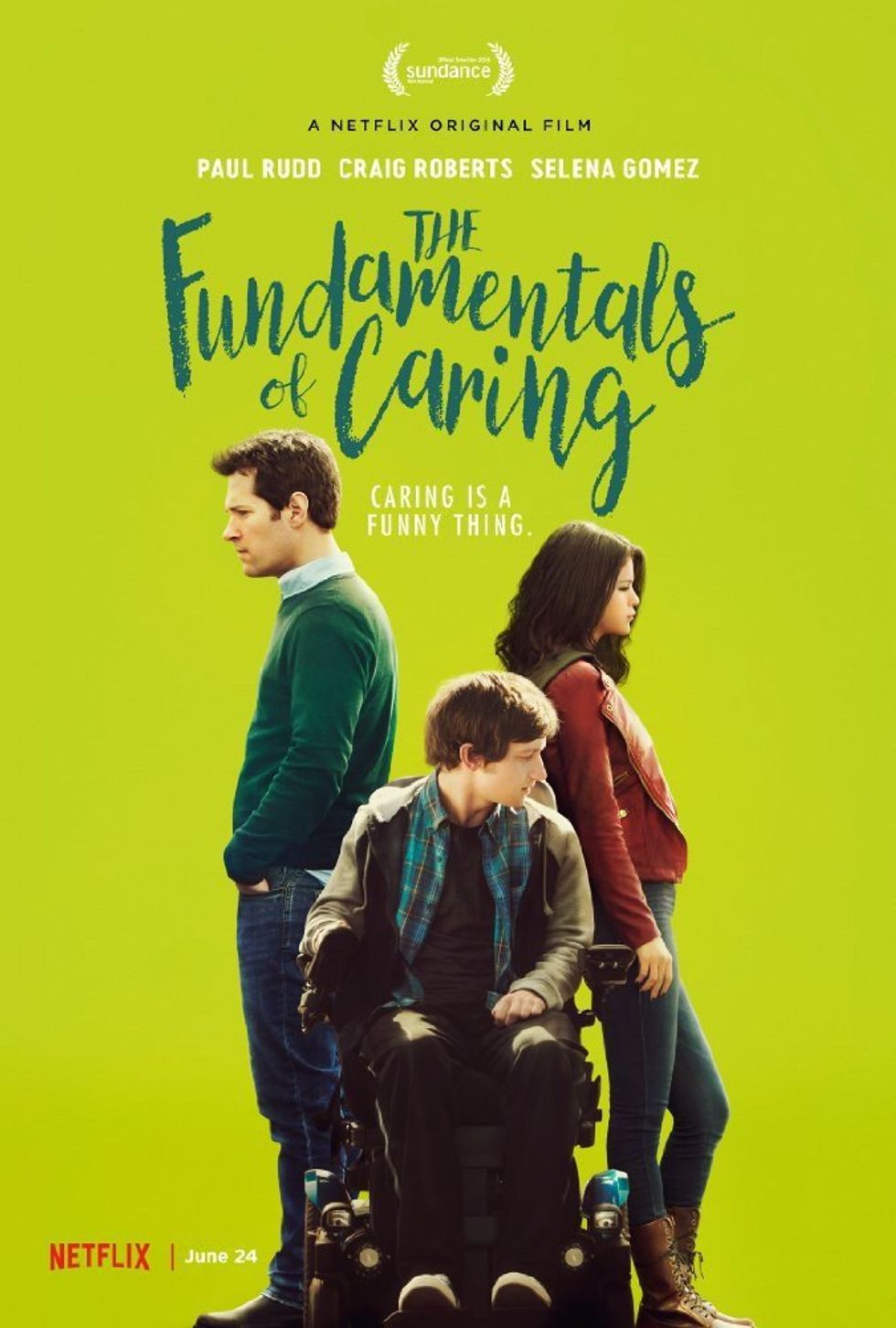
The best thing that someone can do for someone else is simply care. According to Merriam-Webster dictionary, a caregiver is defined as a person who gives help and protection to someone such as a child, an old person, or someone who is sick. Like any word that is found in the dictionary, a formal definition is usually not all-inclusive. Words often embody different meanings and interpretations for everyone. By the end of the 2016 Netflix original film “The Fundamentals of Caring”, we see that the word “caregiver” certainly means more to the main character, Ben, than it does to Merriam-Webster dictionary.
“The Fundamentals of Caring” truly exhibits the concept of ambiguous dictionary definitions. Ben, who is played by Paul Rudd, had recently just finished a caregiver certification course and was looking for a family to offer his services to. He applied for the job shortly after a devastating tragedy occurred in his life and he was looking for a way to make income after his divorce. The instructor of the class emphasized that caregivers should follow the acronym ALOHA; “Ask” “Listen” “Observe” “Help” “Ask Again”; nothing more, nothing less. Ben finds himself giving so much more than “ALOHA” to his job as a caregiver. When Ben met Trevor, his life would be forever changed. Trevor’s overprotective mother was hesitant about hiring Ben due to his lack of experience, but after several interactions with Ben, Trevor decided for himself that Ben was the right caregiver for him.
Trevor, an 18-year-old boy with muscular dystrophy, rarely left his living room due to the fact that he was paralyzed and couldn’t get around easily. As Ben grew closer to Trevor, he cultivated a friendship with him. Ben took notice of Trevor’s carefree and lighthearted personality, despite the fact that he was confined to a wheelchair and was only given seven or eight more years to live. Trevor showed Ben his map of the different places he wanted to visit in the United States, including the world’s deepest pit in Salt Lake City, Utah. Knowing that Trevor’s mom, Elsa, never let her son leave her sight, Ben was hesitant to suggest the idea of a weeklong road trip, but he wanted Trevor to experience life outside of the four walls of his home. After a little bit of persuasion, Elsa gave Ben permission to bring Trevor on the road trip.
The two men embarked on their journey, visiting places that Trevor never dreamed of seeing. One day, Ben asked Trevor what he would do if he didn’t have muscular dystrophy. Trevor laughed and told Ben, “I would like to pee standing up.” When the men arrive in Salt Lake City, Ben makes it possible for Trevor to pee standing at the top of the deepest pit in the world. Although peeing standing up is a normal routine for most teenage boys, it was a luxury for Trevor and Ben made this new experience special for him. Throughout the trip, Ben and Trevor pick up a few friends along the way who each shared with them their own values and perspectives on life.
Originally, Ben wanted to be a caregiver to make money, but he ultimately reaped more benefits from the job than just a paycheck. The relationship between Ben and Trevor is symbolic of many friendships that we have in our lives. We must be open-minded about new people we meet and give them the opportunity to change how we see the world. I certainly have found that friendship means more when you put everything you have into it. We need to love and support one another in the same way that Ben and Trevor supported each other in the film. Trevor was physically disabled, but he was far from disabled in all other aspects of his life. As a human race, we need to realize that we are allowed to offer more than the standard “ALOHA” acronym. Caregivers are told that they cannot become attached to their clients, but as Ben discovers, this seems to go against human nature.
Loving and caring for people drives the energy in our lives. When we care for people in the way that we would like to be cared for, we are able to feel something amazing. Although we may not all be certified caregivers, we can all relate to the themes set forth by “The Fundamentals of Caring”. We are all in this world to help each other and lend a helping hand. Words often mean more than how they are formally defined. We care for others when we can’t seem to care for ourselves. We love others because we can’t seem to love ourselves. We look at others in ways that we can’t imagine looking at ourselves. We are each other’s caregivers, and we need to start realizing that.















