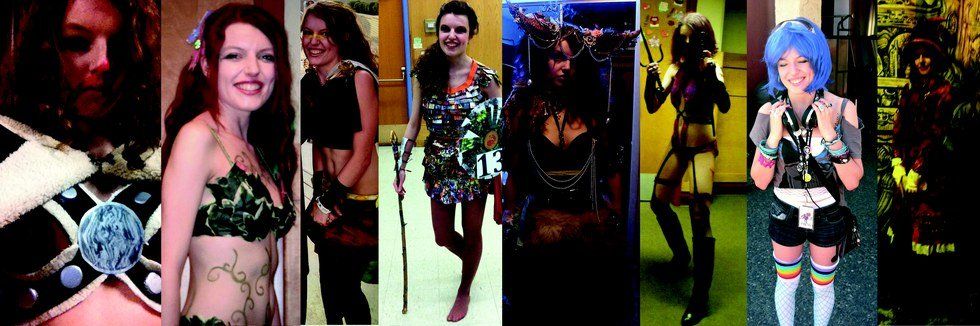
There’s a certain comfort in concealment. I carefully ease on the homemade armor, checking its integrity as I position it perfectly upon my shoulders. I am no longer myself, but a reimagined Valkyrie. A long, carefully crafted sword and large, feathered wings complete the effect — transforming me from a diminutive, shy young lady into a formidable female warrior. This transformation eases my own shift into a more confident social being — a sharp departure from my habitually introverted self.
I’m not often invited to parties. I even more rarely attend them. But a masquerade always prompts a positive RSVP. Why?
Masquerades allow the participants to shed their identities and inhabit new ones at will, to reimagine themselves outside of societal bounds (or, at least, within different ones). During the 18th century, few events were so wholeheartedly enjoyed while yet being considered so detrimental to young women’s virtue. Terry Castle, in Masquerade and Civilization, cites multiple stories featuring the dangers of these parties. In “London as a Text,” E.B. Kubek expands on this idea:
These stories may reflect some truth about masquerades, but they also seem evidence of contemporary anxieties centered around women who conceal their identities; all of these themes relate to violation of the paternalistic familial structure. Here also women could see the unrestrained sexual behavior of other women, even prostitutes . . . The dominant fear seems to be that women in this atmosphere, no longer defined and controlled by the identities given them by the father or the husband, will throw aside the restraints of decorum and become — the unnameable. (307)
Castle also comments on the rejection of identity, as she “points out [disguise] is a concept which involves the violation of unwritten social codes” (Kubek 307). The titular character of Eliza Haywood’s Fantomina, epitomizes these fears exactly. Her first disguise as a prostitute begins her loss of virtue. Her talent in appearing and behaving as a lady of the town leads to her eventual banishment to a monastery even.
Arguably, this has become a sort of tradition among women — at least in October. You would be hard-pressed to find a modest Halloween costume on shelves for any woman over the age of 16. Even though my costumes are always homemade, they have also fallen into the immodest category on occasion.
When showing a friend my catalogue of costumes recently, she questioned a certain cosplay I had done a few years prior of Mileena from Mortal Kombat. She looked at me with surprise, asking how I could possibly wear something so revealing in public comfortably. My answer was simple, but perhaps no less surprising.
While I would never wear anything that immodest as myself, I was not myself within the realm of the costume. I was Mileena, and since it was her costume, I felt no discomfort within it. After all, I was not myself and would not be judged as I as myself would’ve been. If I ventured into class at my university wearing that one day, I have no doubts that I’d be slut-shamed or sexually accosted. However, I was not in class, I was at a video game convention surrounded by those who knew the character and the game she appears in. While in that community, and obscured by a facial mask (also part of the costume) and with dyed hair, there was no concern about my reputation or self being sullied by patriarchal standards of female behavior.
Like Fantomina, I manipulated my identity, allowing myself to appear as someone less socially acceptable to enjoy the freedoms it allowed me. Fantomina in disguise is at liberty to speak with the object of her interest without the trying formalities of formal courtship. Through her other disguises she is allowed to enjoy sexual comforts as well as maintain the interest of her beloved.
Fantomina continually refreshes herself for the benefit of a man, molding herself to better become his object. Her first disguise allows her to be subject to his gaze for perhaps the first time. Before, as a lady, she was still an object, but possibly an unattainable one. As a prostitute, a maid or a widow, she is a much more possible conquest for Beauplaisir.
I, too, become more of an object for the male gaze while in costume. As myself, I am frequently unapproachable, but in costume I willingly transform myself into a piece of art to be admired. While my goal is not to receive compliments on my physical appearance, but instead to inspire admiration in my handiwork, I willingly pose for photos and participate in what are little more than beauty contests.
Female agency is certainly in play in both Fantomina’s and my work, but its end purpose is still to work within the realm of a patriarchal world, embodying the roles created for women. I can only cosplay as scantily-clad game or comic book characters, or create my own characters based on the myths and stories of past male-led societies. Fantomina can only inhabit roles meant for women — she does not disguise herself as a gentleman or blacksmith.
Disguise, thusly, is mostly a female art. The last costumed event I attended, less than half of the men present had even attempted any sort of concealment. There is no need for men to move within a different strata of society, since they are already free to do so. Similarly, appearance traditionally matters much more for women. This is as true now as it was in the 18th century.
Will Pritchard states that “a woman’s exterior would be carefully scrutinized in the belief that it manifested her social or spiritual identity, but that exterior might also be seen as a disguise or impersonation,” in his work “Masks and Faces: Female Legibility in the Restoration Era” (31). This entire essay expands on female disguise in the Restoration and 18th century. Within, Pritchard emphasizes the change in attitude towards women as theatrical beings. He represents the opposing views that the new actresses are simply playing a role and may be completely different beings and, conversely, that those who perform as such must be as such. However, Pritchard argues the complexity of the issue and relates it back to even the non-actresses of the day. In his analysis, decorum books, many written by men, tended to urge women to be authentic in their behavior and dress. They abhor the act of pretending, particularly in the interest of courtship; though, unlike Fantomina, most men were afraid of women pretending above their station rather than below.
Is theatre really to blame for this questioning of identity? Possibly so. After all, where did costume and disguise play out in the years before the Restoration? Costumes have always been intrinsically linked with theatre. Similarly, the earliest case of literary disguise I can recall is within fable or Shakespeare’s comedies. The former utilized disguise as punishment. Then, of course, the disguise was a literal transformation rather than an imagined or feigned one. In Shakespeare, women were still those most frequently in disguise, often leading to romantic interest. Concealing identity is the very point of theatre and as women began to permeate the casts of plays in London, it is no wonder that disguise began to shift more towards the feminine than ever before.
Now, in the 21st century, disguise is still more feminine than masculine. Most women don’t leave the house without some form of makeup, but heteronormative men are never seen with it. Concealment (whether of wrinkles, acne or identity) is akin to female beauty, hence my propensity to feel my most confident when fully disguised. It is this comfort and ease of being that consistently draws me back to costume, just as Fantomina’s love for Beauplaisir draws her into disguise after disguise. I question whether Fantomina would have spoken to him at all without the opportunity of doing so without fear of true rejection, since his rejection of her alter-egos is hardly a rejection of her herself. Whether it is the release of the devastation of rejection or the enjoyment of being beyond judgement, disguise offers possibilities not frequently available otherwise.
Perhaps not much has changed. Too frequently I find myself and others like me, blamed and ridiculed for our freedoms. While I am technically allowed to walk from campus and back home at night, it is suggested that I never do so. That if I do, I am asking to be assaulted. As though it was my fault for being in the wrong place at the wrong time, and not the fault of the man who breaks the law and acts without concern for another person. I must follow the rules to remain safe. I don’t have my freedom in order to protect me. Perhaps this is the same women felt then. “I must,” the young lady thinks, “stay within these set boundaries or I will be unsafe. I must be caged so I am not in danger.” While this isn’t untrue, it also portrays women as being unable to protect themselves. Of being helpless. Fantomina was simply fighting back against this helplessness. “I am not allowed to speak to him of my own accord, he must speak to me.” Then, as she sees the freedom she so wishes for being enjoyed by others, she acts on that desire, unminding of the consequences in her wish to fulfill herself. By doing so, she does put herself in danger. But is it her fault for speaking to him, or his for acting without her consent? This is no different than now, unfortunately.
Even when in concealment, this doesn’t end. If anything, the dangers of it increase. If no one knows who she is, no one can judge you for acting crass towards her. “Perhaps,” the onlooker thinks, “she merited this treatment somehow.” All the while ignoring that no one should ever merit poor treatment. Recently, at a convention, I saw a sign. “Cosplay is NOT Consent,” it declared in bold red letters. Why is this necessary? Because dressing in a certain way opens one up to harassment. It doesn’t matter who she is underneath the clothes, she is wearing them, so she must be open for business, so to speak. Women are constantly judged by their dress. If she wears shorts or a low cut top, or, god-forbid, one of her bra straps is showing, she must be a moral-less wanton. If she covers her hair, wears long skirts even in the hottest of weather, she must be some kind of weird, religious prude. There is never a thought along the lines of, “Maybe she is simply comfortable that way, or maybe there is some reason for her dress -- maybe she’s in a play or is too warm or is sick or…” At this point, I’ve almost made an art of changing my personality to fit my clothing.
Fantomina’s personality is mutable as well. As a prostitute, Fantomina is hesitant to behave so far below her station, but still manages to “converse with [Beauplaisir] in this free and unrestrained manner” (Haywood 43). Her disguise is, thusly, judged incomplete:
"She very much resembled that Lady whom she really was; but the vast Disparity there appear’d between their Characters, prevented him from entertaining even the most distant Thought that they cou’d be the same."(Haywood 42)
Fantomina’s skill in bending her very self to suit other’s perceptions becomes more refined with time. However, her care in choosing both costume and venue also become more evident. Eliza Haywood, as a narrator, comments upon Fantomina’s ability to effect change at length, comparing her to the finest “Comedians in both Playhouses” (57). After Beauplaisir’s rape of the prostitute, Fantomina’s disguise as the serving girl Celia is more mindful of consequences. She seeks out employment where “she was in no Apprehensions of any Amorous Violence, but where she wish’d to find it” (Haywood 52). As such, Fantomina’s disguises move up the class ladder: from prostitute to servant, to widow, to noblewoman. This allows her increasing amounts of control over her personal goals and sexual pleasure. As a lady of the night, Fantomina has no agency. As an innocent serving girl, she has a limited ability to give consent, as illustrated by her “half-yielding, half-reluctant Body” (Haywood 53). As the Widow Bloomer, Fantomina has almost the same amount of agency in her sex as Beauplaisir, the only imbalance of power being shown is in her inability to refuse sex without feigning ailment. Her final disguise, Incognita, shows her newfound control over her sexuality. Incognita seeks out and propositions Beauplaisir herself, and remains in control of their time together by refusing to reveal her identity. Unlike her other alter-egos, Incognita is not abandoned when Beauplaisir bores of her, but rather the opposite. Her continued reliance on disguise allows her to act with agency and control that is otherwise absent from the female grasp.
After donning my armor and sheathing my sword, I set off for my masquerade, reveling in the attentions I received as a Valkyrie, socializing with those I would never dare approach otherwise. As a tingle of excitement and validation fills my breast, I wonder if Fantomina felt this as she sat down in the playhouse, for the first time free to speak to whomever she wished, however she wished. Maybe, more substantially, revelling in her newfound freedom, without the sacrifice of her reputation or fear of repercussion. Maybe one day I will be able to do so without a disguise.