


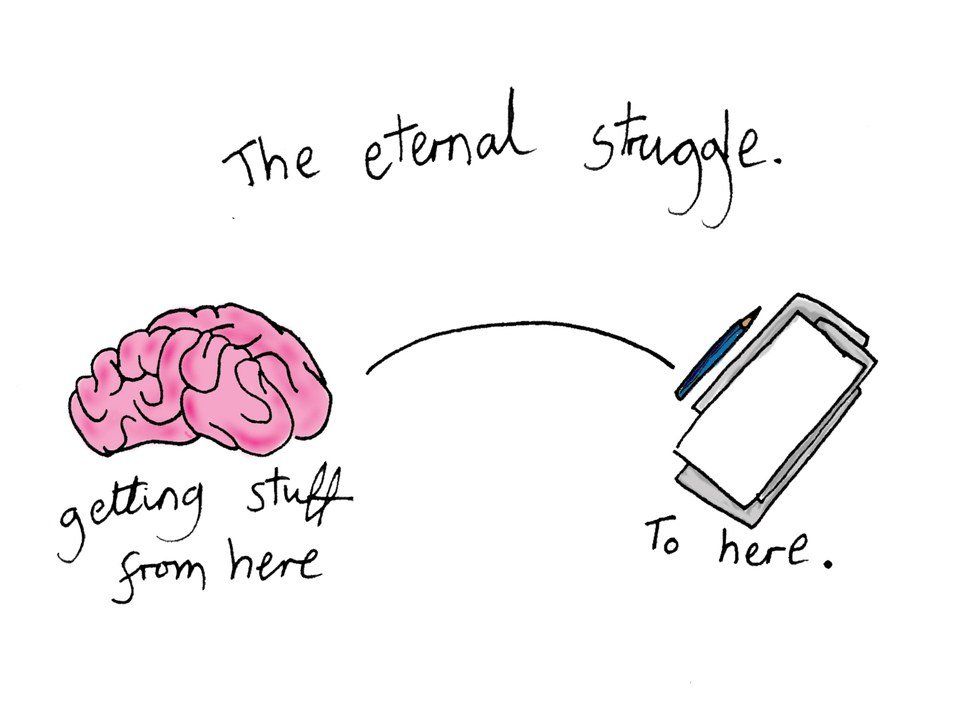
There it is the blank paper in front of you with a pen or pencil beside it, ready to be used. Or perhaps, for those who find themselves more technologically comfortable, the image is of a blank Word document, the cursor blinking patiently. Where are you? Well, you are busy waiting for the ideas that you just had a minute ago to cooperate so you can write or type them down. However, at some point, you realize that the more you wait, the less you remember. Or, if you somehow manage to have a few pages written, perhaps you struggle to continue the story. Either way, you have been infected with the dreaded writer’s block (otherwise known as a “writer’s worst nightmare” or WWN for short).
This would be the part where I explain what writer’s block is, but there’s no need. Every person, writer or not, can understand the condition- a temporary blockage of creativity or ideas. However, it affects writers in a way that only avid writers can truly relate to. If you aren’t in the situation of having no new ideas of where a story will go then, at the very least, you are in the tauntingly terrible situation of having a really great idea in your head in which you’ve created a fascinating conflict and complex characters but cannot, for the life of you, put them into tangible words. For us, it’s not necessarily that we are bad writers, it’s that our brain temporarily decides not to cooperate, which can have frustrating repercussions for us.
Such a cruel phenomenon can even affect artists and musicians. I cannot specifically speak for them, but I’m sure that they’ve experienced this in the form of song lyrics or a new painting. Writer’s block (or creativity block, for those in other creative mediums) is no joke.
Perhaps the worst part of having writer’s block, no matter how long it lasts, is the process of trying to get out of it. Writers have different ways of getting inspiration and one size does not fit all. What works for one person will not work for the other and thus, this is why it is so difficult to get out of the writer’s block phase. It’s like getting contracting a common disease but having to try one hundred different treatments until you find the one that cures you. Though it may be a slightly dramatic analogy, it definitely feels like you have a disease.
For me, I have a few methods (think of it as having a plan B and C method in case plan A doesn’t quite work). In the case of short stories and novels, I write in sections, therefore, depending on where the characters are and how they’re feeling in a particular part of the story, I’ll listen to a “trailer song” that I believe corresponds with those characters’ particular feelings. “Trailer songs” are dramatic songs that sound like they can be used in movie trailers or movie scores due to their instrumental (and sometimes choral) nature. I have many “trailer music” playlists in my phone for this reason. The best part? If you don’t want to purchase any, you can always look them up on YouTube.
If that doesn’t work, I also like to reread what I have so far or, if it’s a new piece, I reread the outline I’ve made for it. Sometimes rereading things helps to jog your memory and creative juices.
Again, every writer is different so I can’t guarantee that my methods will work for everyone, and even the right method can take a while to cure you from writer’s block cycles, but despite these differing strategies, there’s one thing that all writers agree on. Writer’s block is the actual worst. So if any fellow writers find themselves stuck in the dark pit of blockage, make it your mission to find your ideal inspiration method — take a walk, eat a snack, listen to music, watch a movie, meditate, anything. Don’t let writer’s block stop you from finishing your piece. Even if it takes you weeks or months or years, don’t give up. Don’t let writer’s block win.
















