
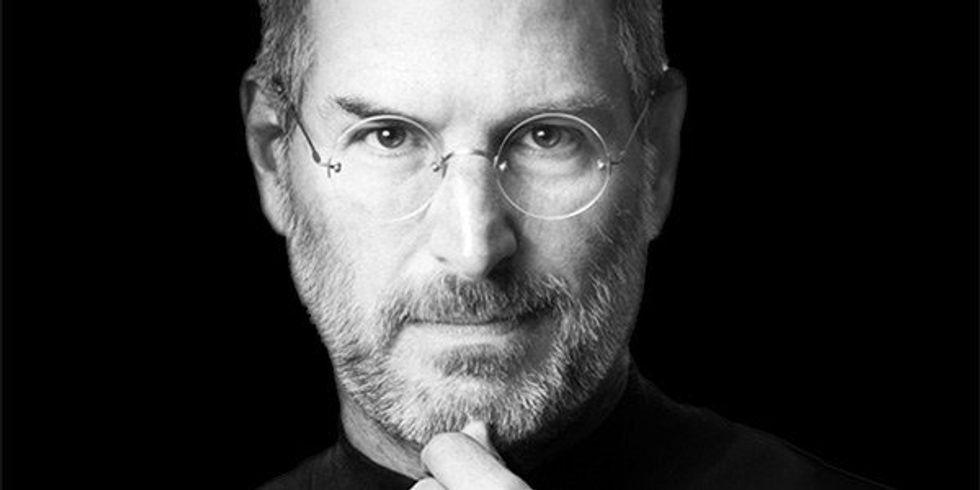
In an era where the word "apple" no longer conjures up visions of Galas and Granny Smiths, it's virtually impossible to envision a world of technology without Steve Jobs at its core. Today marks 61 years since the birth of the man who put a ding in the universe — here's to the revolutionary who placed the future in the palm of our hands.
“If today were the last day of my life, would I want to do what I am about to do today?”
Steve Jobs asked himself this question every morning upon rising from bed. Although his life was cut short in 2011 by an untimely death at the age of 56, Jobs very well may have lived more fully than others who have surpassed his lifespan by decades. Acknowledging the fact that life does, indeed, have an expiration date enabled Jobs to prosper. It stirred him to do what he loved every single day — to craft his own inimitable niche in the world of technology. Jobs, however, has left us with far more than a smorgasbord of screens. By means of his life story, the creator of Apple has also planted the seeds of inspiration for humans worldwide.
Jobs was a firm believer that in order to truly succeed, one must follow his heart and trust that the dots will connect further down the road. In his own life, this philosophy proved true early on. Enrolled as an undergraduate at Reed College, Jobs found himself uninspired day in and day out. What, he wondered, was the point of receiving an education if he did not love what he was learning? Trading practicality for instinct, Jobs dropped out of college six months into his freshman year. Ironically, this wound up being one of his first major steps toward achieving greatness. As Jobs stated during a 2005 commencement speech at Stanford University, “[Dropping out of college] was one of the best decisions I ever made.” By abandoning academia, Jobs inched one step closer to discovering his true calling. Camping out on friends’ floors and savoring free meals at the local temple once a week, Jobs lived minimally but loved every second of it because he was finally following his heart. Then, one day, he enrolled in a calligraphy class and stumbled upon a newfound passion. Despite the fact that studying calligraphy was deemed impractical, Jobs stuck with the craft simply because it ignited a formerly dormant fire within him. Years later, in 1976, he employed his finnesse to design the typeface of the first ever Mac computer. The dots had finally connected for Steve Jobs.
In 1985, Jobs had a falling out with Apple and was fired from the very company that he had once founded. Pushing devastation aside, however, he refused to stray from innovation's path. As Jobs once said, “Your work is going to fill a large part of your life, and the only way to be truly satisfied is to do what you believe is great work. And the only way to do great work is to love what you do. If you haven't found it yet, keep looking. Don't settle.” Heeding his own advice, Jobs proceeded forward into what he would later dub “one of the most creative periods of [his] life.” During this five-year hiatus from Apple, Jobs created a company named NeXT as well as Pixar (which is now the world's most successful animation studio). Eventually, Apple purchased NeXT and Jobs returned to his former company as its new CEO. At last, he had wormed his way back into Apple.
Then, in 2004, a nightmarish diagnosis struck Jobs with news beyond his control: he had pancreatic cancer and a mere three to six months to live. By a stroke of luck, however, a later biopsy revealed that Jobs had a rare form of the disease that is treatable with surgery. Jobs emerged from the hospital post-operation with temporarily restored health and a new insight to life: “Remembering you are going to die is the best way to avoid the trap of thinking you have something to lose.”
Jobs once said, “I want to put a ding in the universe.” Steve, your wish came true.

















