
“This is a safe place, Ellie,” I remember my counselor telling me as I sat across from her, fidgeting my legs and staring at the floor. At 12-years-old I guess I didn’t understand what that meant. Now, I realize she was trying to tell me was that her office was a place where I could talk about my feelings without fear of judgment.
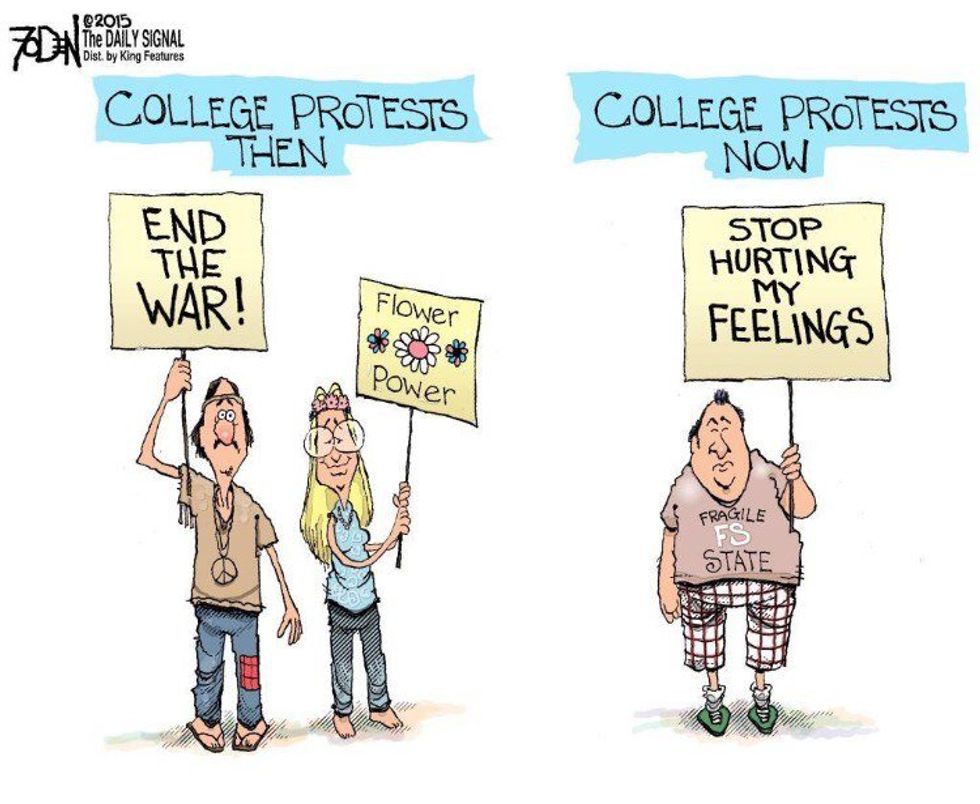
That little yellow room with board games and cartoon drawings depicting emotions was a place where I could be coddled, protected, and loved. It’s where she would tell me that people who hurt my feelings were in the wrong and that I deserved to feel good all the time.
It was a place where my fragile ego could be upheld, as were most of the places of my childhood. Similar to other children, my church, elementary school, sports clubs, and my home were all places where everything was supposed to be fair. Maybe that’s the problem. Maybe that’s how my generation got this way.
We grew up being told that we shouldn’t say things that may hurt others feeling and that politeness and manners are of the utmost importance. However, as we got older manners turned into political correctness, and even talking about your feelings could get you labeled a “bigot” or “hater”.
I never really thought about the impact of our inability to understand other people’s feelings and opinions. I used to walk past protests or rallies on campus with my head down and went about my day not concerning myself about these issues. I didn’t post politically charged statuses on Facebook or join in on controversial fights on social media. Personally, I didn’t care.
My blasé attitude changed when I joined a discussion based sociology class this semester. We covered the heavy topics of inequality, poverty, racism, sexism, and more. In the first week of class, we began discussing police brutality against African-American men.
A student sitting in the middle row chimed in about how he believed police were not the root of the problem. Based on his answer, the room erupted with everyone talking at once, and someone quickly whipped their head around and saying, “do you have any idea how offensive that is?”
From then on, that’s basically how every discussion went. One person would say something that would offend someone else and then that person would get upset, and the discussion would be over. Eventually, our professor gave up the open forum conversations and we just sat there and took notes for the rest of the semester.
I wholeheartedly believe that universities should be places free of prejudice and discrimination. Schools should be places where a student’s race, gender, or sexual orientation shouldn’t affect their ability to safely attend the university. However, universities aren’t places free of opinions, and open dialogue about controversial issues should be allowed.
Opinions aren’t inherently correct; that’s why they aren’t facts. Stating that you feel a certain way about an issue isn’t discrimination. It may not be stated politely, or without bias but how someone feels about an issue is not incorrect because opinions can’t be right or wrong.
Freedom of religion is the ability to practice your religion wherever you choose and for others to do the same, not the ability to go somewhere and never see other religions being practiced. Freedom of speech applies to the same constructs. You do not have the freedom to go anywhere you wish and not hear things that you don’t want to hear. You do have the right to speak on issues in whatever way you want, and so does everyone else.
Our hyper-political correctness is inhibiting our ability to learn and grow. If we can’t talk constructively about our beliefs and opinions, how do we find solutions to complex problems?
Higher education cannot solely be defined by a greater attainment of textbook-based knowledge, but by improvement of critical thinking, greater global awareness, and ability to understand different perspectives.
If we as students simply sit down and shut up to save face and protect feelings, we disadvantage ourselves. Maybe our generation has a fear of repeating the mistakes of our parents and grandparents, and that fear fuels our silence. We don’t want to look back and be the people who supported injustice.
So instead, we don’t talk. We don’t dare say something that might be considered offensive. We stop pushing limits and pushing buttons, and we stop progressing. Instead of leaving behind a legacy of injustice, we will leave behind a legacy of political correctness. We are not problem-solvers and deep thinkers. We are polite bystanders.
Universities don’t need political correctness because they aren’t political parties. Students are still learning and growing. We should be challenged by other opinions to develop our own fully.
We live in a country whose government shutdown for 16 days over the inability to develop a fiscal budget. We are learning from the leaders that it’s better to do nothing than to understand other perspectives, and to meet in the middle. In America, it’s worse to say something offensive than it is to be inactive in solving problems; But we can change that.
The next time something offends you, let it. Let it anger you. Then, let that anger motivate you to do something constructive. No, please don’t write a strongly worded letter about how your feelings got hurt. Let it widen your perspective and deepen your passion for what you believe. Talk about it, write about it, and allow it to better you, instead of curling up and saying that the world is too mean.
We have the rest of our lives for social niceties but now is not the time. Political correctness may have its place, but it shouldn’t be in a college classrooms meant for growth and learning. Graduate with the understanding that not everyone sees the world through the same lenses as you, and let that shape your mind. "And while it may not be easy to get past the things you don’t always understand, it is absolutely possible if we only do it together."