
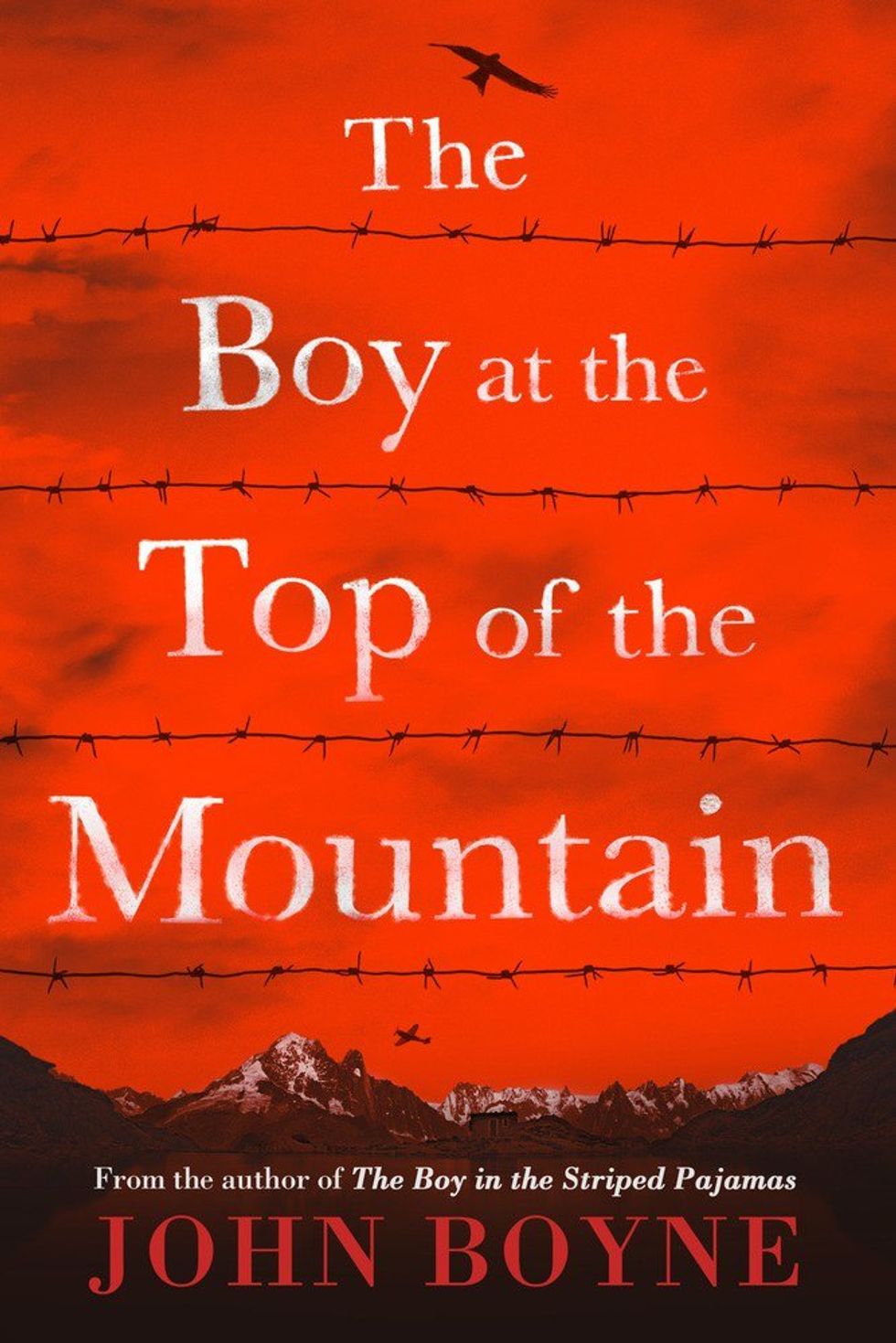
"John Boyne delivers a poignant tale of innocence ruined by Nazism. This is a story full of suspense and heartbreak that will leave readers wanting more. Compare this book to The Boy in the Striped Pajamas." ―School Library Connection
It is an engaging story in which I began to feel as if I was growing up alongside Pierrot. I absolutely loved Pierrot - not because he was perfect or even always a “good” character, but because he is one of the most human characters I have ever read. A well written character indeed, Pierrot is often a very bad person, but not an unredeemable one. John Boyne beautifully paints a story filled with great potential for redemption. It is perfectly tied up in the final line of the story when Pierrot goes back to see Anshel, to tell him his story, and Anshel accepts him, signing, “Let us begin.”
One of my favorite elements of the story is how Boyne used dramatic irony to unfold information through the young Pierrot’s eyes. This was most effective prior to Pierrot meeting the Master of Berghof, Adolf Hitler. To Pierrot, seven years old at the time, the master remains a mystery when he first moves to Obersalzburg, but a reader with even a small background in history understands the cues that Boyne is giving. For instance, Beatrix and Ernst are constantly reminding Pierrot how he should and shouldn’t behave in the house when the Master comes home, emphasizing not asking questions and not mentioning his French heritage, as well as his Jewish friend from Paris, Anshel. In reading the first few chapters, I caught other indications that the young Pierrot did not pick up on such as “the Master’s” book, which sat, in multiple copies, on shelves of the home. This, of course, would be Mein Kampf. It was also present when he met the boys from the Hitlerjugend on the train, and, as with his father, the image if the uniform held power in Pierrot’s eyes. Boyne’s use of this combined with the massively built up moment of Pierrot (Pieter) meeting Hitler, was immensely effective and created a great deal of suspense. It was also a perfect transition into the second part of the novel where Pierrot’s admiration and respect for Hitler grow.
Watching Pierrot transition from a innocent, kind young boy to a teenage junior Nazi was painful and heart-wrenching, but so well set up. Pierrot has a hole in his life that his father, who struggled with alcoholism and Post-Traumatic Stress Disorder following World War I, left not only in his death but through his relationship wth Pierrot after returning from the war. While not a good role model by any means, Hitler is a powerful male figure who praises Pierrot, and in that way, he gives Pierrot so much of what he is seeking. Pierrot is bullied for being small when he is young, but Hitler teaches him how to be a figure of power, demanding respect from those around him. Hitler becomes like a father to Pierrot, and that leads him to the unwavering loyalty he feels toward Hitler and the German cause. At first, Pierrot sees it as the “right way,” fooling his conscience. He only truly begins to question right and wrong when his Aunt Beatrix and Ernst are brutally annihilated when Pierrot ruined their attempt to poison Hitler. This shows that, while the attempt to poison Hitler may not have been the morally right decision, Pierrot was brainwashed enough to betray family, stopping what could have saved millions of lives.
One of the most impactful parts of the book, for me, was when Pierrot stopped acknowledging himself as such and called himself Pieter, representing how he had accepted German life and internalized the way that Hitler wanted him to think and feel. It was ingrained in him by his father to have German pride, and Hitler took advantage of that, and it worked exactly how he hoped it would, making Pierrot all but his slave. When Pieter sexually assaulted Katarina, I saw how deeply he was affected by growing up on Berghof. At this point, he is no longer the Pierrot at the beginning of the book, but a new person entirely.
I was amazed at the way that Boyne highlighted both the humanity and the monstrosity in Hitler, painting him, at times, very caring of Pierrot. He is manipulative of everyone, and it is terrifying. To have a look inside his home is both intriguing and disgusting. The part which made me most uncomfortable is when Pierrot is taking notes as they plan the concentration camps, and Hitler seems almost giddy at the size of the potential camps and the means to which they are going to ensure no one will escape. I found myself in tears.
I would recommend this book to anyone who loves history or is looking for historical fiction to use in the classroom.
"With skill and emotional detachment, Boyne tells Pieter’s story through descriptions and dialogue that are concise, spare, and vivid . . . . Pieter’s traumatic childhood, infatuation and interactions with Hitler, adolescent angst, and destructive choices will captivate teens and prompt thought-provoking discussion." ―School Library Journal, starred review