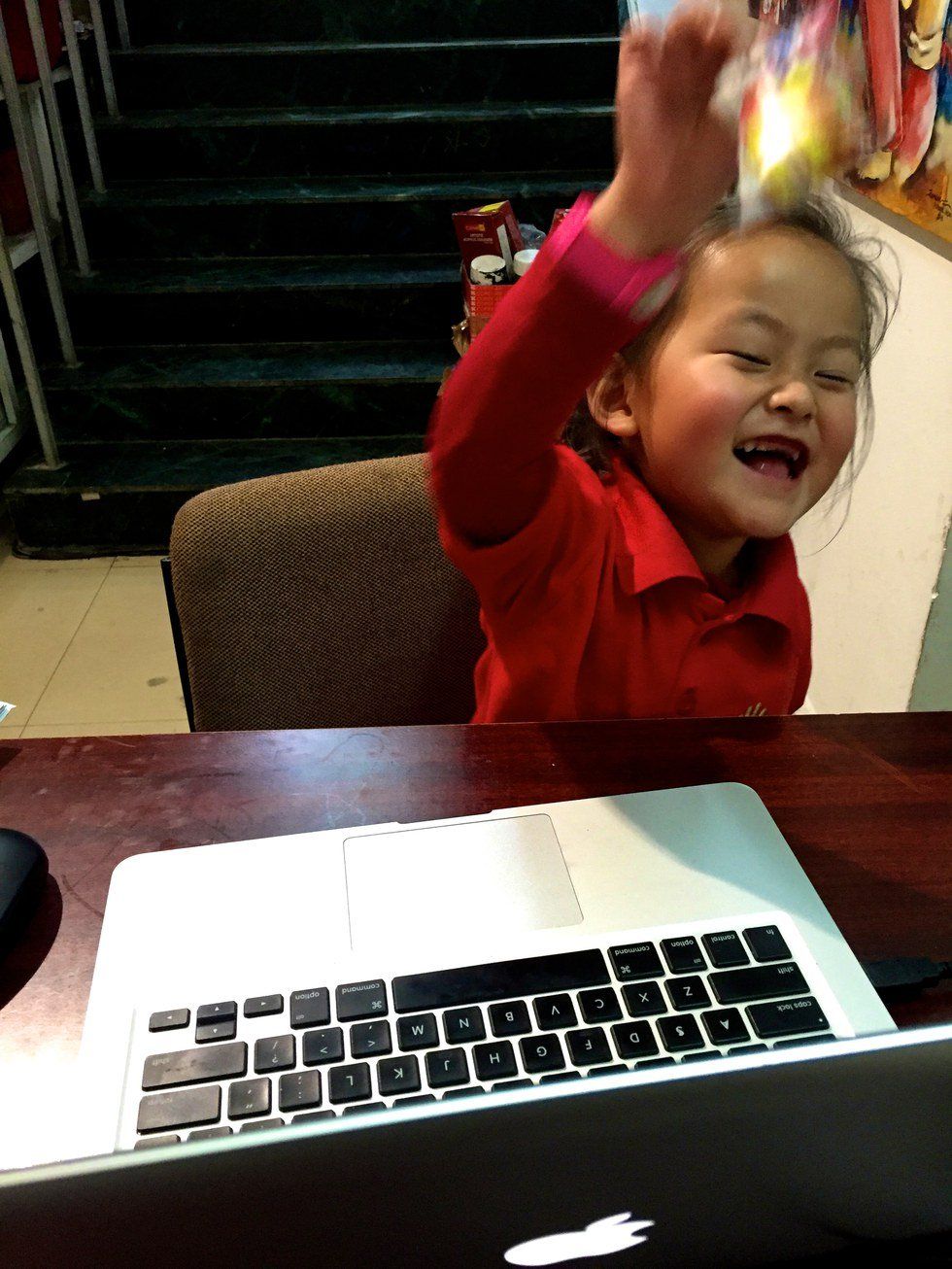
My favorite Dzongkha tutor is named Petta. She calls me azhim, which means “older sister” in Dzongkha, the official language of Bhutan. She calls me this because I am approximately 18 years older than her. Petta is 3 years old and she has helped me more with my (admittedly abysmal) Dzongkha than anyone else in Bhutan.
Our lessons go something like this:
Petta’s mother, her ama, Choney, works at VAST, the arts organization where I am currently interning while studying in Bhutan. Most days after lunch, Choney goes to pick up Petta from nursery school and brings her back to VAST. For a 3-year-old, especially one with as much spunk and energy as Petta, VAST is a dream. There is space to run around and countless people who dote on her because, well, she is just so darn cute you can’t help it. Eventually, Petta will tire out enough and decide it is time to sit down. This is when our lessons truly begin.
Whenever Petta climbs into my lap, I am helpless to forget the email I was writing or the article I was reading. Historically, I do not like children. Whatsoever. But I like people who want to learn and are willing to share their wisdom with me. My juvenile Dzongkha tutor is an exception to many rules.

Petta points at the various icons and images on my computer and exclaims “Yellow! Blue! Red! Green!” I respond “Se:p, hom, ‘ma:p, jang-se:.” This routine continues with other objects lying around the office. “Green!” Petta shouts pointing at my blue pen. “Blue,” I say. She gives me a quizzical look, scrunching her eyebrows up and squinting in concentration. “Blue?” she asks. “Hom nyugu” I say; blue pen. Petta gives me a smile, happy that we have understood each other. Then she laughs a laugh that only a 3-year-old can produce, full bodied and unrestrained. It’s infectious.
Last week, I came into the office wearing a sweatshirt with the words "Wheaton College" emblazoned across the chest. Pointing to the letters, Petta cries, “blue!” Then, poking at the large "W," says, “Eeee! E! E! E!” I pull out a piece of paper and write "E" and "W," trying to communicate the difference. Petta stares for a while at my chicken scratch and then, under her breath, begins to mumble the alphabet song. I quickly write out the 26 letters in my best print and we begin to sing together. This continues for the rest of the afternoon while we walk down the street hand in hand to the print shop to pick up the logos for Bhutan Post. We may have gotten a few questioning looks, the American with bleached hair and the small Bhutanese child. I wouldn’t know; those people were not my priority.
Spurned on by our newly discovered harmonies, I ask Petta if she knows "Head and Shoulders." She looks at me as if I have three heads. “Guto, pcato, guto, pcato,” I begin, gesturing to my head and shoulders. Petta jumps up and claps her hands, pulling me from my seat as well. We start again together: “Guto, pcato, guto, pcato; pumo dang dzumo, pumo dang pzumo.” I cannot remember how to say eyes or ears or mouth or nose. Petta notices my uncertainty. None too gently, she begins poking at my face and sings, “’mito, ‘namco, lhapa, kha; ’mito, ‘namco, lhapa, kha.” Eyes and ears and mouth and nose...
If you are interested in learning more about the Wheaton in Bhutan program, be sure to follow us on Instagram: @wheatoninbhutan!