
I am not, by any means, a vegetarian.
In fact, I’d almost consider myself the opposite: a "Parks and Recreation" Ron Swanson, meat and steak loving opposite, with an avid passion for steak, and Chick-fil-a number ones, and bacon. I could smell bacon from a mile away. I love meat, as the majority of us Americans do, and I doubt life would be as substantial—and far less thrilling—without it.
That being said, however, I—like many Americans—rarely think about what I eat. And how can you, really, when you’re wolfing down a quarter pounder and a side of fries. It’s just a spur of the moment kind of thing. Just a twinkle of that grease-filled magic we Americans call dinner.
But it’s time to think about what we eat. And not only for the good of our bodies—we all know the threat of our own lives when it comes to downing those literally heart-stopping cheeseburgers—but rather for the good of own morals. The meat industry has proven itself a disgusting element of our society, and it’s not just because it’s the element of our society that is the closest thing to legal murder. There’s a difference between killing for food, and slaughtering for a profit, and the industry has most definitely crossed the line.
I would recommend you go watch the videos. They are out there. Videos depicting the horror some of these animals face on a daily basis. Baby goats being dragged from their hind legs from their mothers, cows by the hundreds stuffed in a small areas, people brutally throwing baby chicks as if they are invaluable machine parts. The most horrific part of it all, according to the non-profit organization, Animal Equality, is the distance at which the meat industry keeps the true reality away from the meat-consuming masses.
Animal Equality also released a 12-minute virtual reality film at this year’s Sundance Film Festival, attempting to spread the voice of these animals. The filmed movie, called “Factory Farm," takes viewers through the last moments in the lives of the pigs in a factory farm and a slaughterhouse in Mexico. The virtual reality technology allows the viewer to witness a 360 degree video and each surrounding, from “floor-ceiling,” is practically real.
Highlights of the virtual experience include watching the “stun-and-slaughter process,” which entails the pigs regaining consciousness just moments after the initial “stun” and then left to writhe, suffer, and bleed out. (You can read more about the movie here.
After witnessing this, many members of the audience pledged to go vegan, or vegetarian, or eat less meat. But that’s really no surprise—no one wants to picture a piglet getting its neck snapped when you’re biting into a strip of bacon.
But the majority of us will continue to ignore the suffering our food causes in order to enjoy the pleasure it gives us. That’s where the ethics come in. It’s necessary we know the pain that these animals undergo. And it’s just as necessary that we change this pain by changing our meal plan.
But I am not a vegetarian. Or a vegan, or anti-meat, and to be honest with you, I most likely will never be. My protein intake will not change, despite these disgusting videos. It mostly likely will not be as enjoyable, but it will not change. So, to the vegetarian world, people like me are considered heinous. We continue to sin against our animal brothers and sisters for the sake of a good meal, and to be honest with you, I’d have to agree with them. The idea of continuing the hypocritical lifestyle in which I say I love animals and then eat them, that’s not particularly a life I want to live.
But that’s the thing. We do not have to give up meat to stop animal cruelty. Eating meat is ethical, if it is procured through the proper means.
My first point of defense is to defend the act of eating meat itself.
Humans were meant to eat meat. Harvard Biological Anthropologist Richard Wrangham book, "Catching Fire: How Cooking Made Us Human," argues that our ancestor’s taming of fire and use of it to cook meat, came around about 1.8 million years ago in Kenya, at the origination of "Homo Erectus. H. Erectus" was species of hominid with smaller jaws, teeth, and shorter intestinal tracts than their previous ancestors. Wrangham’s theory is this: that the "H. Erectus" would not have developed it’s smaller teeth and intestines if it were not for the regular consummation of softer, cooked food. (This theory is often debated, and you can check out the article here.
Wrangham furthers his argument that with the growth of Homo’s brain came a larger need for higher calorie intake, which called for a regular feasting on larger prey animals. Cooking meat also allowed our ancestors the health they needed to reproduce, and the act of cooking itself produced a social dynamic (the cooperation needed to hunt and cook food allowed small societies and the development of what scientists believe is rudimentary communication). Further along the Homo line, our ancestors shed their body hair, which allowed for sweating, or the ability to run for long distance—or group hunt animals for long periods of time.
Human’s consumption of meat is what, in fact, made us human. It was essential to our evolution.
However, the anti-meat argument today stands that we are not chasing animals across the savannah. There really is no need for these high protein and fat diets. And “tradition” has always been a flimsy argument for justifying morality—just because we always have done something, does not mean it is morally correct.
And that is true, the past cannot justify the present—but then we have to call into question our future. What about our ecosystem? Certainly if there was not a regular consumption of farm animals, there could be an extreme overpopulation of them.
The anti-meat side retaliates this argument by claiming that we possibly could “sterilize” the population—that is decrease the population by controlling the amount of cows, the amount of pigs, etc.
But if we do not use these animals for food, what would we use them for, and better yet, what on the food chain could possibly “provide” this control. We could treat them like dogs and cats, spay and neuter them, but then what? Certainly, it is not efficient for a farmer to keep a pasture of cows if the cows will not one day provide him with business. They’ll eat his pasture, use his means, and for what end goal? So the farmer can have a bunch of cow friends to go frolicking around with?
Furthermore, we have seen what has happened to pet animals like dogs and cats—we cannot “control” them. They, because of us, overpopulate to the point where they suffer brutally and are killed anyway. (However, this does not condone the consumption of dogs and cats to “control” their population size. Their role in American society is for pleasure and not for meat, and so they fall under a completely different entity.)
I am not at all criticizing the roles of vegans and vegetarians—if I could do it, I would, and I have the upmost respect for those who sacrifice pleasure for a clear conscience.
But I love meat, and however weak an argument that is, I believe that is a beautiful element of our lifestyle. On top of this—meat can be justified, if we know where that meat comes from. We can eat ethically.
Restaurants like Farm Burger, an Atlanta based Burger restaurant, is a prime example of this.
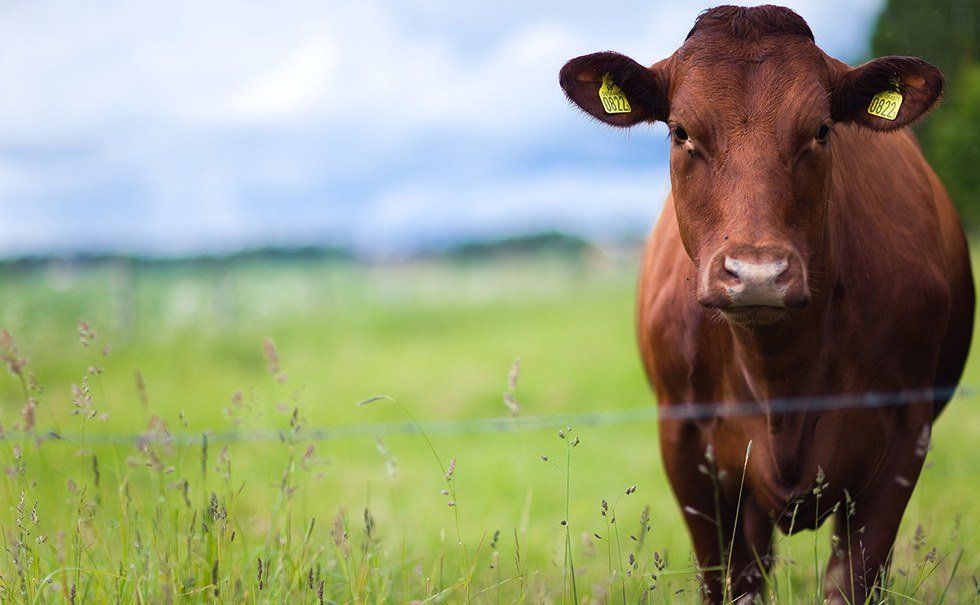
The restaurant—where I worked as a cashier and waitress for about six months—serves burgers, pork, chicken and other vegetables all raised on local farms. The burgers are made from “grass-finished” cattle, meaning the Farm Burger cows spend their lives in an open pasture, eating grass, as opposed to the typical feedlot cattle, who feed on commodity based corn mix.
Cattle Farmer George Cooke raises cattle for Farm Burger in Madison, Georgia. Cooke claims that the grass-finished process for cattle makes a world of difference, not only for the health of the meat but also for the health of the animal.
“One question I’ll get occasionally is how do I feel about raising beef cattle that I know are going to be eaten when it feels a little like a pet…Well, it doesn’t really feel like a pet,” said Cooke in a recent video Farm Burger filmed for the purpose of informing their consumers, “For an animal like this, this is their highest and best use.”
To understand the importance of grass-finished beef, Cook explained the biology of the cattle, in which he clarified that cows are “ruminants” and not herbivores. Their stomach system is four chambered apparatus, and one of these chambers contains rumen bacteria. The bacteria breaks down grass into protein, and the cellulose from the grass is the only product that this bacterium can survive off of.
“When we talk about feedlot,” Cooke continued, “we’re talking about removing the forage that keeps the rumen system alive. That’s where the danger is for the cattle—that’s where the danger is for us in eating that kind of meat.”
The danger Cooke talks about is this: because of the lack of grass, the rumen bacteria begin to die, and because the rumen begin to die, the cattle start to die. So the farmers in charge of commodity cattle use a shotgun approach, pumping the cows full of antibiotics in order to keep them alive. And no surprise, the meat from these feedlot cows are full of high saturated fat.
But Cooke’s cattle, which are allowed to roam and consume the pasture till they’re of mature age, have meat full of Omega 3 and antioxidants. But even before they’re meat, the cattle, according to Cooke, are living full, rich, satisfied lives.
“[These cows] are living the way they were intended to live. They are treated with respect, handled ethically. These are happy, happy cows."
By supporting Cooke’s work, Farm Burger is intimately connected with the local farmers. They endorse the health of their consumers, the pleasure of their consumers, and they make ethical eating easy.
Institutions like Farm Burger allow us to stomach food without feeling the pains of saturated fat, and the pains of tainted morals.
We carnivores can finally justify meat, if we are not ignorant of the toll that the meat industry takes on our bodies and on animals. We can lead our own fight for animal conditions without being complete hypocrites. We can stand up to better our society.
And most importantly, we can still enjoy the smell of bacon.