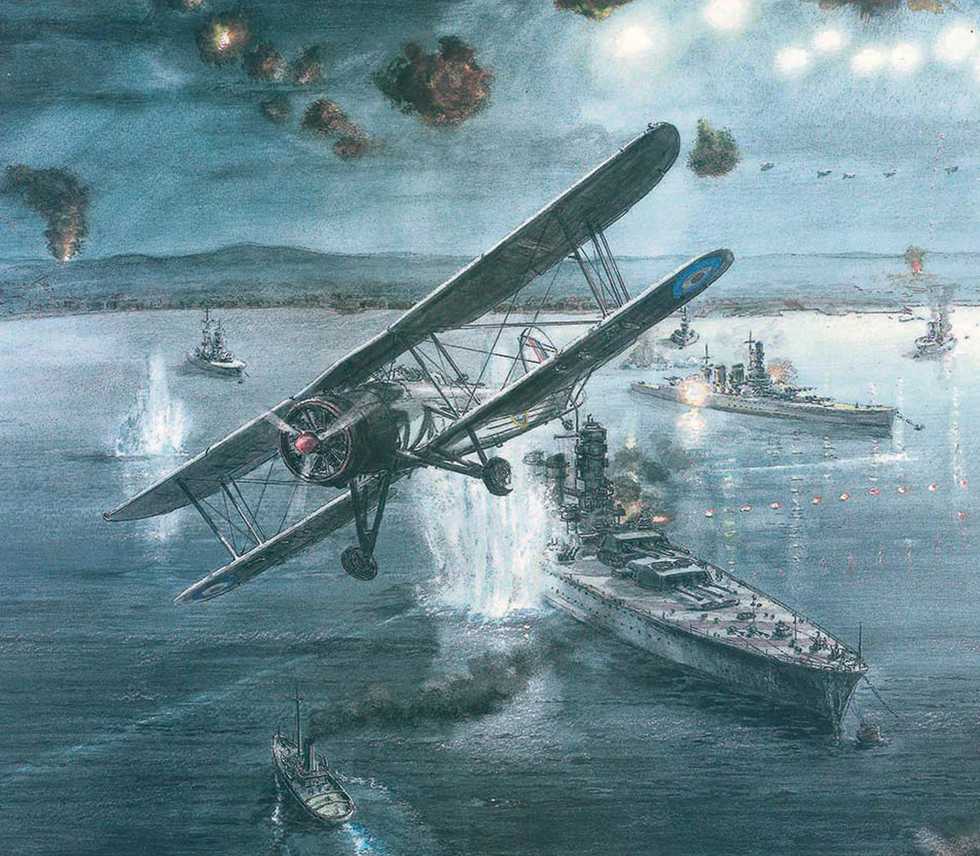
November, 1940. This is perhaps the bleakest time for England, shut away in her island fortress under siege from Nazi Germany. France has fallen and Hitler's armies are triumphant at every turn. The Battle of Britain is underway, and there is still no assurance that Germany will not invade the isle. This is the darkest hour.
However, there is an oft forgot victory – one that would lose Italy the war. Why we never hear of this battle is beyond me, but its contribution to the war as a whole cannot be overstated. The Battle of Taranto is probably considered a minor battle compared to other naval engagements that would follow, but in 1940 it was a stunning victory.
To set the stage:
Italy was an aspiring empire, Mussolini leading the way to a "Novum Imperium Romanum." He saw the colonial expansion of Britain and France and so saught to follow suite, claiming Ethiopia in 1936. The fall of France in 1940 offered Mussolini the perfect excuse to expand Italy's colonial holdings, perhaps even uniting the colony of Libya with the fresh conquest of Ethiopia. All that stood in the way was the British garrison in North Africa, and in 1940 this force was still... lacking (it would not become a serious force until '41, but that is a different story).
It was feared that should North Africa fall to the Italians, Britain would be cut off from easy access to its resource-rich colonies to the east. The strategic importance of the Suez canal became ever more clear when Japan declared war on Britain, attempting to seize those same colonies. While there still existed a route around the Cape of Good Hope, this was a dangerous and much longer route than through the Suez, and reinforcements would take much longer to arrive in the British Raj (India) and British Malaya. In other words, the Suez canal, and North Africa as a whole, was a lifeline for the British Empire. If it were cut, Britain might have been starved out of the war.
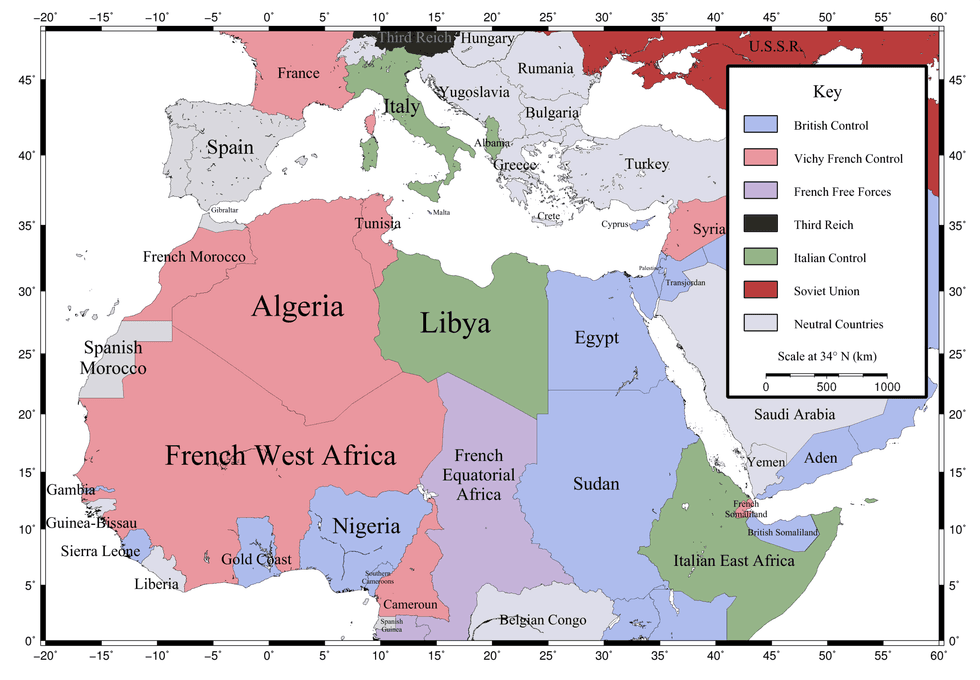
It may seem obvious, but the map above should reveal a glaring problem with Mussolini's planned expansion. Can you see it?
It is the problem every army has faced since the dawn of war: distance. More accurately, it has to do with distance and supplies. Soldiers need food and equipment to fight, and the quickest way to defeat an army is to cut off access to those supplies.
The supply route for a North African campaign would have to cross the Mediterranean, massive convoys of supply ships going to and fro, from Sicily to Libya and back again. Now, I know what you must be thinking: "But England had the greatest navy in the world! Of course Italy was stupid to launch a campaign that would depend on crossing the ocean." There are two reasons why this is a false assumption.
1. Britannia did indeed rule the waves, commanding the largest fleet in the world (although America was close by 1940). However, Britain had the most overseas colonies, meaning this mighty fleet was spread thin over the oceans of the world. There was also the threat of German invasion, so the Mediterranean was not given as great a priority as the home waters of England.
2. The Italians are given much grief for being a weak force in the war, playing second fiddle to the Wehrmacht (German army). But the Italian Navy was an impressive force in 1940, even if it was a bit outdated, and could easily outrun, if not outgun, the British Mediterranean fleet. To quote Brigadier General S.L.A. Marshall, "Class for class, type for type, Britain's fighting ships were slower than Italy's by two to six knots." (Illustrated Story of World War II, Reader's Digest). This meant that the Italians could run supplies past the slower British ships, never even having to engage.
Admiral Andrew Cunningham was the commander of the British fleet out of Alexandria, Egypt. He realized the comparative strength of the Italian navy and so held off from direct engagements, prioritizing escort duty for British convoys. This changed when Cunningham was granted two carriers, the Ark Royal and the Illustrious. Naval air power was still in its infancy at this stage of the war, but Cunningham knew that he now held the upper hand. He had to seize the initiative, but where best to strike?
Most of the Italian fleet was holed up in the well defended port of Taranto, rearming and refueling: a tempting target. Cunningham's plan was simple. The Ark Royal would launch diversionary attack at Sardinia, drawing out the Italian Air Force. With the enemy air power otherwise engaged, the Illustrious would attack Taranto directly, seeking to do as much damage as possible with her twenty-one Swordfish torpedo bombers.
The plan was a resounding success, as it caught the Italian fleet completely by surprise. Two aircraft were lost, but in return the Italian fleet lost two battleships, with another battleship receiving substantial damage. A cruiser and a destroyer were also heavily damaged. All in all, this was an incredible victory. It would be followed up later by the Battle of Matapan, essentially destroying what remained of the Italian fleet. Britain now ruled the Mediterranean, hampering Italian expansion into Egypt.
The war would continue for many more years, and many other turning points would decide the final outcome. But now you know at least a bit more of the story.
Sources:
Illustrated History of World War II, The Reader's Digest Association, INC. 1969. Various Authors.
https://en.wikipedia.org/wiki/Battle_of_Taranto
http://www.wikiwand.com/en/Military_history_of_Ita...http://www.navweaps.com/index_oob/OOB_WWII_Mediter...