
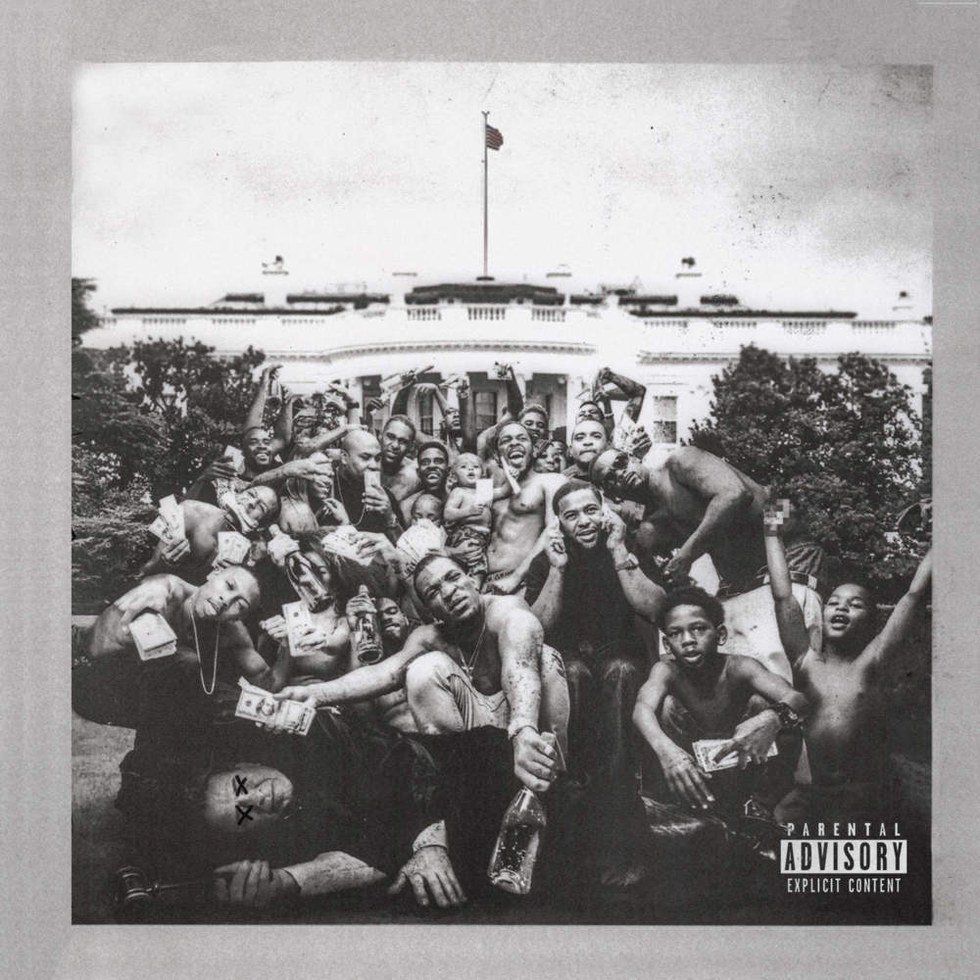
It's impossible to not admit Kendrick Lamar's impacting presence as a societal figure, especially through his recent success. His inevitability of success and groundbreaking societal voice has been proven by his five Grammy wins last weekend, as well as his many other notable accomplishments. I saw fitting to take a gander at his complex album, "To Pimp A Butterfly", and look at it through an autonomous lens.
Kendrick Lamar’s "To Pimp A Butterfly" is an autonomous work of art as it explodes with newness and transformation, constantly challenging the experience of listening to the album as a piece of music. The album is an autonomous being in relation to Theodor Adorno’s theory of aesthetics in his essay: “The Autonomy of Art”. Adorno’s theory states that good art does not directly function or respond to the political platforms of current society. “Art loses its essence when it concedes heteronomy.” Therefore, art becomes less great when it surrenders to influential, outside forces. Art is a “windowless” entity that lives and acts completely on its own, radiating essence and meaning that is so compact and layered that a naked eye may not even touch its poignancy or existence. Great art is not meant to be beautiful, aesthetically pleasing or explicitly understood. Great art is meant to be affective, drawing on extensive feelings that may or may not be cohesive to the current state of society. Great art is not based on sameness, but rather is “independent from society”. The art acts as a sole unit by itself. Its layered and compact nature makes it impossible to completely relate it to specific themes or conditions. However, the art affects the reader, listener or viewer enough to be transported through a challenging and transformative experience. Lamar’s album collectively lives as an autonomous being, translating his personal experiences between Compton and the celebrity world. As the album examines the responsibility of Lamar’s celebrity and the fight against temptation and evil within the music industry, "To Pimp A Butterfly" acts as an expressive exit out of the conditions he illustrates. Kendrick Lamar’s "To Pimp A Butterfly" lives as an autonomous work of art as its narrative does not explicitly convey a telling of the corruption that exists within our current society. It shows rather than tells the truth and realism of Lamar’s encounters with evil, temptation, injustice and racism while transcending its genre of music within the category of art, exercising as a piece of music, literature, and commercial art.
"To Pimp A Butterfly" explodes into a self-loving declaration in its first track, “Wesley’s Theory”, that sets the tone for the entirety of the album’s efforts: “Every nigga is a star / Who will deny that you and I and every nigga is a star?” The track’s sample subtly enters the ears of the listener, conveying a notion of the mortality of these lyrics. These words are the first introduction of the album, asking the listener to be challenged in order to conceive their notion, influence and impact, in accordance with what the rest of the album will entail. Following the sample is a continued introduction issued by a distant individual: “Are you really who they idolize? To pimp a butterfly”. Still within the introductions of the song, the listeners are explicitly given the two most prominent themes that will be executed throughout the next sixteen songs: race and celebrity. The question of idolization witnesses Lamar’s struggle to use his celebrity in a positive way by not succumbing to the “evils of Lucy” that he will share later in the album. “To pimp a butterfly,” begs the question of: how does one pimp their situation in order to not be pimped by the industry? How does one pimp their celebrity into something good? Lamar will answer and explore these questions.
“Wesley’s Theory” quickly enters a state of ambiguity, as Lamar shifts his address to a lost lover/ “first girlfriend”, following claims of his future fame and success as a rapper. “You a house, you a car? Forty acres and a mule, a piano, a guitar? / I’mma put the Compton swap meet by the White House...Uneducated but I got a million-dollar check like that.” Lamar offers ideas and wishes that trace to a time where the idea of success was new yet distant. In a 2015 interview with MTV, Lamar admits that: “these lyrics is me going back to the feeling of what I wanted to do when I got signed”. Therefore, the artistry in this particular opening song transcends beyond its face-valued reading. Lamar consciously offers the thematic essence of the album’s narrative, and then quickly turns to ambiguous storytelling in order to create a more effectual experience. Lyrics such as: “uneducated, but I got a million dollar check like that / We should never gave niggas money, go back home,” exude Lamar’s strategically offering conflict, as the idea of fame and celebrity negatively affecting black culture is problematic and racist, due to the fact that Lamar’s people are ill-prepared for success. In his MTV interview, he explains his frustration: “I spent my time in school escaping prison and the system. So you mean to tell me that the moment I become successful, and I don’t know how to manage my money, that you’re going to throw me back in jail with taxes?” (Lamar, 2015). Lamar witnesses that there is a reproachful system of violence and ill education that terminates his culture. This inescapable lifestyle troubles Lamar, and this inevitability of suffering causes him to make such music, so that a change may occur.
"To Pimp A Butterfly" quickly transitions into an inexplicable interlude that exhibits intangible, thematic qualities that are not explicitly presented on a surface level. A female’s monologue presents a telling misuse and conflict in a relationship. The blatant questioning exuded in the female’s argument finally begs the question: “What the f*ck is really going on?” Finally, Lamar enters with backlash against the female. His freedom and liberty are jeopardized in this relationship, causing Lamar to scrutinize the affects of the situation: “livin’ in captivity raised by my cap salary.” This realization leads to an unveiling of layered meaning behind the relationship and conflict with this woman. Lamar ends his lament: “oh America, you bad b*tch, I picked cotton that made you rich, Now my d*ck ain’t free.” Lamar unveils that this abusive relationship is actually representative of a black man’s experience living in the United States. Lamar’s deliberate choice making when issuing songs that exhibit great conflict and problematic topics through thematic and symbolic storytelling furthers his work’s ability to be considered autonomous. "To Pimp A Butterfly" does not directly display the issue at hand, but rather acts as a challenging, unfolding experience that involves the listener in its unveiling.
"To Pimp A Butterfly" continues its transformative nature in “King Kunta”, where Lamar illustrates his returning to Compton as a successful rap artist. In the 2015 MTV interview, Lamar claims: “I wanted it to be simplistic in a boastful way. I also wanted a sense of integrity behind it. I wanted it to be about making it your own, and saying I am a king” (Lamar, 2015). The amount of artistry in the album is apparent in this up-tempo track as it illustrates Lamar’s frustration with the rap industry, however his ability to overcome and challenge the evil that surrounds him. “Now I run the game / got the whole world talking, King Kunta / Black man taking no losses / Everybody wanna cut the legs off him when you got the yams.” The question of “what’s the yams?” is answered: “the power that be”. Lamar is indicating that as soon as a black man exhibits success, wealth and power, society takes no avail in attempting to bring him down. The up-tempo nature of “King Kunta” masks the dangers and discrepancies that exists in Lamar’s lyrics, allowing listeners to be challenged and question what is truly be communicated. Again, "To Pimp A Butterfly" may be considered an autonomous work of art through this track, as the explicit meaning of the song is not fully presented to the surface listener. This follows Adorno’s theory: that great art isn’t instruction or politically doctrinaire, but forces us to think.
Following “King Kunta”’s up-tempo track is a dark, vivacious story in “These Walls”. Prior to the songs beginning is the album’s first unveiling of Lamar’s final poem that is shared with Tupac in “Mortal Man”: “I remember you was conflicted, misusing your influence / sometimes I did the same.” Following the poem is a song full of narrative and storytelling. Rather than writing another song that explicitly exhibits the thematic qualities of the diction, Lamar chooses a narrative to express the trials of evil that one may experience when being a victim of the celebrity world. “Killed my homeboy and God spared your life / dumb criminal God indicated same night / So when you play this song, rewind the first verse / about me abusing my power so you can hurt /about me and her in the after hours of the morning.” Lamar issues a narrative of an experience with a man who killed Lamar’s close friend, and is now serving life in prison because of it. In order to enact vengeance on the individual, Lamar sleeps with the man’s girlfriend. Lamar presents an intensely controversial situation, allowing the listener to be challenged by the storytelling. Why does Lamar include such a narrative? The narrative contributes to the thematic essence of the album by providing an explicit, living example of how the “evils of Lucy” affected the rapper. The act of choosing a factual narrative to present the truthful consequences of gang violence and the celebrity life further illustrates the autonomy of art within the album. Though explicit in its storytelling, “These Walls” does not directly point towards Lamar’s themes. Its challenging and transformative nature is what brings the listener to an understanding of the demons Lamar faces. The track ends with a continuation of the poem: “abusing my power, full of resentment / resentment that turned into a deep depression / I found myself screaming in a hotel room.” The continuation of the poem displays the demons that Lamar has endured in these experiences, and it is in this lament that the artistic message of the album continues to unfold.
"To Pimp A Butterfly" continues its autonomy through a trilogy of songs that journey through Lamar’s experience with finding self-love in the entertainment industry. “u” finds Lamar screaming, issuing that “loving you is complicated”, meaning himself. This song is a self-declaration of Lamar’s struggle to find reverence and love for himself, as he places “blame” and “shame” on himself for reasons indirectly shared. This particular track is one of few where Lamar directly expresses his emotional journey in lyrics, rather than exhibiting storytelling in a narrative. His most poignant admittance can be found in the lyric: “the world’ll know money can’t stop a suicidal weakness”. His suffering is evident, despite his fortune and success. This track suggests that Lamar has fallen under the “evils of Lucy” at some point in his career, and he is here now to share what he has experienced.
The second track of the trilogy follows directly after: “Alright” requires a thematic transition from “u”, a self-deprecating track to a relatively uplifting, empowering and hopeful song. “But if God got us / then we gon’ be alright”. This track indefinitely pays witness to the treacherous experiences of recent events towards the Black community in the United States, however a message of hope and optimism is issued in order to bring an emphasis of positivity to their situation.
The final component of the trilogy, “i”, acts as a complete reversal of “u”. “i” exhibits a song of self-celebration: “I love myself”. Inspired by the lack of self-love in the streets of Compton, “i” is a song about self-expression, offering redemption in comparison to other songs on the album. However, what is so especially impacting is that Lamar deliberately chose a live performance track of the song to be featured on the album in substitute of the studio single. The impact this decision made is that the song trails into an off stage argument, in which Lamar displays some of the most profound lyrics in the album:
“On how the infamous, sensitive n-word controls us…until this my explanation straight from Ethiopia / N-E-G-U-S definition: royalty; King royalty - wait listen / N-E-G-U-S description: black emperor, King, ruler, now let me finish / the history books overlook the word and hide it / America tried to make it to a house divided … take it form Oprah Winfrey, tell her she right on time / Kendrick Lamar, by far, realest Negus alive.”
Lamar’s choice making in including this narrative challenges the listener to witness and understand the true meaning of what Lamar is conveying. Lamar finds refuge in a word that has infamously degraded his culture, linking its roots to a definition that actually engages in empowerment. The inclusion of this discussion profoundly influences the themes within the album, as Lamar takes his celebrity opportunity to educate and empower; “pimping” his celebrity into good: “a butterfly”.
As "To Pimp A Butterfly" comes to a close in “Mortal Man” with Lamar’s discussion with the late Tupac Shakur, it is evident that the album has transcended the genre of rap music. Lamar’s work is autonomous in this transformation. The transformative, exploding nature of the album adheres to Adorno’s theory, as Lamar works within the genre of rap to expose the limitations of a “fully administered capitalistic” world by exploring its ills indefinitely.