

This Thursday, millions of Americans across the country will gather to give thanks and gorge themselves on turkey, cranberries, pumpkin pie, and stuffing. Thanksgiving has become a highly commercialized, heavily advertised holiday, the popularity of which appears to be inversely proportional to the amount space left in American stomachs post-feast.
Please don't misunderstand me--I love thanksgiving. Any holiday characterized by the consumption of massive amounts of food is an automatic 'win' in my book, and I treasure the annual reunion with loved ones just as much as the next person. However, I do think that the essential point of the holiday is often lost in the hustle and bustle of Macy's parades and Black Friday deals. In its original form, Thanksgiving was a celebration of immigrants, by immigrants, and for immigrants. The common misconception of a harmonious feast between Native Americans and Pilgrims has been largely debunked.
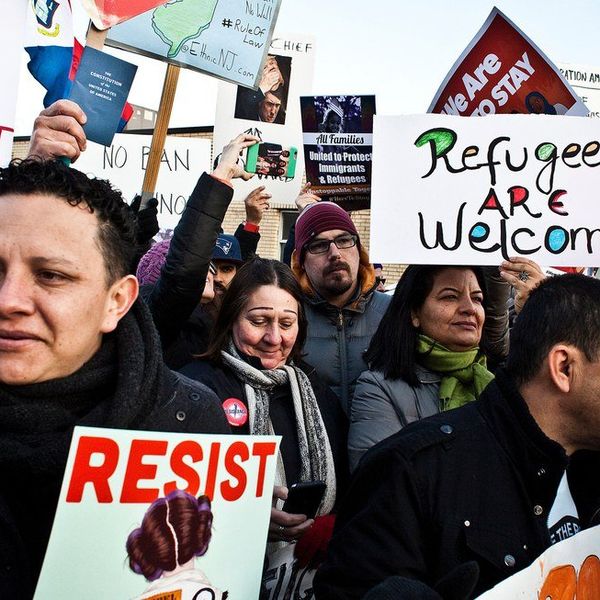
This year, in the midst of the Syrian refugee crisis, it is perhaps particularly important to remember the true origins of Thanksgiving. Perhaps acknowledging this will help break down the imaginary notion of what constitutes a true "American" and the us vs. them mentality that has come to characterize the immigration debate.
European countries, including Turkey and Germany, have made active commitments to providing sanctuary for Syrian refugees. The United States, on the other hand, has admitted a measly 1,500 refugees into its borders. Why should the United States admit Syrian refugees? Granted, general human compassion and decency may provide a rational basis for admittance; of the 12 million Syrians forced to flee their homes, half are children, and the coming winter months spell disaster for the homeless refugees. Of course, in the past arguments for compassion have yielded little substantive action; fear, often in the form of illogical generalizations, tends to override even our most basic instinct to help others.
To alleviate concerns, one must only take a look back to history for reassurance. In 1980 alone, the US admitted over 125,000 Cubans immigrants. In 1975, we took in 125,000 Vietnamese refugees. In 1988, 300,000 Soviet Jews fleeing persecution. These major immigration influxes did not wreak havoc on the United States--conversely, they contributed to the rich fabric of social and cultural diversity that characterizes the United States today.
In response to those who fear overpopulation, I argue that the major problems of overpopulation arise from poor allocation and conservation of resources, a problem that will NOT be solved by refusing admittance to needy refugees. In response to those Americans who fear that the admittance of refugees may equate to the admittance of terrorist into US borders, my argument is two-fold:
Firstly, that the United States does not just wave immigrants through its borders haphazardly--there is a comprehensive screening system set in place to combat the admittance of terrorists along with the innocent.
Secondly (and more importantly), that these individuals have fled their homes for a reason: to escape violence, persecution, and poverty. The underlying assumption that Syrian refugees may carry some sort of terrorist agenda is inherently racist and reflects a disturbing ethnocentrism on our part. After all, 82 percent of terror-related deaths have occurred in the predominantly Muslim countries of Iraq, Afghanistan, Pakistan, Nigeria, and Syria. Understand who the real enemy is.