
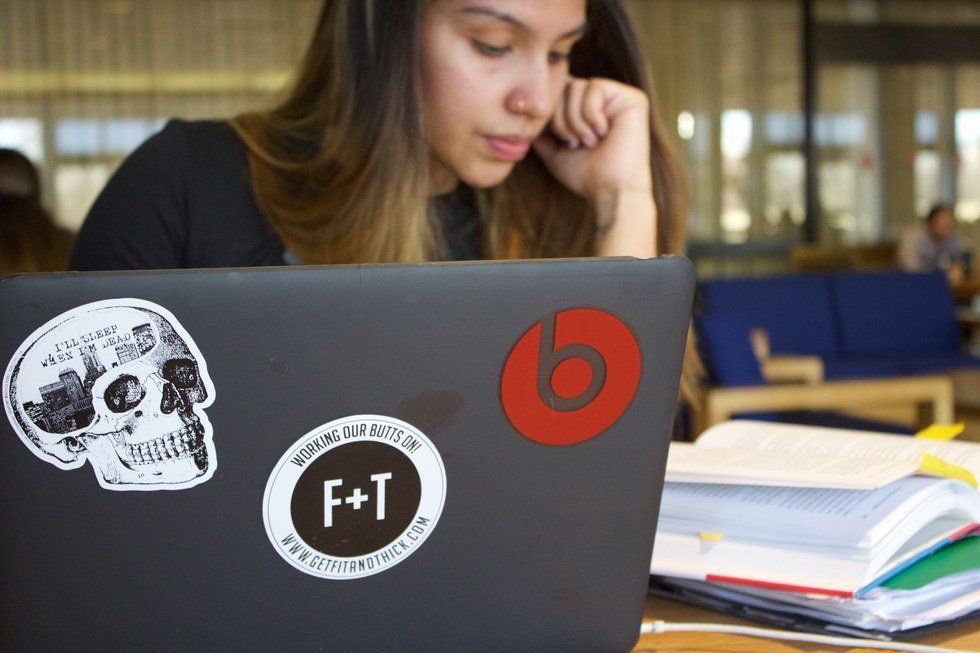
The semester is coming to an end, and, as the summer sun peaks out from behind the spring clouds, finals week rears its ugly head and we all have to bend to its will. Everyone knows the pain of being cooped up in the library while the rest of the world is outside enjoying the last few days of the semester. It sucks! Here are a few tips to help make finals week less painful and hopefully get out of the library quicker than usual.
1. Don't procrastinate.

Procrastination is your worst enemy. Whether you study or not, your final is still going to happen. I know that it is really tempting to do literally anything other than studying. Maybe you'd prefer to hang out with your friends for an hour or watch cat videos on YouTube until 1 a.m., but the sooner you get started with your studying the sooner you can finish! Then you'll have tons of time to do whatever it is your heart desires.
2. Put the phone away!

This is the tip that I struggle with the most. Texting, scrolling through Instagram, playing "Flappy Bird," etc. is all so tempting, but it eats up hours and hours of time. I always find that as soon as I put my phone away I am so much more productive and I finish things 10 times faster. I also notice that if I'm not constantly distracted by that bright little screen, I tend to retain and understand information much better. So take it from me and put the phone away!
3. Create a study schedule.

This tip goes hand-in-hand with avoiding procrastination. Sitting down and allocating time each day to do what you need to do will ensure that you stay on track and don't forget anything. The best strategy is to block off a little time every day do review for each of your exams. Thirty minutes every day is a lot more manageable than six hours in one night!
Also, don't forget to write down all of the other tasks and deadlines that you have to meet for the week. There's nothing worse than the panic that accompanies the realization that you forgot to turn in a practice test or go to a review session!
4. Sleep!

According to my Psychology professor (shout out to Professor Dunne!), there is a direct correlation between sleep and cementing of information in your brain. So basically, if you don't sleep, whatever it is that you are trying to learn is not going to stick in your head. Also, if you pull an all-nighter the night before an exam, chances are you could sleep through your exam the next day and miss it all together, so just go to bed! Sleep is really important for your overall health, so make sure you're getting at least six hours a night.
5. Make a study group.

Sometimes studying alone just isn't enough. With a study group, you have a team to work through problems with and discuss things you don't understand with. You can bounce ideas off of one another and quiz each other so that everyone knows the material. In a study group, you have the opportunity to learn from your peers and to teach them as well. Chances are if you can explain (or teach) a concept to somebody else, then you know it pretty well.
6. Take breaks.

I don't mean open up all your books, read a sentence and then get lost in cat videos on YouTube for the next three hours. I mean study for an hour and then get up and do something else for a maximum of 15 minutes. Take a walk, read a book, get a snack, catch up on your Snapchats -- whatever you want, but don't get caught up in it! Set a timer, and when the time's up, get back to work.
7. Change it up.

Don't just work on one subject all day. If you vary the topics that you are studying for then you are less likely to get bored and frustrated. Reviewing for a variety of exams each day will ensure that you are better prepared for all of those tests, not just one. It will also give your brain a much needed break from whatever it is you were doing, so that when you come back to it later, you aren't as overwhelmed by all the information.
8. Review old exams.

There's an old saying that goes, "Fool me once shame on you; fool me twice shame on me." Obviously, this idea can be applied to a bunch of different situations, but for our purposes it means that you should review the mistakes you made on past exams to avoid making them again! Also, when you review past exams, you should pay attention to the style of the exam that you are going over, because it is more than likely your final will be written in a similar style.
9. Take a deep breath.

My dad always tells me to take three deep breaths before I do anything that I'm nervous about, and it always helps. I never knew why it worked until this year, when I discovered that there's actually a physiological reason behind it. Taking slow, deep breaths engages what's called your parasympathetic nervous system, which calms you down and relieves stress.
10. Picture yourself succeeding.

I am a firm believer in positive manifestation. I think that if you believe that you are going to do well, then you will. Remember, no one ever achieved anything without believing that they could!