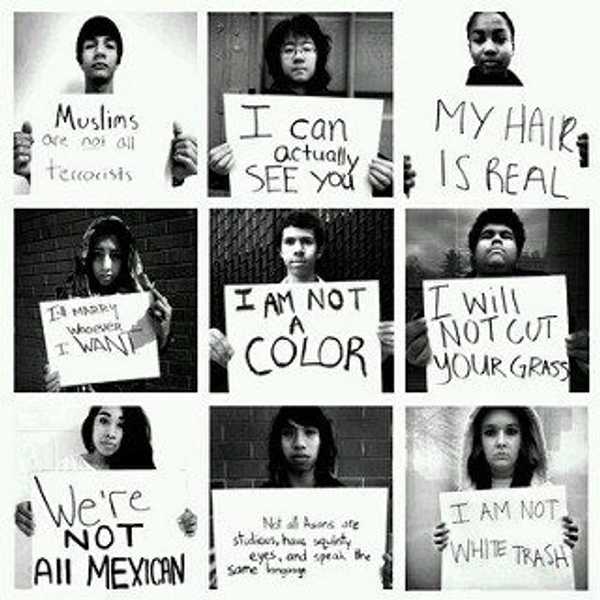


A “disposition” can be defined as a value, attitude or belief that influences behavior. Dispositions develop over time, and are often consequences of circumstance. Here’s a simple example: If I decide to eat lunch at a chain restaurant—say, Chick fil A—and become sick shortly thereafter, I’m going to hold a negative disposition in regard to that restaurant. I may not choose to eat there ever again, and in that way, my disposition influences my behavior.
Since dispositions develop with time, no one is born with them. They are learned and conditioned. The most harmful dispositions are race-related, but no one is born a racist. This fact alone proves that the cycle of perpetual racism can and will be broken, so long as we cease teaching these hurtful behaviors and emphasize inclusion in their place. The first step is to identify where these behaviors are learned.
Throughout our lives a wide range of people will teach us new ideas: parents, coaches, siblings, friends—but perhaps some of the most influential are our elementary, middle and high school teachers. Teachers meet with young, impressionable students for nearly seven hours every day. They stretch their job descriptions so much farther beyond basic curriculum; they facilitate students’ academic, social and physical development. Their job is an important one: they can help to break the cycle.
A more diverse world calls for more diverse teachers: teachers who implement racial-cognizance and multiculturalism within their lesson plans can be defined as “diverse.” Teachers who negotiate cultural differences can be defined as “diverse.” Celine Provini, EducationWorld editor, claims that teachers who “discuss how race, religion, culture, geography and socioeconomic status intersect” can be defined as “diverse.”
I was once told by an old classmate of mine that “racism doesn’t matter.” I was told “it will always exist, and that I should just get over it.” I can’t accept that. Racism is learned. Racism is unnatural. No one is born with racial dispositions.
Teachers are so important to our society because they can take it upon themselves to deconstruct racist beliefs. For seven hours a day, every day, teachers can tackle racial bias. Multicultural curriculum is needed now more than ever, and a more diverse world demands teachers willing to negotiate cultural differences.