
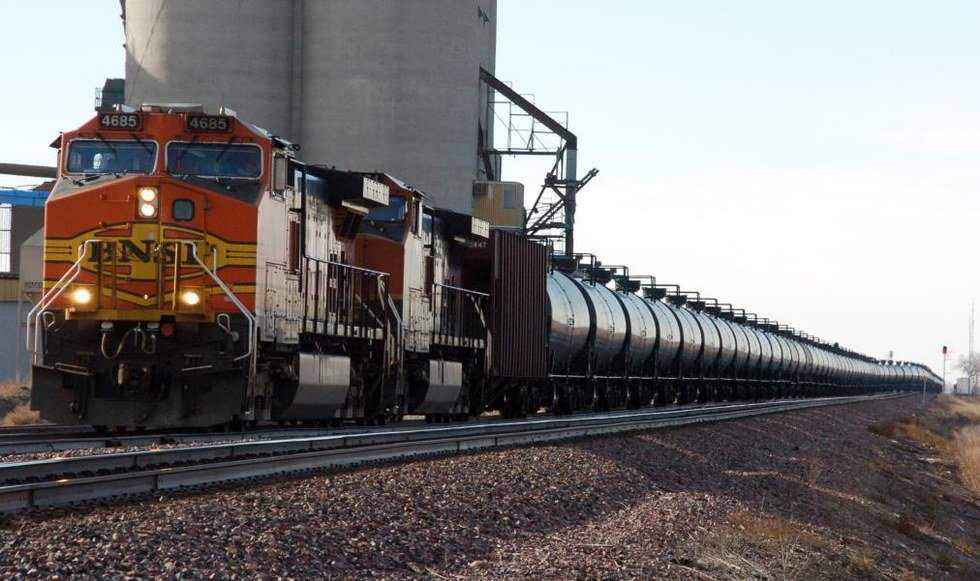
Across the United States there are roughly 140,000 miles of track. In a lot of ways, trains literally connect and create a backbone for the US, and more importantly provide industries around the country cheap and fuel-efficient ways to move large amounts of merchandise and commodities. Trains will become even more valuable if/when oil prices go up again, but as great as trains are, there is one issue in particular that concerns me. I should mention that I am a person who has grown up loving watching trains travel across America. On some days, you may even find me down at the railroad crossing in Huntingdon, PA, the town where my college, Juniata College, is located. But, as much as watching a mile or more long freight trains roll through Huntingdon, which fills me with excitement, I have a problem with one type of commodity train in particular. These are the Brakken Oil trains. I have a problem with these because every one of these 100+ tank cars on that train is a disaster waiting to happen. The tank cars which transport this crude oil are known as DOT 111s. They have been shown to be inadequate for carrying crude oil and have a tendency to rupture.
One of the best documented cases took place in Canada in July of 2013. An oil train carrying 72 tanker cars derailed in Lac-Mégantic, Quebec, causing extensive damage and the loss of 47 lives. Of those 72 tank cars, 63 of them derailed. The most disturbing aspect to these 63 derailed tank cars was that they all suffered rupture damage, large holes in the shields which were designed to keep such rupturing from occurring. Not only did this accident have a huge impact on those living within the community, but also on the environmental. When it was all said and done, the Transportation Safety Board of Canada estimated a total of 158,503 gallons of crude oil leaked from the damaged cars. However, if people want evidence of the continual dangerous use of DOT 111s, it is not even necessary to go to Canada, as there have been documented cases of oil train derailments here within the U.S.
A rather current example was back in early June of 2016, when a train in Oregon carrying a fully loaded oil train ran over poorly maintained tracks, causing it to derail and cause a subsequent pile up of DOT111s, along with a fire when the leaking oil was ignited by a spark at the crash site. The Department of Transportation (DOT) is well aware of the inadequate construction of these tank cars, but what exactly are they doing about it? In truth, they do have a plan in place, but they are taking too long to implement the strategy. The DOT released their plan to replace the DOT111s with the redesigned and safe DOT117s, but have given the railroad till 2018 to get the task done. Although this date is within the near future, if the tank car replacement action goes anything like the positive train control deal, it will be many years before America sees the full removal and use of the dangerous DOT111s.
Fortunately, the US has yet to experience an oil disaster such as the one which impacted Lac-Mégantic, Quebec, but the longer those volatile tank cars are used, it comes down to a question of not if a major oil rail disaster will happen, but when.