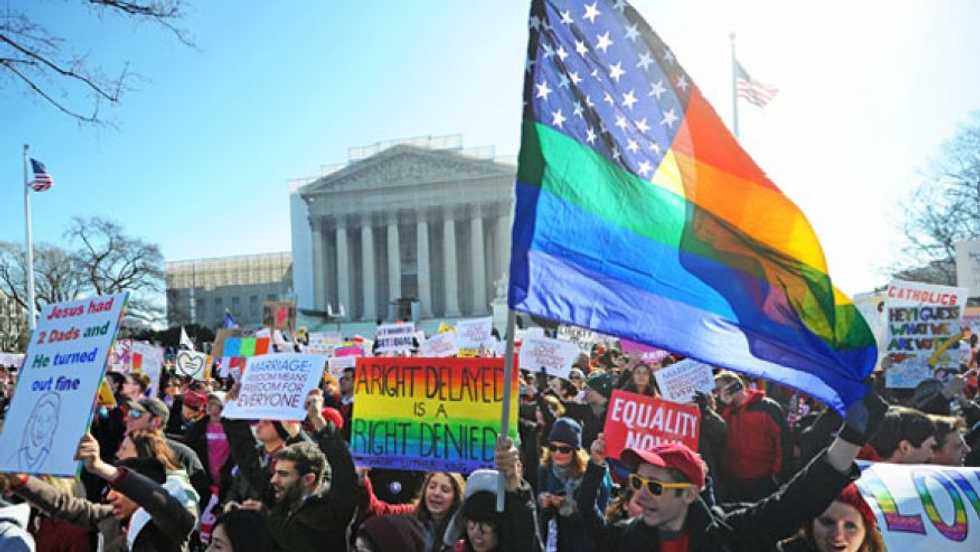
My first real Facebook purge came not long after the Supreme Court released its decision to lift the ban on same-sex marriage in all fifty states. Though a lot of my timeline was filled with love and acceptance, there was also a lot of anger. While everyone is entitled to their own opinion, in my six years on Facebook I had never read as much hate and bigotry as I had in the few days following the ruling. The second time came when Bruce Jenner came out as transgender and began his transition to being Caitlyn. The most recent purge came from the recent Kim Davis debacle here in Kentucky.
Is anybody else noticing a theme here?
Arguably the most common phrase I read was, “homosexuality is wrong because it is destroying the sanctity of marriage”. But to be perfectly honest— I don’t see how. This past summer, I was given the opportunity to intern with a judge in family law and I got to see the ugly side of marriage up close and personal. For three straight months I witnessed hundreds of people wait in line to end their marriage— hundreds of heterosexual couples— and let me be the first to say that you have never seen drama until you’ve spent some time in family law. I saw people break up marriages that had lasted forty years and some that barely made it to six months. I heard horror stories of abuse and infidelity. I listened as people dragged their spouse through the mud over a couple hundred dollars or a missed alimony payment. Families were ripped apart, children were put in the middle of the battle, and very few people ever tried to reconcile their differences. While this was happening, did anyone ever protest these actions? Did the judge ever try to refuse them their dissolution because it went against his or her religious beliefs?
The answer is no.
We don’t focus on these things because they’re commonplace. They happen on a daily basis and we’d rather chastise the decisions of other consenting adults than try to fix our own problems. No one wants to talk about what same-sex marriage really does for people and why it is important because they don’t understand it, but I witnessed a small part of it this summer. I watched as a transgender individual got to change her names to the gender that she felt most comfortable with. I watched as a woman lit up and ran into the arms of her spouse when the judge granted her request to change her last name. I watched as each one of these individuals felt accepted for the first time, and it really made me think twice about everything that’s going on in the news. This leads me to the whole Kim Davis controversy.
Let me just start off by saying this— Kim Davis is not a martyr. She is not the next Martin Luther King Jr. or Rosa Parks. She is a criminal and whereas they broke the law to grant basic rights to people, she is fighting to take them away. Contrary to what Republican Presidential candidate Mike Huckabee wants to think, the jailing of this woman was not the first step in the ‘criminalization of Christianity’. Kim Davis was not put in jail because of her convictions or her religious beliefs. Kim Davis was put in jail because she tried to impose those beliefs on other people, and more importantly she ignored a direct order from the Supreme Court. Under any legal definition is most certainly grounds for contempt. Despite what many people want to believe, this decision isn’t the start of mass persecution in a country where Christianity is still the majority religion. This isn’t the beginning of the end. This is simply the punishment for a woman who broke the law.
Putting her in jail is not the government saying that she can’t have those beliefs. They aren’t saying that she can’t view the marriage of a same-sex couple as wrong. They are telling her to do her job. They are telling her, that as an elected government official and a public servant, she cannot use her power to discriminate against people based on her own personal views.
At the end of the day all you really have to do is ask yourself one simple question. If Kim Davis was Muslim or Jewish or Hindu or any other religious affiliation would you be fighting just as hard for her rights? If she wanted to deny someone a marriage license based on another belief would you be okay with her going against a direct order from the Supreme Court or infringing the rights of other people to satisfy her moral obligations?






 man running in forestPhoto by