


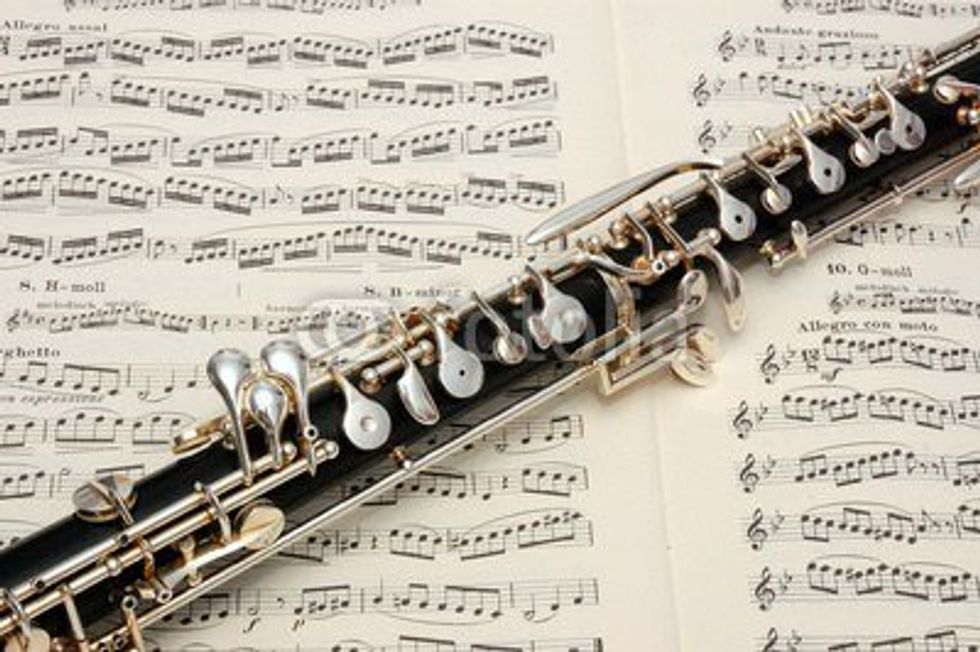
Like many other elementary schools in my area, in fourth grade, I had the opportunity to learn how to play a band instrument, and subsequently play in the concert band. It was a great life decision, and there are many, many things I could say about how music has shaped my life and helped define me as a musician. That being said, this article is dedicated to the instrument that I chose and have been stuck playing for the past 11 years and the inevitable struggle every person who plays it faces. What is this instrument, you may ask? The oboe.
I can’t count the number of times people have come up to me while holding my oboe in my hands, asking, “Oh! You play the clarinet?” I usually stand there dumbfounded and assume the person I’m speaking to has no knowledge of band instruments. I realize that it looks similar, with the black body and silver keys, but no, sorry, it has a double, not a single, reed. I also can’t fathom why Google images seems to think that an oboe is a bassoon -- the oboe is in treble clef, the bassoon is in bass clef, and there’s also a bit of a size difference. Really, people? It’s the worst insult.
Speaking of insults, when I was in high school, my friends, while they said they loved me, took joy in insulting me and joking about my oboe. My friends have said that the oboe sounds like a dying duck, someone strangling a duck, or, one that a special friend has explained to me, a duck in a vacuum. The most common jab I’ve heard from people is, “How do you get two oboes in tune? You shoot one.” I get it. Oboes sound awful when they are played blaringly out of tune. There are immense amounts of others. Just type “oboe jokes” into Google and you'll find the cache.
While concert band was one of my favorite extracurriculars during grade-school, I was also a participant in our school’s marching band. When I arrive with an instrument other than the oboe to the first rehearsal, they ask where my oboe is, and why I’m not playing it. Excuse me, are you made of money? Neither am I. Oboes, ones that are well-made, are usually made of wood, and are really delicate and sensitive to temperatures and humidity. If it gets too cold or dry, my oboe will crack right down the upper or middle joint, and I’ll have to pay upwards of $1,000 to repair it, or buy another joint all together. Instead, I play the saxophone. Others play flute or mellophone, because they are made of metal and won’t die a horrid death if they are played outside.
Additionally, when there’s no oboe part in an arrangement, which happens more times than you may think, oboes play the flute part. This isn’t as bad as it seems, until there’s a flute part that goes into four or five leger lines above the staff. On the other hand, and much to my dismay, there are also many band pieces that have some sort of oboe feature in the middle of it. Anyway, because oboes are so diverse in the moods they can accomplish, it makes them the perfect instrument for solos in any piece. In orchestral pieces, you should just leave rehearsal if you are an oboe player who doesn’t like soloing -- there’s an oboe solo in almost every orchestral piece. So if you’re one of two oboe players in your school, and there’s a symphony orchestra, you’re stuck playing all those solos… like I was. (Can’t you tell I hate solos? I’m probably only one of a select few that do.)
Finally, the biggest and most annoying struggle for every oboe player are reeds. You’ve probably heard all woodwind players (aside from flutists), complain about their reeds. Oboe players are no exception; it’s probably even worse because it’s a double reed, and not a single reed. Let me explain. A box of clarinet or saxophone reeds costs anywhere from $20 to $40. A single oboe reed, which lasts about a month, or 12 to 15ish hours, sometimes even shorter, depending on the quality, start at $15 to $20 apiece. They’re extremely fragile, temperamental, and no two reeds are exactly the same. Some blare, some are too short, and, therefore, too sharp. Sometimes, you play them so much they stop working, and you cry when you have to put that reed to rest. Professional oboe players make their own reeds, because it’s cheaper, but for college students (who are in the process of learning how to make their own) and grade school students, $20 a pop is usually a good price for a handmade reed (the mass-manufactured ones are absolutely awful). It’s a sad fact to say a large portion of my bi-weekly paycheck goes to my oboe reed-making supplies and oboe reeds my instructor makes for me.
But hey, despite all of these struggles, there’s no other instrument I can picture myself playing -- and let’s face it, it’s fun to complain about, too.

















