Once upon a time, there was nothing - no things, no space, not even time. And then, there was everything. But that everything was condensed into an infinitely dense, extremely hot, extremely tiny point: a singularity. This was the result of the Big Bang, the birth of our universe.
And then a hundredth of a billionth of a trillionth of a trillionth of a second - to put it into numbers, 10 to the -34 seconds - after the universe started, it began to inflate. Rapidly. It went from smaller than an atom to the size of a golf ball in almost no time at all. And then it slowed its expansion and began to cool.
A millionth of a second after the Big Bang, the forces of nature separated themselves: gravity, the strong force, the weak force, and the electromagnetic force. The Higgs field interacted with other subatomic particles and gave everything mass. Matter became a thing, and hydrogen atoms formed.
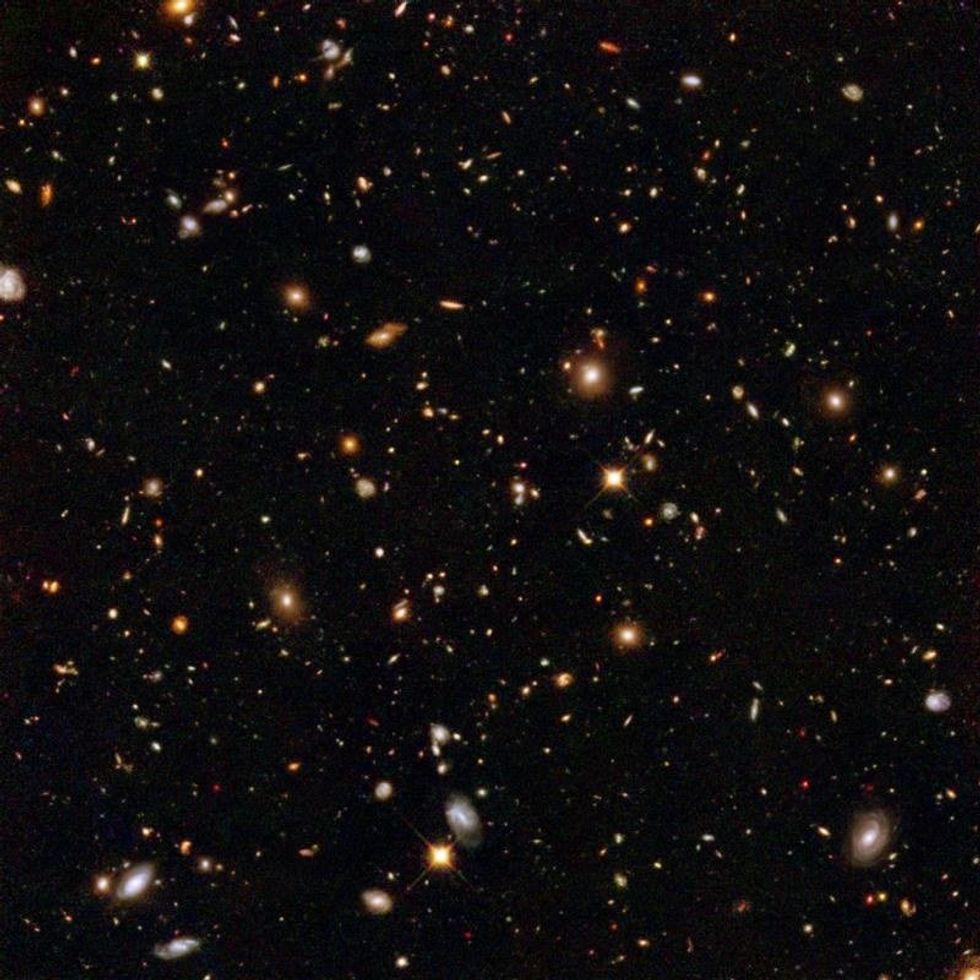
The universe was pretty smooth and even throughout. But not perfectly. There were clumps in the gaseous universe-soup. Slowly but surely, those clumps grew. When the universe turned about three to four hundred million years old, those clumps of gas collapsed into the first stars.
Fast forward to five billion years ago. By this time, the universe was filled with stars and galaxies, and its rate of expansion had increased again so that everything was moving farther away from each other, faster and faster. In a galaxy with about a hundred billion others, a cloud of molecular gas sat. It was relatively uninteresting, until a rather exciting thing, or perhaps things, happened.
Massive nearby stars exploded. They expelled their masses at rates of 67 million miles per hour (10 percent the speed of light!), outshining their galaxies for just a few short weeks. These supernovae sent a shock wave through space, through that cloud of molecular gas, and the densest regions collapsed in on themselves. At the densest part, the center, a new star was born. This star was our Sun.
The region around the Sun was not empty. There was a much cooler disc of dust and gas surrounding it. Closest to the Sun, the rarer, heavy metals accumulated to form little rocky objects. Beyond those, larger objects made of lighter elements formed. They would become, respectively, the terrestrial planets and gas giants of our solar system.
In that area closer to the Sun, where those small, rocky objects formed, one object in particular would become quite interesting. This little object, which was what we call a planet, formed an atmosphere. This planet, like many others, accumulated water. The water here was special, though -- while it was only vapor or ice on other bodies, on this world, water was liquid. The planet was not so close to the Sun and its heat that the water would vaporize, and it was not so far that it would remain solid ice in the extreme cold. In the words of the great Goldilocks, it was just right.
This just-right planet was the Earth. It was also just right for organic compounds to form. About 3.6 billion years ago, the first life, simple single-celled organisms, arose from these organic compounds. A short two hundred million years later, photosynthesis-performing cyanobacteria came about. They slowly infused the Earth’s atmosphere with oxygen, and life continued to grow in its complexity.
It took 3 billion years from the formation of the first life forms, but eventually, life on Earth evolved into animals. And only 200 thousand years ago, a really cool species of animal appeared. That species developed complex social organizations and civilizations and employed simple tools in their daily lives. Those simple tools evolved into much more complex technologies, and eventually these animals that took so long to form on the Earth traveled outside of it. They built vehicles to travel over the Earth, across the oceans, in the air, and, finally, above their atmosphere as they looked to the stars. And among those animals are you and I because this species was homo sapiens, humankind.
This is the story of us, and for us to exist, the universe had to go through a fourteen-billion-year long, painstaking process. It started with energy and subatomic particles, then formed our galaxy and our solar system and our planet, which gave rise to life. And then it gave birth to humankind. Maybe humans are a blip in the history of everything, and maybe we don't affect the rest of the universe. But, you've gotta admit, the story of our existence is pretty astronomical.