
When I wrote about living life with no regrets, I mentioned all the reasons as to why "now" is always the right time to do everything that you have always desired. But what I failed to discuss then (for the sake of keeping the article to the point) was why people often find it difficult to always go through with their ideas. As I continued to think about this (and still continue to do so), I realized that one of the primary reasons (I think there could be many reasons and I hope to continue to discover them) for it is people's fear of failure as well as the feeling of safety that results from staying in their comfort zone.
Let's take a moment to think about a time when you really wanted to do something but were really scared to do it. Now think about what was it that made you not go through with it. I'll give you an example when I very recently found myself in such a situation.
For one of the classes I am currently taking at school, we were asked to summarize our readings in an artistic manner (it could be in any form--visual arts, performing arts). Our professor asked us to use this opportunity to explore our artistic selves and try to do something that we would not usually do; in my case that was representation through singing or dancing.
Even though I have learned Indian Folk Dance and have been to plenty of dance classes, my ability to dance in front of other people has always ended there. So, when this opportunity presented itself, I was determined to use the platform to finally be able to dance in front of other people. But after giving it a lot of thought, in the end, I chickened out, had cold feet, and ended up doing my representation by creating something physical out of scrap materials (something that I have always felt comfortable doing).
Now, the important question is, why did I chicken out? Why did I not dance in front of my classmates when I knew that they weren't out there to judge me? When I think about this, I believe that I had cold feet because I was afraid of failure, because I had a million what if's going on in my mind-- "What if they don't like it? What if they find it funny? What if I forget my steps in the middle of the song?" And also because staying in my comfort zone felt like an easy option.
I suppose we all like that feeling of comfort and we all have this fear of failure in us. And because I am working with children now and have witnessed this is several instances, I believe that that fear stems from the fact that we have constantly been told about what is right and what is wrong, what is acceptable and what is not. And because everything (or most things) has always been defined for us, we are afraid of treading into the unknown. "Because why do this when we know that the other way is tried, tested, comfortable and foolproof!"
So what is it that we can do to get over our fears and step out of our comfort zone to try new things? In my opinion, one of the ways in which we can do this is by taking baby steps.Sometimes just taking the leap helps but other times it is okay to take the small steps. It is like when you go for a swim and the water is too cold: some take the plunge and jump right in and others start by dipping one foot, then the other, then half the body and then the whole body.
Now, let's go back to my example; after I chickened out for the first presentation, I took a baby step for the second one (luckily we had three tries!) and did a dramatic reading of a book. While it was still something I was comfortable with, I stepped out of representation in the form of visual arts and moved to performing arts. It went well, I got some good feedback, the water was warming up.
So finally, for the third presentation, I dared to dare and took that last step to do the dance! I was shaking throughout the dance, very conscious of eyes poring through me, but regardless, I went through with it. And I must say, it was an exhilarating experience (and this was just for a college class!)
Another example, that further helped me realize the importance of taking baby steps, occurred during my work with an eight year old boy, named Stuart (pseudonyms used), who is on the autism spectrum (I would like to clarify that I am in no way generalizing or stereotyping children with autism. This is just one example of one child that I am working with. This example neither gives a complete picture of who this child is nor defines children with autism).
On a good weather day, we had taken all the children to the park for a picnic. After eating our food, the children had some time to play at the park on the swings and the slides. While all the children were playing, Stuart was pacing back and forth (it is something he does when he is not engaged in a teacher-led activity).
One of the teachers wanted him to use the climbing bars as a way to help him get out of his comfort zone (the pacing). She led him to the bar but he refused to climb more than a step and went back to the pacing. Since I too was interested in pushing him out of his comfort zone (after having worked with him for three months, I know he has several untapped capabilities), I was thinking of ways to do so.
In that moment, I decided to pace back and forth with him and imitated everything he was doing (I had learned about this technique in another class though I was not sure it would work in this situation). We did this a couple of times after which I asked him if he wanted to climb the bars. While he didn't respond to me, I gradually guided him towards the bars to see if he would resist. He did not and he walked with me.
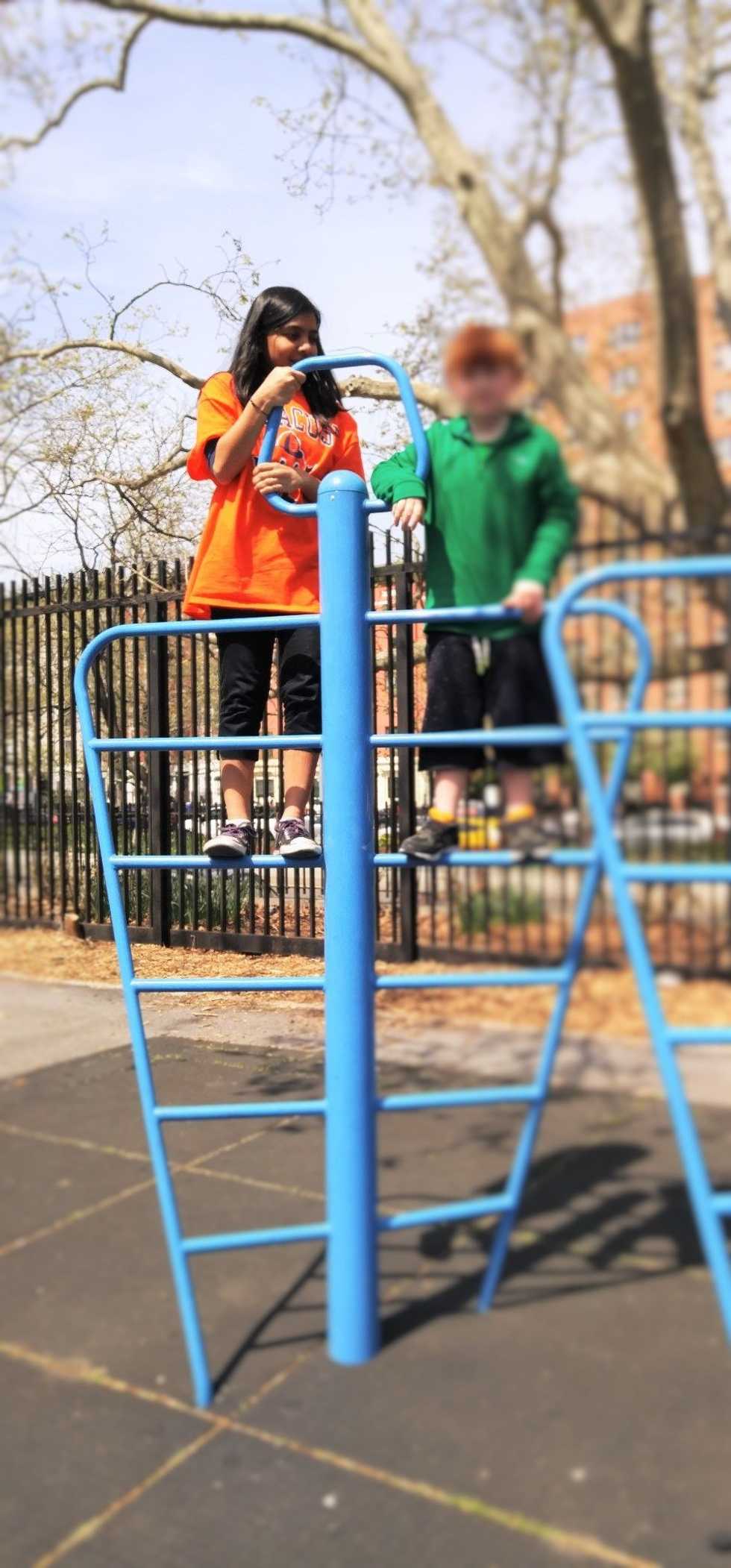
At the bars, he now took the first two steps after which he went back to the pacing. I went back to pacing with him. I repeated the process several times and after each round he climbed up one more step (the cover photo shows the accomplishment). The teacher who had been previously working with him said that this was a big step forward for him for he was finally stepping out of his comfort zone!
All it took to accomplish this was baby steps; have the child warm up a little bit to the surrounding and help him accept that it is okay to try something new while still engaging with the old. We all have our comfort zones (there are so many comfort zones that I have that I just refuse to step out of!), and that is okay because, I will not deny that it is always nice to have a home base, a place where you feel comfortable with your ideas and thoughts.
But it is also okay to try new things, to face your fears, to do what you have always desired, to step outside (one baby step at a time) your home base every now and then always knowing that the base will always be there for you. Who knows, when you are out there trying new things and doing what you always wanted to do, you might find yourself a new comfort zone!