

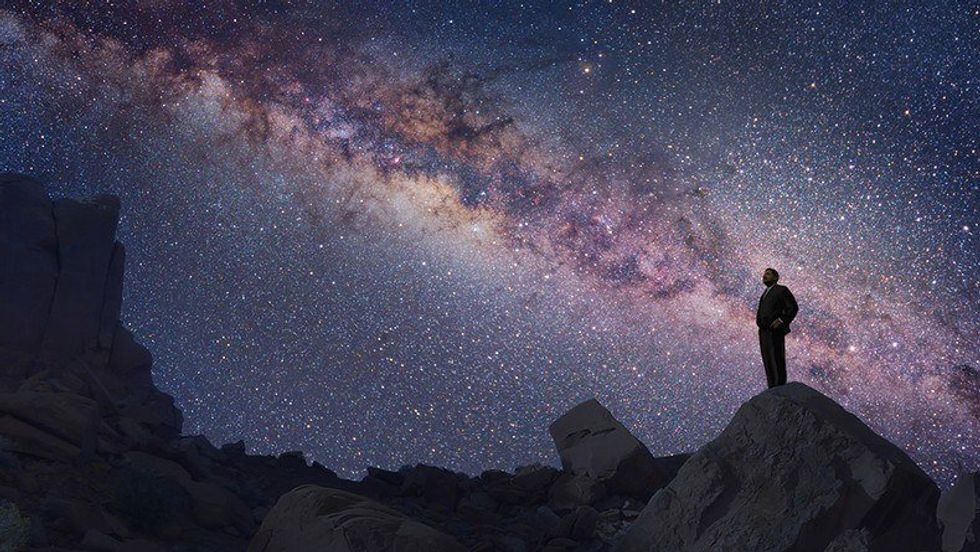
Stargazing is an essential part of life. Whether you're pursuing perfect solitude under a velvety, diamond-strewn sky, or competing with friends to see who can count the most shooting stars, there's nothing quite like lying back and realizing just how big and beautiful the universe is. Furthermore, it's free and you can do it after local coffee shops close, which is why I found myself dragging a friend out to the middle of nowhere, one Saturday night.
After settling ourselves in our preferred stargazing positions and realizing that sixty degrees isn't as warm as it sounds, we laid back and drank in the view. The moon was mostly dark and we were far enough from the lights of civilization that we could see dozens of constellations, among them Canis, Pegasus, Ursas Major and Minor, Andromeda, and Pisces. For every identifiable collection of stars, there were fifty that we knew nothing about. Inevitably, our conversation turned to the vastness of the universe, and my friend mentioned our comparative insignificance as individuals. Usually, I agree with that sentiment--what are two college freshmen in comparison to a universe that's approximately 46 billion light years across? Nevertheless, that night I found myself thinking that humans, though tiny, can be significant.
I don't deny that the world is bigger than I can comprehend. I'm a freshman at Walla Walla University, which has a 1,917 member student body. WWU is located in College Place, WA, having a population of 8,997 people; it's in Walla Walla County, with a population of 60,338 people; located in Washington State, boasting 7.17 million people; found in the United States, the third most populous nation on Earth, with a population of 321.418 million people; which contributes to the total population of Earth: 7.414 billion people. And that's just on our planet--it doesn't even scrape the surface of the minuteness of Earth in comparison to our solar system, the Milky Way galaxy, or the cosmos at large (no pun intended). How can the individual be significant in the face of the overwhelming magnitude of the world around us?
While thinking about that question, I thought of my college professors. Each of them has spent decades studying their field, amassing information and forming some very well-educated opinions and conclusions. When they teach, they present their students with a source of knowledge that in some ways is equally as vast as the night sky. No, they don't possess the entirety of human knowledge. But their specific knowledge--as individuals--is far from insignificant, and they represent the incredible potential belonging to every human to improve themselves and the world around them. As Renaissance philosopher Pico della Mirandola said, "[Humans], constrained by no limits, in accordance with [their] own free will . . . shalt ordain for [themselves] the limits of [their] nature[s]." Humans dictate their own limits, and if they so choose, those limits can cease to exist.
In the words of Hazel Grace Lancaster, "Some infinities are bigger than other infinities," but that doesn't make the smaller infinities less amazing. The magnitude of the universe, which might as well be infinite, can seem intimidating and overwhelming in the face of our tiny lives. But we still matter. We have the ability to do whatever we choose, which makes our potential infinite--and significant.