


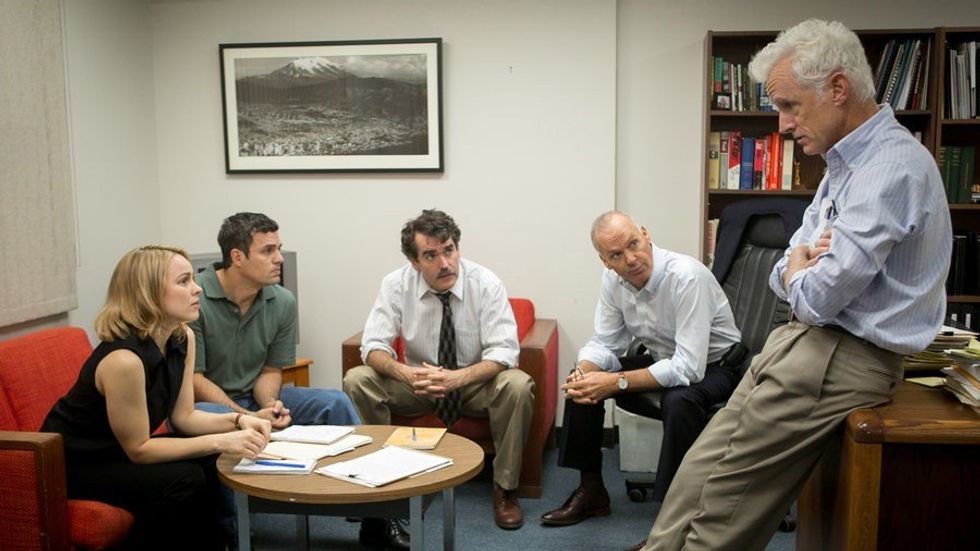
Rather than list off the monotonous cheers and jeers of 2015 and sift through the obvious dreck audiences were exposed to this year, there is one form that deserves the most praise.
"Spotlight."
Spotlight is the title of the Boston Globe's Investigative unit that was able to uncover the widespread sexual abuse conducted and systematically appropriated by Catholic priests, bishops, and cardinals in the Boston community and was eventually published in early 2002.
"Spotlight" is a love letter to the glory days of journalism, as well as a testament to how new-age media consumption has slightly altered our minds on how we view reporting.
The film's opening is one of the best put to the screen this year. A priest is sitting in an interrogation room in a Boston police station in 1976. In the room down the hall we see a mother and her children being spoken to by an elderly bishop of the Church, who reaffirms that what happened to her children was an isolated incident and the priest will be removed from circulation. With this small exchange, we get a clear picture of the skewed bureaucratic jargon the Church uses when scandals arise and those that have power within the Church must save face.
The film jumps nearly 30 years into the future where the Boston Globe is under new editorial jurisdiction in the hands of Live Schreiber's character Marty, who wants attention to be focused on the Catholic abuse that has swarmed the Boston community. Marty, not being a native Bostonian, is met with a cold shoulder from Michael Keaton's Walter Robinson.
Seeming reluctant at first, Walter and his team go after all angles of this case so they can point a firmly justified finger at these crooks who go about their crimes much like the mafia would do so. Throughout the movie, there are graphic and detailed monologues from victims and several subplots that dig far deeper than the audience is prepared to go.
Honestly, there are a multitude of stories that can be compelling to an audience if told appropriately. And "Spotlight" does not falter on the crutch of having weak characters or subjects that detract from the plot.
It wants its story to be told.
If the film did not believe that the subject matter could carry a two-hour movie, then the characters would be painted as caricatures. Looking at movies like "Frost/Nixon" or "Zodiac," it is apparent that the directors of these movies fell into a nostalgic trap.
One is about a flashy reporter interviewing the president about Watergate, and the other is about a newspaper cartoonist trying to catch a serial killer. Because these stories are "larger than life" these two films miss out on a fundamental part of journalism. Ethics.
Ethical dilemmas are only superficial in nostalgic-type films because human interest is what sells.
But "Spotlight" is filled with a multitude of ethical problems always piercing the gut of each reporter. And honestly, if you make a film about journalism, ethics and research should be a priority. But Hollywood has difficulty with taking things as they are. Maybe after more people see Spotlight, they can see that a film detailing the drone, often uneventful, and sometimes disturbing can be endlessly mesmerizing.
Beats me why the film barely turned a profit at the box office.
Oh yeah...

















