


At 10 a.m on Friday July 10, 2015, the South Carolina Statehouse, succumbing to public pressures, lowered the Confederate flag that had been flown for decades. To some this stood as a testament to the fight for racial equality and an end to oppression; to others it stood as an attack on their history and Southern pride. Regardless, it was easy to see the flag’s very existence and prominence as a symbol in modern society was a heap of controversy.
It seemed reasonable that the easiest solution to the situation was to side with the government’s utter separation from public sentiment. Many pundits claimed that because the South Carolina Statehouse was a publicly funded government institution, it did not have the right to fly a flag that so clearly offended and ostracized voters and residents in the state. This reasoning was satisfactory for most, and it was widely understood as de facto law that as a private individual, you are free to practice those beliefs, but the government will have no part in promoting an oppressive agenda.
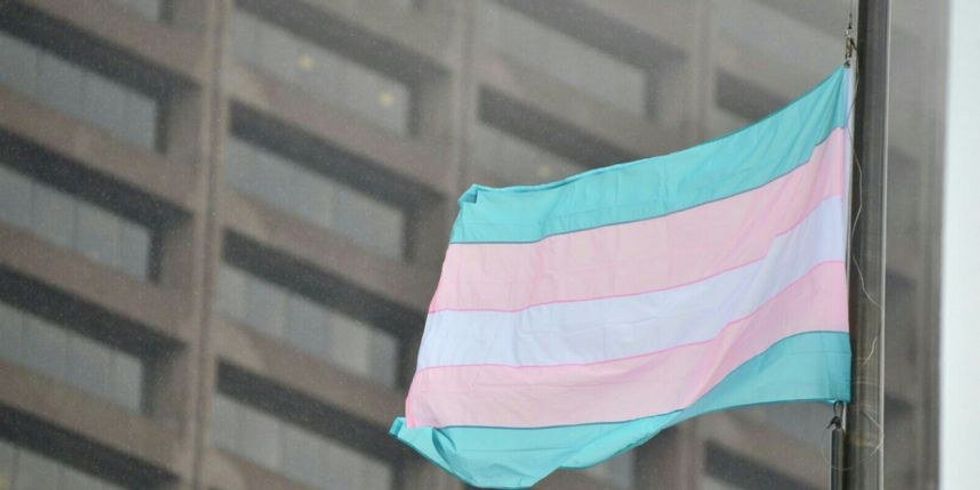
Much further north on May 2, 2016, in the liberally charged city of Boston where cries of “no taxation without representation” were a once daily occurrence in the late 1700s, a new symbol of controversy (and oppression in the eyes of some) was raised: A transgender pride flag.
Now before you accuse me of hating transgender individuals or of bigotry, or before you remark that "these situations are completely different", it is important to know I am not offended or otherwise bothered by a flag that Boston Mayor Marty Walsh says will continue to fly until everybody is equal under the law in Massachusetts, just as I was not personally offended by the flying of the Confederate flag in South Carolina. Yet, as was clearly the case in South Carolina and is the case in Massachusetts, some people were offended and felt attacked by the symbolism of the flag. The religious right and the conservative movement, in general, have already lost a large battle in their opposition to same-sex marriage, and to some, the fight against transgender rights movements are where they draw their last line of defense.
The most common understanding of transgender pride is one clearly orientated towards tolerance. Rainbow flags, and the transgender pride movement, have been heralded by many LGBT individuals and allies as a movement to end discrimination towards non-gender conforming individuals. There is undeniably a history of oppression towards transgender and transsexual individuals, and many individuals feel that exerting a sense of pride and public acceptance for all of the LGBT community will help make individuals feel safer and more comfortable, creating a thriving community of diversity and tolerance. By supporting legislation that creates gender neutral bathrooms, and legal protections for transgender individuals
However, this is not the only understanding of transgender pride. For some, the acclamation of transgender tolerance is oppressive in the sense that transgender toleration effectively requires the denial of the idea that gender is an inherent quality that can not be changed by surgery. Conservatives feel the transgender movement has crossed a line in demanding their gender identity be validated, and many Conservatives feel that there are only two genders and that gender dissociation is a mental health issue.
Whether or not you agree with their logic, they are not wrong in claiming to disagree with advocates of transgender pride and the raising of a flag because this is genuinely how they feel. Just as people in South Carolina genuinely felt emotionally damaged by the Confederate flag effectively symbolizing a way of life they feel is morally and legally wrong. To tell the residents of South Carolina that they were not offended by the Confederate Flag, or that it is wrong to feel offended, falls beyond the scope of an opinion, and borders on pretentious. It would require that whoever is giving this directive to act as if their opinion is the truth, and that if others feel differently they are wrong or in some other way "bad". In this way many conservatives feel the things symbolized by the transgender flag, which includes acknowledgment of a trans person, is wrong, and I hardly think it is the place of any of us to tell them that they aren't allowed to feel this way.
Now comparing the Confederate Flag and Transgender Pride Flag does not come without precedent. Many conservatives are already drawing parallels, and many liberals are dismissing this comparison as a deceptive simplification. Regardless of your viewpoint, I thought one of the most interesting points made was found on a Qoura thread , by a user who claimed that despite the differences in meaning between the two flags (whether you believe they individually support pride, oppression, tolerance, racism, etc.), at the end of the day both flags are symbols. The user points out that according to US Law "Your right to support bigotry is exactly equal to your right to support tolerance. You can't force your views on others in either case, but you are free to express your opinions."
Other users echoed his sentiment, which is important in shifting the discussion from what these flags represent and their relation to pride and oppression in society ( a controversial emotionally charged topic) to a plainly legal one. In the Supreme Court Case NATIONAL SOCIALIST PARTY v. SKOKIE, (1977), the right of free speech and demonstration prevailed over any claims of the offensive results that speech or demonstration could create. From a legal standpoint, the raising of the confederate flag and the raising of a transgender pride flag should be treated equally.
I will concede that this legal argument may not sit well with the public or majority opinion. Public opinion sits overwhelming in favor of Transgender pride being symbolic of tolerance. However, there is a certain danger in allowing certain private or civil interests upon the government simply because they fall in line with the majority opinion and not that of the minority. Just because the majority can reach a consensus, it does not follow that their viewpoint is right. At one time, the majority felt slavery and racism were okay and this was the accepted consensus. In fact, in 2014 (just a year before the decision was made to lower the confederate flag), public opinion favored keeping the flag up by nearly a 2 to 1 margin, whereas in the month prior to taking down the confederate flag from the statehouse, public opinion had flipped to favoring taking it down by a margin of nearly 2 to 1. So in this case, an idea or movement being popular does not necessarily reflect its moral worth.
In conclusion, you may ask why have I raised all of this discussion in response to the raising of two flags for which I am not offended by? It is the very principle of the idea. If as a society we are going to say the state should have separations and limits constitutionally, then it is wrong for them to support one side of a free speech symbolic demonstration (a flag is essentially a symbol) versus the opposing opinion. As a society we cannot simply say it’s okay for party A but not okay for party B, simply because I agree with what party B is trying to do, but not what party A is supporting.This type of decision-making has no legal basis or precedent and sets a dangerous standard for choosing when and in which situations to apply the law or allow for public discussion.
Ultimately it begs the question: where is the line? Who is to determine what is bigotry and what is tolerance? Who gets to decide what constitutes cultural pride and what is appropriation or oppression? How similar or different is the raising of a Confederate Flag or Transgender Pride Flag on state property? In the name of peaceful debate and constitutional freedom, I support the idea of reinforcing symbolic speech as a constitutionally symbolic right, and tasking the government with the difficult task of reexamining legislation and flags from a legal and constitutional standpoint rather than simply a public perception mindset.

















