Imagine this: 4-year-old you — in all your chubby-cheeked glory — is sitting in your childhood den, clad in light-up Skechers, staring up at the purple and green dinosaur you call God. He looks at you with his large T-Rex eyes as you munch on your third bag of cheese Ritz Bits. And in that synthetic-sweet voice, he educates you on the benefits of sharing. Letting your friends borrow crayons during a play-date is being kind. You should feel good about giving some of your lunch to a classmate who forgot theirs at home. Of course, you nod gleefully and smile your crumb-freckled smile because it makes sense. If Barney The Great says it, it has to be true.
“Sharing is caring,” is a phrase that I grew up with. My teachers would say it, my family would say it, even the mailman would say it (okay, maybe not him). It was a mantra used to combat every scowl or whiny “but why” I shot my parents’ way whenever I didn’t want to give up a piece of clothing to the Red Cross, or let my twin sister have a turn on the swings. “Because,” they’d say, “sharing is caring.” And that was that.
Sharing is selfless. But something has happened to the simple act of giving to another. If you were to look up the word in the dictionary, you’d get the predictable definition about the division and distribution of a whole. However, one scroll down on the Dictionary.com page and there it is:

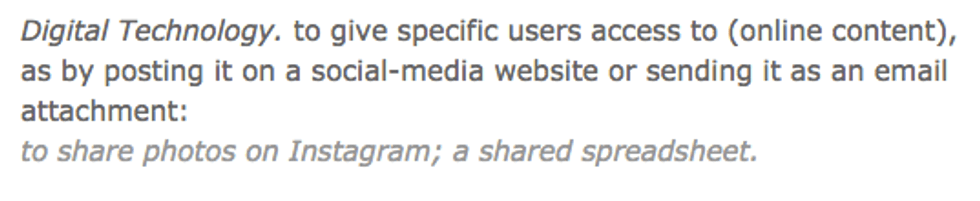
When I asked fellow Millennials to explain what the act of sharing meant to them, they described it as an invitation for others to receive something in your possession, an act that implies openness. But when I asked what they thought of when I said the phrase, “I shared that,” almost all of them said they thought I was referring to a social media post. For instance, one shared on Facebook.
But why exactly do we share these posts with others? According to a New York Times article, “For the Love of Being ‘Liked,’” we share pictures, commentary, and statuses as a mechanism of “approval seeking.” Journalist Bruce Feiler writes that in 2012, Harvard conducted a study which concluded that humans devote “up to 40% of our time to self-disclosure, and doing so is as pleasurable as having food or sex.” But we are inherently driven to share information with others and seek their approval in a purely selfish manner, to benefit our own mage and to validate our sense of identity. Thus, in today’s social media-savvy society, there is a new form of sharing—what I’d like to call, “selfish sharing.” It’s an oxymoronic concept motivated by the presence of social media, where you contribute your thoughts, feelings, etc. solely for your own sake. Think about it. Why do you post a status on Facebook? Why do you share a funny BuzzFeed video? Most importantly, who are you really posting for? Others or yourself?
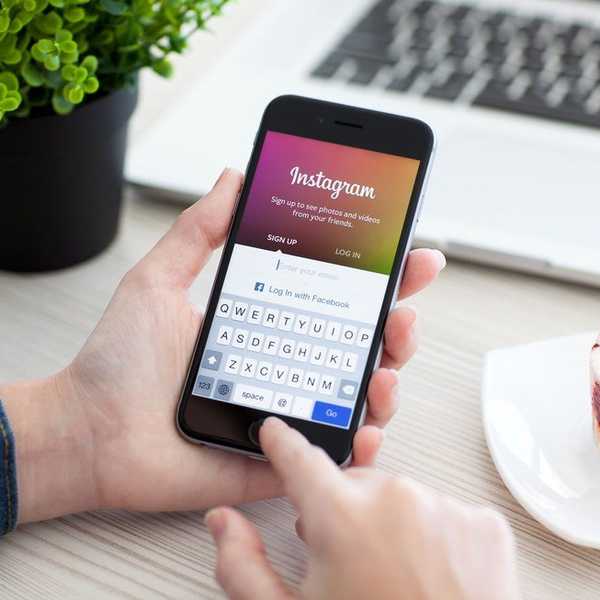
Think about the process of posting a photo on Instagram. You’re sitting in class, secretly scrolling through the throwback pictures, inspirational quotes, and weight-loss progression montages. You see that Jessica from Chem Lab has gotten over 200 likes on a throwback photo of her second birthday party. “Did I ever have this much fun at my own birthday parties?” you ask yourself. In a frenzied panic, you search through your phone for a photo — any photo — from your childhood where you look happy. You can’t find one from your party at Chucky Cheese or from when that petting zoo came to your backyard that one year. So, you settle for a photo of your munchkin-self holding your mom’s hand at an apple orchard — one click and you’ve posted it. What a sigh of relief. “See, self? You had a good childhood, and people will like the photo to prove it.”
As an avid user of social media, I’ve noticed this deep-bellied thirst for approval, this act of “selfish-sharing,” in myself. Don’t get me wrong, I’m a big advocate for using social media sites as platforms to foster connections for the future — it’s a great place to network. It’s also a great place to bring awareness to worldwide issues and start powerful movements — take, for instance, #BlackLivesMatter or #YesAllWomen. And let's face it, social media is fun. But, of course, I’ll post that adorable video of a Golden Retriever tumbling down the stairs and expect everyone to think it’s equally as share-worthy as I do, why else would I have posted it? I’ll need to validate my own feelings of admiration for this puppy — if people like what I like, instead of reprimanding myself, I’ll give myself a pat on the back.
In the Guardian article, “‘Pics or it didn’t happen’—the mantra of the Instagram era,” writer Jacob Silverman breaks down this urgency for approval, referring to what we post on social media as “receipts of experience.” Through our acts of giving others what we think they will appreciate, we implicitly search for self-validation that we’re living. I want your approval so that I can sleep at night knowing I exist. It's rooted in our fear of being silenced and isolated from society. Current social media practices validate our sense of identity, as leaving these receipts for others to see is proof of our existence. So, without these receipts, we often fail to find the worth in experiences, because when people don’t acknowledge our presence on social media, we blame ourselves and what makes us who we are.
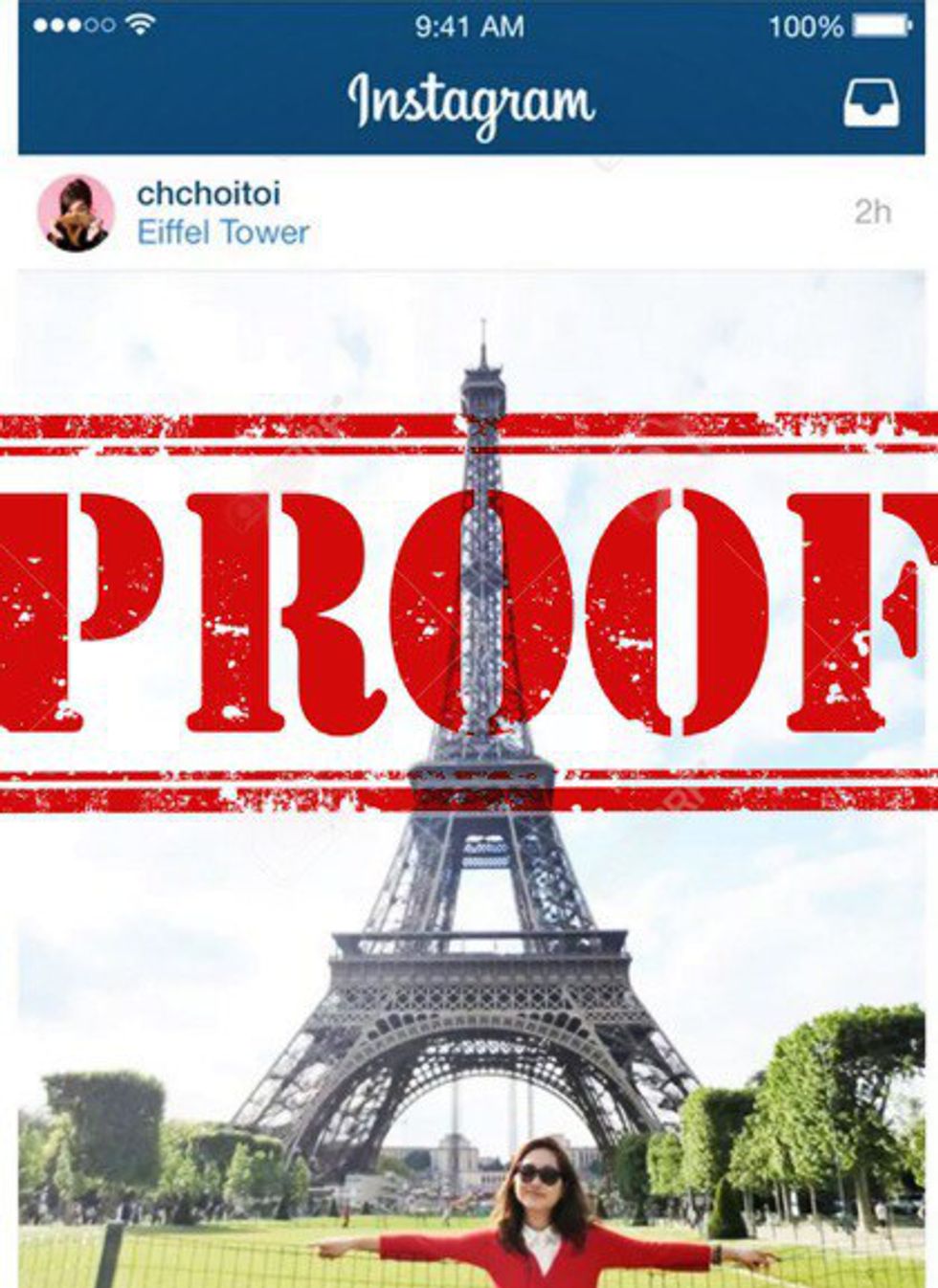
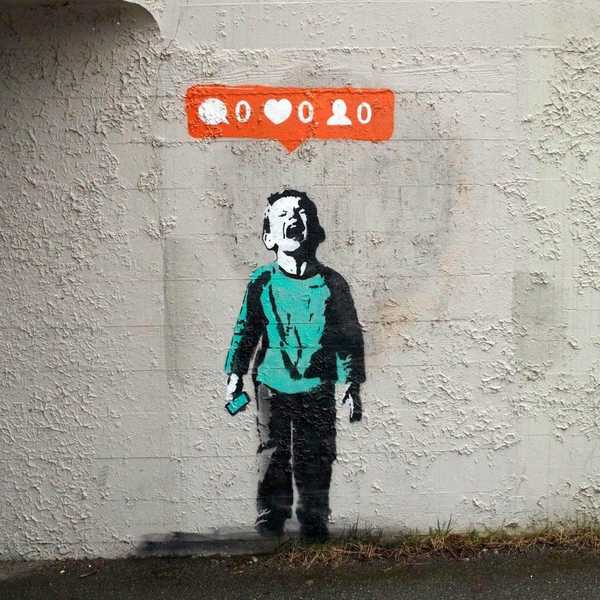
Think about it: if people don't validate your posts, do you curse the existence of thousands of virtual followers viewing these posts, or do you curse yourself? You criticize yourself. You think, “why isn’t this good enough — why aren’t I good enough?” If through the persistent fog of white noise, people don’t hear you, see you, or press ‘like,’ you feel a sense of failure as if you aren’t worth anyone’s time, even your own. Therefore, there is this constant need to prove to yourself that your life is worth living, which creates the need for those “receipts.” You probe yourself to prove to the world that your world is worth their thumbs-up, which in turn will give you peace of mind.
So, welcome to Generation Y. You better be able to tell your life story in 140 characters or less, or else you won’t be able to share it. No one will read it. You better take a picture of that chopped salad or that Five Guys burger before it’s gone or else you didn’t actually eat it. You better prove that you’re living life, and maybe you’ll intrigue followers to come along for the ride. Without their approval, you don’t exist. But why do we exist online, waiting for validation of our existence in reality? Without virtual presence, no one will know we just won that award or got accepted to grad school against all odds. And it’s not enough to be proud of yourself—you need others to tell you that you should be proud.
Barney was right that sharing with others is caring. But when will our own validation be enough? When are we going to start caring for ourselves enough to exist without the need for receipts? It’s not like I’m going to return my life — I’d like to keep it.