

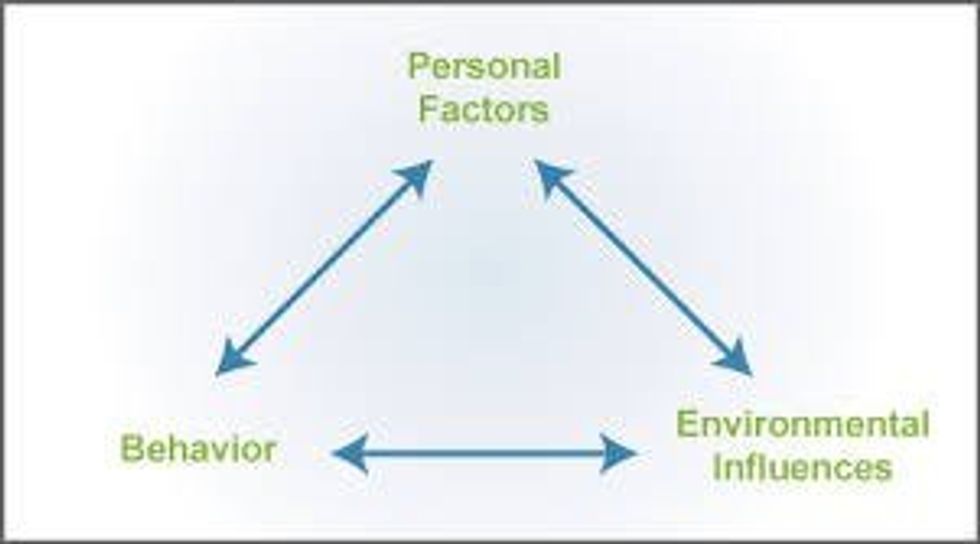
Social Cognitive Theory has become a broad and extensive psychological theory used to explain many characteristics, traits, and behaviors of human beings. Initially established by Albert Bandura, it focused primarily on how individuals gain specific behaviors by observational learning, social cognitive theory is now a concept that is applied to a plethora of behaviors, reasoning skills, decision making, learning processes, and motivation—just to name a few of the components that Bandura’s social cognitive theory explains.
Though there are many concepts and aspects to social cognitive theory, one of the central and most prominent concepts, observational learning, can be noted in an individual’s life nearly every day.
For example, this past Saturday I experienced a branch of observational learning known as the "mastery model." Mastery model is an element of observational learning that is best utilized when learning a specific skill.
At my 8 a.m cheer practice, the team was learning a new routine choreographed by our cheer captain. In order to learn the routine, I had to observe and retain the eight count by eight count motions our coach was demonstrating. At first, she performed the routine full out to the music so we could observe the intended end result. Then in order to best learn the general idea of correct body and motion placement, our captain broke the dance down one eight count at a time and ensured that the whole team knew the correct moves before we moved on to the next eight count of the routine. I would then try to copy her moves exactly so I could retain the correct placement of moves in our choreographed dance. If there were particular areas of the dance that looked sloppy or incorrect, we would drill those motions to collectively get a better understanding of what the team was supposed to be doing and exactly how those moves were performed, therefore creating a more successful routine. Because of observational learning, I was able to observe, copy, and retain the mastery model presented to me.
Another concept Bandura helped introduce is the idea of outcome expectation. The development of outcome expectation was formed using Bandura’s notion that an individual’s behavior is influenced by their perceived ability to perform a given behavior.
Last week I made the decision to drop a class because I felt I was being treated unfairly by a particular professor based on his pre-conceived label of what kind of student/person I am. Specific factors of the social cognitive psychological concept termed "outcome expectation" aided in my decision to completely drop the class.
One portion of outcome expectation explains that certain decisions are shaped when individuals what actions to take and which actions are they feel are better suppressed. A factor in determining which actions are to be taken and which are to be avoided are often formed by the individual’s past experiences and/or through the observation of other individual’s actions and the repercussion of their particular actions. This then leads to the beliefs that are formed about likely consequences certain behaviors entail. My decision to drop the class was made based on my outcome expectation of unfair failure of the course due to the professors outright and aggressive disagreement of action I took during a group discussion to disclose my personal beliefs and opinions of the discussion’s topic.
My previous experience of being treated negatively because of particular actions I took during an election poll in a politics class led me to believe that staying in the class would result in a biased, unfair judgment of my class work, essays, and exams. As it is stated that behaviors with unfavorable outcomes are more likely to be avoided, so my outcome expectation led me to take the actions to avoid the class in order to avoid getting a bad grade that I felt I did not deserve. As I stayed in the previous class in which the same type of situation occurred, my GPA was slightly affected. My behavior to suppress engagement with authority figures that have control over something as important as my GPA led me to believe that, in this case, the best course of action is to drop the class and completely avoid the overall unfavorable outcome of the disadvantageous effects the action of staying for remainder of the classes would create for my academic career.