The sketch-comedy show Saturday Night Live has become a vital part of America's cultural bloodstream since it premiered on October 11, 1975. Known for jumpstarting the careers of many comedians and actors over the last three decades and being unafraid to make fun of everyone, every trope and every institution, the show has long held the tradition of making fun of the president. President Trump has not taken his portrayal by Alec Baldwin on the show very lightly.
.@NBCNews is bad but Saturday Night Live is the worst of NBC. Not funny, cast is terrible, always a complete hit job. Really bad television!
— Donald J. Trump (@realDonaldTrump) January">https://twitter.com/realDonaldTrump/status/8207641... 15, 2017
In light of this dissatisfaction and Baldwin's 17th hosting of SNL on February 11, here's a history of presidents 38 through 43 on SNL.
Gerald Ford (In office from 1974-1977)
Ford was the first president in U.S. history to have not been elected to either the presidency or vice presidency. In light of the Watergate Scandal in 1973, vice president Spiro Agnew resigned from office and Ford, House majority leader at the time, was next in succession to become the vice president. Nixon resigned a little over half a year later and Ford was seated as the president for the rest of what would have been Nixon's second term.
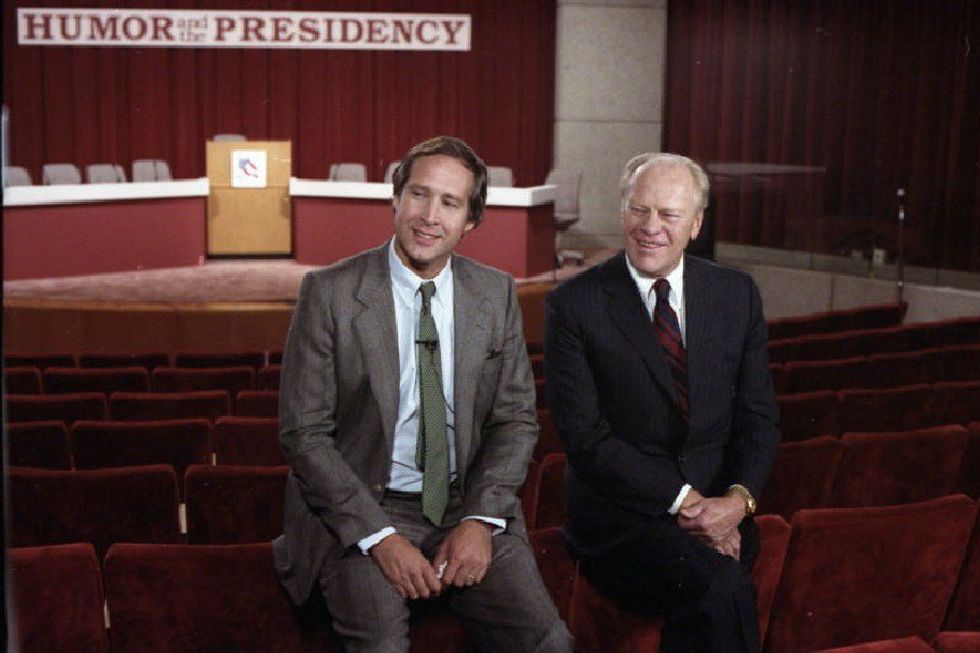
Played on SNL by original cast member Chevy Chase, Chase's Ford was a good-hearted but obliviously inept man. From having major difficulties with phones to toppling the White House Christmas tree in an attempt to place the star on top, the clumsiness of Chase's Ford was matched only by his efforts to communicate to the American people.
Jimmy Carter (In office from 1977-1981)
Jimmy Carter was a humble peanut farmer from Georgia who rose through political ranks through senatorship, governorship and eventually to the presidency. His effectiveness as president is debated by political scientists, but he did lead the United States through various crisis both at home and abroad. His post-presidential career of humanitarian work is generally lauded.
His character on SNL was split between Dan Ackroyd while in office and Joe Piscopo post-presidency. Ackroyd's Carter was an intelligent, albeit blunt man, able to demonstrate immense knowledge on acid trips but able to address the American people with a straight face and ask them to burn 8% of their money to combat inflation. Piscopo's Carter was more built on regret and annoyance with being succeeded by someone amused by their own hand gestures.
Ronald Reagan (In office from 1981-1989)
Ronald Reagan is generally hailed for strengthening the republican party through his presidency. An actor in Hollywood during the McCarthy era, Reagan was very well spoken in dealing with the McCarthy trials and would go on to serve as a spokesperson for General Electric, which would forever reform Reagan's views on big business. He became governor of California in 1967 and President in 1981, focusing heavily on reducing government's interactions with people and the private sector alike.
Though Reagan himself was generally seen as a jolly man, Phil Harman's interpretation at SNL portrayed Reagan as a mastermind behind all the controversies that would arise out of his time in the oval office. Despite his tactical genius, however, his knowledge on American landmarks is slightly confused with the pictures he saw during his time in Hollywood.
George H.W. Bush (In office from 1989-1993)
George H.W. Bush was Reagan's Vice President and would become president after Reagan's second term. Bush's focus would be on foreign policy and notable events like the fall of the Berlin Wall and the Gulf War; these events would define Bush's time as president.
Dana Carvey's flamboyant portrayal of H.W. shared the man's Texas drawl and was excited with the thought of military operations in foreign countries. He was also easily distracted by the thoughts of exports of invadable countries and in lieu of economic trouble, advertised what products he thought would be selling well in the holiday season of 1991.
Bill Clinton (In office from 1993-2001)
Bill Clinton was a charismatic candidate from Arkansas, rising from governorship to the presidency like many of his predecessors. Despite high approval ratings, Clinton's presidential legacy would be plagued by a sex scandal during his second term with White House employee Monica Lewinsky. Clinton was impeached by the House after lying under oath regarding his relations with Lewinsky but was pardoned by the Senate.
Luckily enough for Darell Hammond and SNL, this scandal delivered a lot of room for good material. Hammond's Clinton was a smooth talking, flirtatious and persuasive man who would casually call his enemies for favors and demonstrate his ability to go from laughing to puppy-dog eyes in an instant while asking for forgiveness.
George W. Bush (In office from 2001-2009)
The son of former president H.W. Bush, George W. Bush became president in 2001 and would be in office during many major moments in American history like 9/11 and Hurricane Katrina. Not the most eloquent speaker, Bush was widely criticized for the invasion of Iraq in 2003, his approval ratings have been to the top of the graph and at the bottom.
Will Ferrell was the right man at the right moment when Bush came into office, able to near perfectly mimic Bush's drawl and speech pattern. Ferrell's Bush was dimwitted but clever in his convoluted solutions to problems, and was the main character of many of Ferrell's most famous sketches, like the speech to Osama Bin Laden or trying to talk his Vice President Dick Cheney out of being on TV "More than that Sham-WOW guy."