

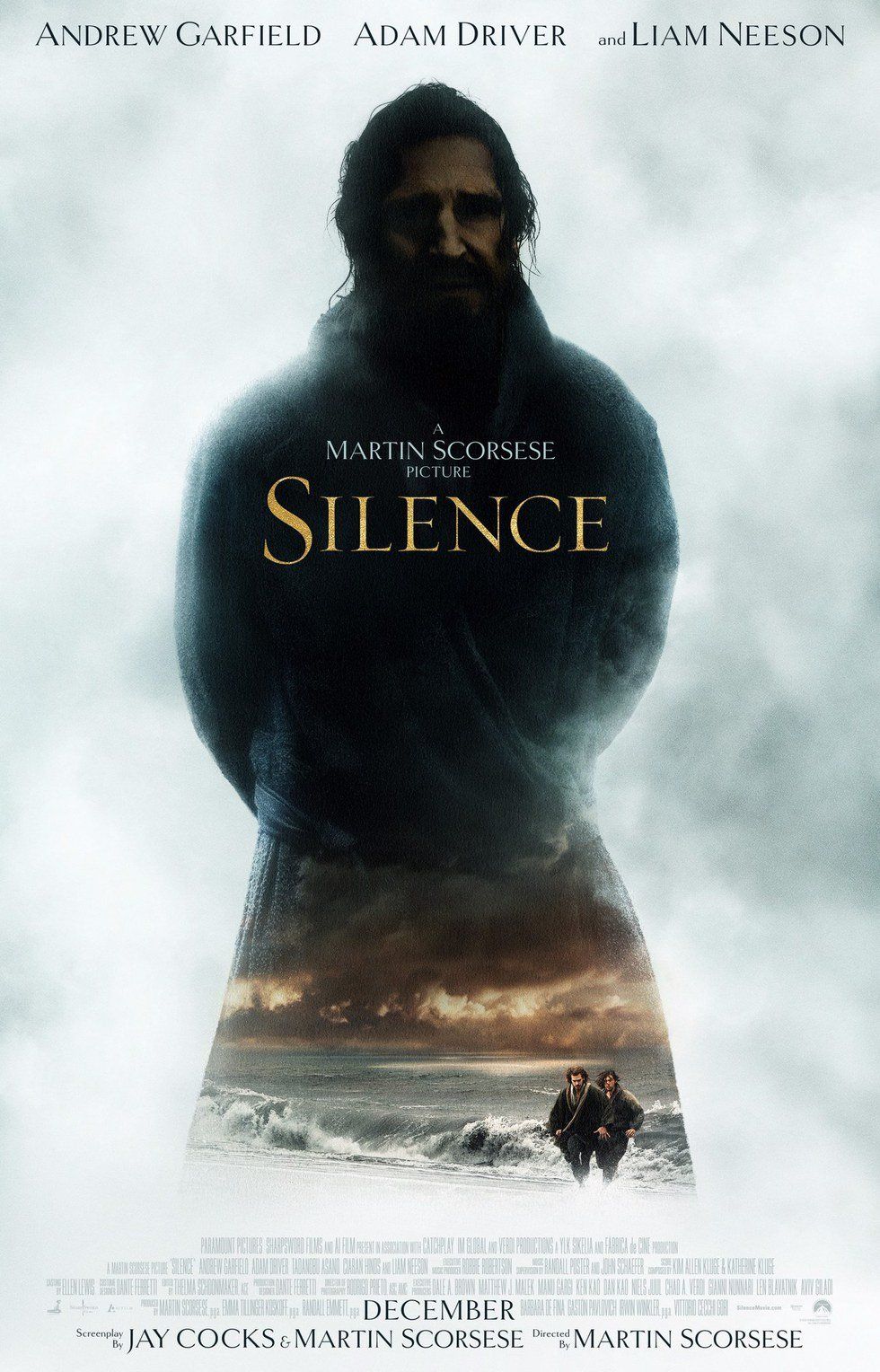
Martin Scorsese recently released his newest film, Silence, which is about two Jesuit missionaries, Fathers Rodrigues and Garupe, who travel to Japan in the 1600s to locate their teacher, Father Ferreria. This has been a project Scorsese has been passionate about for years and he has finally put it onto the silver screen.
Scorsese took a big leap of faith in choosing two Hollywood newbies in Andrew Garfield, who formerly played Spiderman, and Adam Driver, who played Kylo-Ren. Overall, this wager paid off as the two young men excellently portrayed the adventurous side of the missionaries, and specifically, the vigor and passion of the Jesuits. I want to take time to discuss the importance of watching Silence for students of Jesuit education, because it shows Jesuit principles and values put into action. The film raises the question of faith and specifically the process of discernment.
I am currently on my fifth year in a Jesuit institution and this process of discernment put in context is referred to as “contemplation in action.” Contemplation in action involves stopping, thinking, and reflecting over what you have done. The whole film shows Fr. Rodrigues’ process of reflecting; the audience can feel the deliberateness of his actions. The film’s minimal use of music adds to this deliberateness. A few transitions are completely silent, and these, in my opinion, act as an exercise in contemplation in action. This intentional placement of no sound allows the audience to think about the preceding events and what their actions may have been. There is a reason people praise Scorsese and this subtle addition speaks volumes of his ability.
The next principle (my personal favorite) is seeing “God in all things.” In one wonderful scene, Garupe and Rodrigues exit the little shack they are living in, and they just lay outside. The camera then follows a bird flying across the landscape. “God in all things” means that you feel God’s presence in everything and this scene captures the pure beauty of nature that God created and shows God’s presence in both the bird, and also in the serenity of the two relaxing. Andrew Garfield stated it beautifully in an interview with Stephen Colbert: “Finding God in all things. Finding God in every single human being. Finding love in every single human being. Finding possibility in every single human being. Finding God in the tree that was cut down to make this table…Suddenly everything becomes a miracle.”
One final familiar phrase for Jesuit students: the Magis. Literally translated from Latin to mean “the more,” this phrase is one that rings throughout the ears of all those influenced by the Jesuits as well as drives the entire film. To begin, the two Fathers’ desire to do more is what led them to their missionary work in the first place. But the scene that most stuck out to me was when the priests first arrived in Japan and they were swarmed by locals. All of them wanted some tangible item from Fr. Rodrigues and he had to take apart his rosary to give each of them something to hold onto. Even though he runs out of things to give them, he continues giving. I think this is a stunning metaphor for what the Magis is all about. We strive to do more each and every day and when we run out of effort, what do we do? We give more. See, the Magis is a way of thinking about our lives and Scorsese shows it in a very visual way when it is normally something expressed through words. Overall Scorsese did a fantastic job on his passion project and I am glad I was able to watch it.